
Introduction
The PhD journey in India is rarely linear. For many scholars — especially those in private universities or mid-career academic paths — it’s a winding process filled with uncertainty, shifting expectations, and constant self-doubt. The idea of hiring a consultant may arise not out of laziness or avoidance, but out of necessity. Juggling research with teaching jobs, family responsibilities, or health issues can leave scholars with little room to navigate the academic process alone.
Still, there’s hesitation. Some worry that taking help means crossing an ethical line. Others fear being misled or overcharged. But the truth is, when chosen wisely, a good consultant doesn’t replace your work — they help you make it stronger. From research proposal to final thesis submission, the right kind of support can offer clarity, structure, and momentum. Understanding what a good consultant can actually do at each stage is essential for scholars who want help — but want to stay within academic boundaries.
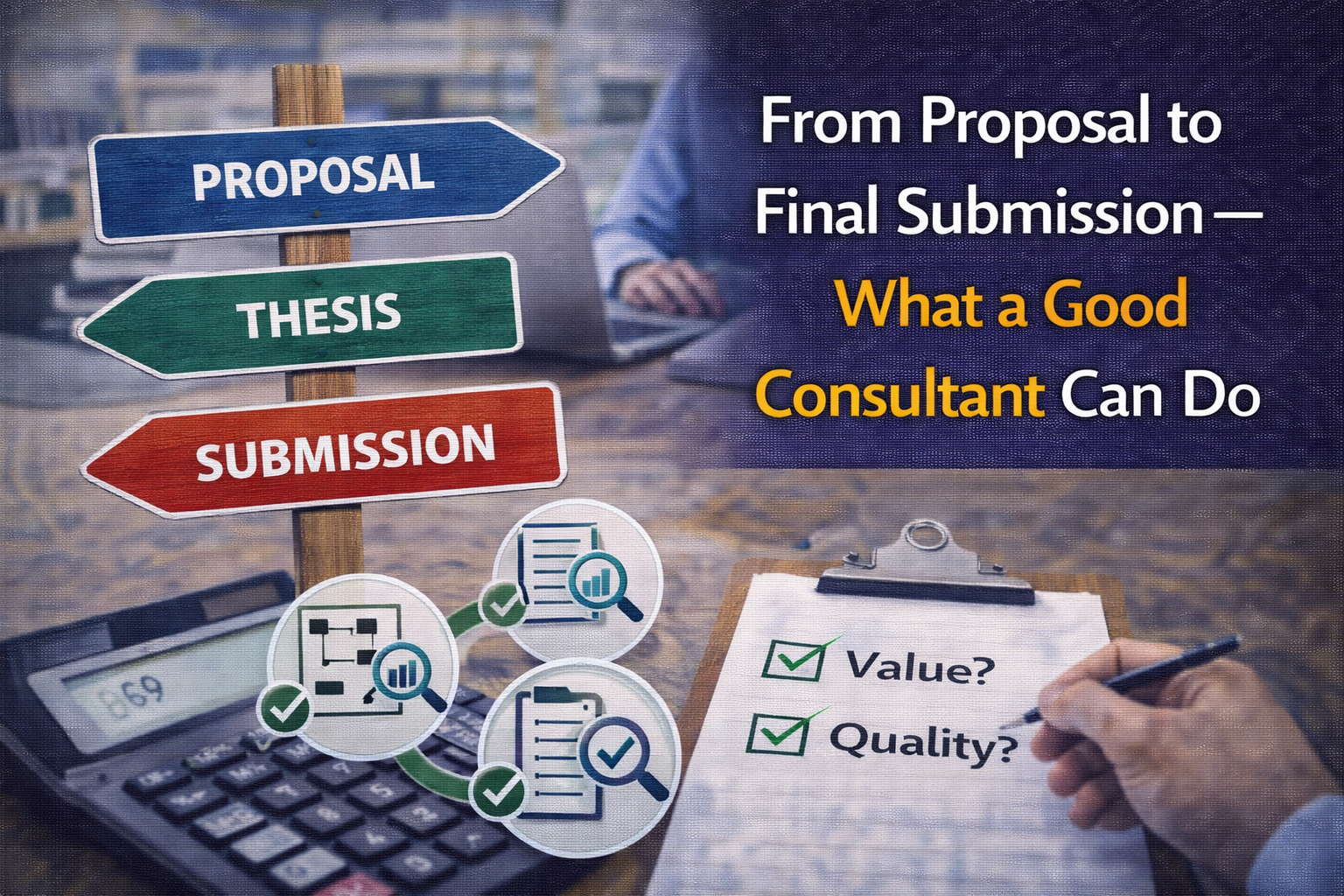
How Support Evolves Through Each Stage
At the proposal stage, many scholars struggle to convert broad interests into a focused research problem. In Indian PhD admissions — especially at private universities — the proposal plays a major role in supervisor selection and topic approval. A good consultant can assist here by helping narrow down your research scope, align your interest with existing literature, and structure your proposal clearly. They can’t (and shouldn’t) choose your topic for you — but they can guide you to shape it in a way that meets academic expectations while reflecting your voice.
Once the proposal is approved, most scholars move into the literature review and methodology phase, which often turns out to be more difficult than expected. For those who are returning to academia after years or coming from professional backgrounds, the sheer volume of reading and unfamiliar citation norms can feel overwhelming. A consultant here can help organise sources, suggest current journals, train you in citation tools like Zotero or Mendeley, and offer critical feedback on your literature synthesis. In methodology, their role may involve reviewing your design for clarity and feasibility — but not choosing your hypothesis or fabricating tools. Ethical consultants keep the scholar in the driver’s seat.
As the writing of chapters begins, the nature of support deepens. You may receive feedback on structure, transitions, argument flow, and formatting. Scholars in Indian universities often complain about lack of consistent supervisor feedback, or feedback that comes too late. A consultant can bridge that gap — giving you chapter-level comments, helping you interpret comments from your guide, and ensuring consistency across your chapters. For interdisciplinary research, especially common in Indian private universities, consultants can also help ensure that disciplinary expectations are met across sections.
During the data collection and analysis stage, consultants may offer technical support — helping clean datasets, clarify tools like SPSS or NVivo, or review the framing of findings. But again, a good consultant avoids crossing ethical lines. They don’t invent data or create fake graphs. Instead, they help you make sense of what you’ve collected and how to present it clearly. In India’s research environment — where not every university offers statistical or analytical guidance — this kind of support can be crucial, especially for first-time researchers.
Finally, during the pre-submission phase, a good consultant acts as a second pair of eyes. They help you ensure that formatting matches your university’s style guide, check for plagiarism, improve language clarity, and assist with annexures, declarations, and reference lists. For many Indian scholars, especially those writing in English as a second language, this final polish can make the difference between a thesis that reads well — and one that feels rushed or unclear. Some also help with viva preparation, offering mock Q&A sessions or helping scholars anticipate committee questions.
What a Good Consultant Doesn’t Do — and Shouldn’t Promise
In a space filled with confusion and inflated claims, it’s equally important to understand what good consultants don’t do. They don’t promise guaranteed approval, they don’t impersonate the researcher, and they don’t claim ownership of your work. The best ones stay quietly in the background — guiding, supporting, reviewing — while letting the scholar lead the academic process.
They also don’t push a one-size-fits-all model. A PhD in education has very different demands from a PhD in computer science. A working mother pursuing her degree part-time has different pressures than a full-time fellow. Ethical consultants respect that. They adapt their support — but never pretend to be your replacement.
Crucially, good consultants set boundaries. They communicate what they can do, what they won’t do, and how your involvement matters. They offer clarity about costs, timelines, and revision rounds. And when they don’t know something — say, a highly specialised statistical technique — they admit it rather than improvising poorly. This humility and honesty often matter more than flashy testimonials or overconfident sales pitches.
Conclusion
In a research ecosystem that’s often fragmented and lonely, the right consultant can bring structure, confidence, and calm to the PhD process. From proposal to final submission, their role is not to write your thesis for you — but to help you write it better, and with more clarity. For Indian scholars navigating the complex world of doctoral research, especially in private universities where systems may be flexible but unclear, this kind of grounded support can be transformative.
Good consultants don’t promise magic. They offer method. And that — more than shortcuts or guarantees — is what truly helps a scholar move forward with academic integrity.