
Introduction
For many Indian PhD scholars, especially those funding their own research without institutional grants, every rupee matters. Whether pursuing a doctorate through a private university or managing it alongside a job and family expenses, the cost of thesis support services often becomes a major concern. It’s not that scholars don’t value expert help — it’s that lump-sum payments can feel overwhelming in an already financially stretched life.
This leads to a practical and often whispered question: Can you pay in parts? The answer, in most cases, is yes — but it depends on the company or consultant. Over the last few years, thesis service providers in India have gradually moved towards flexible payment models, understanding that one-size-fits-all billing doesn’t work for everyone. Knowing what options are available — and what to watch out for — can help scholars make informed, stress-free decisions.
Why Flexible Payment Matters to Indian Scholars
Unlike in Western universities where research funding and stipends are more common, Indian scholars — especially those in private institutions — often bear the cost of their education and research entirely on their own. Many are mid-career professionals paying EMI for housing or children’s education. Others are self-funded researchers with little financial support from their departments.
For such scholars, the thought of paying ₹40,000–₹80,000 (or more) upfront for thesis help is daunting. Even if the service is trustworthy and the support is ethical, it’s simply not feasible for many to make a large, single payment. Flexible payment models aren’t just convenient — they’re enabling. They allow scholars to seek quality help without compromising monthly budgets or feeling pressured into shortcuts.
Recognising this, many thesis support companies have started offering staggered billing — not just as a sales strategy, but as an accommodation to the financial realities of Indian academia.
Common Payment Models Used by Thesis Service Companies
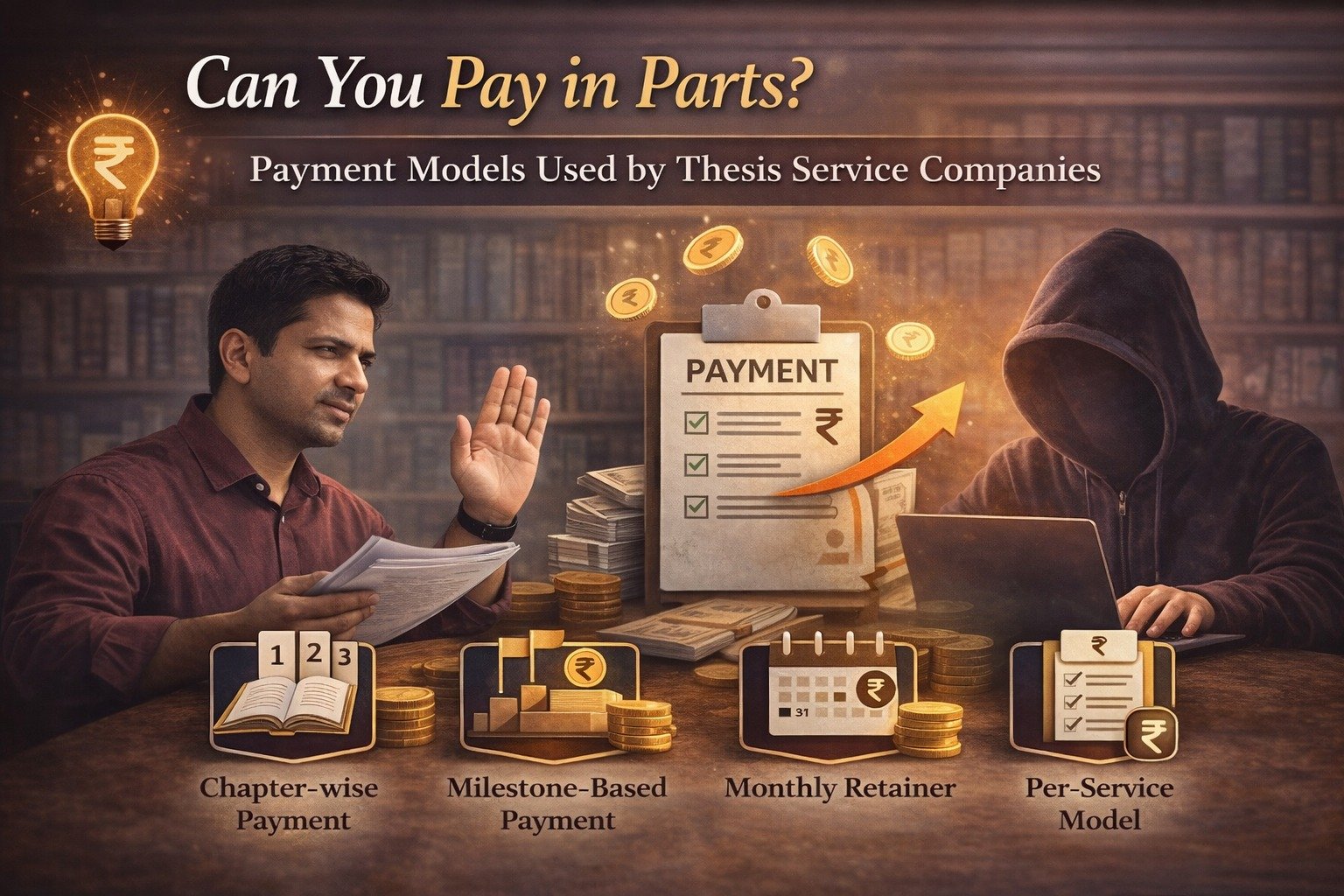
While every company has its own policies, most thesis service providers today offer at least one of the following models:
1. Chapter-wise Payment
This is one of the most popular and transparent models. Scholars pay for each chapter as they progress — for example, separate payments for the proposal, literature review, methodology, and so on. This allows the student to monitor quality before committing to the next stage.
A PhD scholar in Kerala shared how this helped her avoid both financial stress and disappointment. After paying for the introduction and literature review, she realised the consultant’s quality didn’t match her expectations. Since she hadn’t paid upfront for the full thesis, she could exit the arrangement with minimal loss.
2. Milestone-Based Payment
Here, the work is divided into broader milestones — say, “Proposal + Chapter 1,” “Chapters 2–3,” “Analysis + Conclusion.” Payment is made in 2–3 instalments, aligned with delivery. This model works well when the scholar is confident about the consultant but still prefers financial cushioning.
3. Monthly Retainer
Some services offer a retainer model — where scholars pay a fixed monthly fee and receive a set number of hours or services per month. This is often used for longer-term coaching or editorial support rather than complete writing.
A working professional doing her PhD in education in Punjab opted for a ₹7,000/month retainer, which included two chapter reviews, one feedback session, and formatting checks. This allowed her to stay engaged without a sudden financial burden.
4. Per-Service Model
This model is based on individual services: ₹1,000 for plagiarism check, ₹2,500 for language editing, ₹4,000 for formatting. It’s suitable for scholars who only need help with specific aspects of the thesis.
The benefit of this model is clarity. You pay for what you need, when you need it. The challenge is ensuring continuity, as piecemeal services may lack cohesion unless you’re managing the full thesis structure yourself.
What to Look Out for Before Committing
While flexible payments are helpful, they don’t always mean the service is trustworthy. Some red flags include:
- Lack of documentation: If no written agreement or scope of work is offered, avoid proceeding — even if the payment is split.
- Heavy advance before any work begins: Some unethical providers ask for 50% before showing any sample or schedule. This can trap students into poor-quality arrangements.
- Unclear revision policies: If you’re paying in stages, make sure revision rights are clarified per stage.
A scholar in Rajasthan paid ₹25,000 upfront for proposal and literature review. The first draft had major issues, but the consultant refused revisions, citing the “next payment phase.” This situation could have been avoided with a clearer agreement that linked payment to delivery quality, not just word count.
Always ask: What happens if I don’t like the first chapter? Do I still have to continue? A professional service will never pressure you — and often will revise or refund if quality fails.
Asking for Payment Flexibility Isn’t Wrong
Many Indian scholars hesitate to ask about flexible payments, fearing it may seem “unserious” or unprofessional. But in reality, responsible services expect this question — and usually have systems in place to handle it.
You’re not bargaining at a market. You’re requesting an academic service that aligns with your pace and capacity. A consultant or company that respects your financial situation without compromising quality is more likely to support you with integrity.
Conclusion
Seeking thesis help is no longer taboo in Indian academia — but how you pay for that help is just as important as what you receive. Flexible payment models aren’t just about convenience. They protect scholars from financial strain, allow space to evaluate service quality, and promote a more ethical, collaborative engagement.
Whether you’re paying per chapter, per milestone, or per service, make sure the arrangement is documented, respectful, and suited to your working rhythm. In a PhD journey that’s already demanding, financial flexibility isn’t a favour — it’s part of creating a sustainable academic path.