
Introduction
After months — or often years — of struggling through research design, writing chapters, formatting references, and meeting university requirements, the final milestone in a PhD journey is the viva voce. For many Indian scholars, especially first-time researchers or those in private universities, this stage brings more anxiety than the thesis writing itself. You may have written the thesis with support, followed every submission protocol, and still feel underprepared when the date for the viva is announced.
At this stage, a natural question arises: Can the same consultant who helped me with the thesis also help me with viva preparation? The answer is yes — and in many cases, it’s actually the most efficient and reassuring option. But the kind of help they offer, and how involved you remain in the process, makes all the difference.
Why Viva Preparation Needs Structured Support
The viva voce — an oral defence of your thesis — is not just a formality. In many Indian universities, it determines whether your degree will be awarded, withheld for revision, or delayed. The expectations differ widely: some examiners ask methodological questions, others focus on literature gaps or data accuracy. A few simply test whether you understand what you’ve submitted.
This unpredictability makes preparation essential. Yet, most universities — especially private or distance-learning ones — don’t offer structured guidance for viva readiness. Supervisors may be too busy or unavailable. Peer discussions are rare. For working professionals, time is limited. In such cases, returning to the same consultant who supported you through the thesis becomes a practical and focused solution.
They already understand your work. They’ve helped shape its structure. And importantly, they can guide you without needing to “learn” your research from scratch.
How Consultants Typically Help With Viva Preparation
When done ethically and collaboratively, viva support from a consultant is not about scripting answers. It’s about helping you become confident in presenting and defending your own research. Here’s how this often plays out:
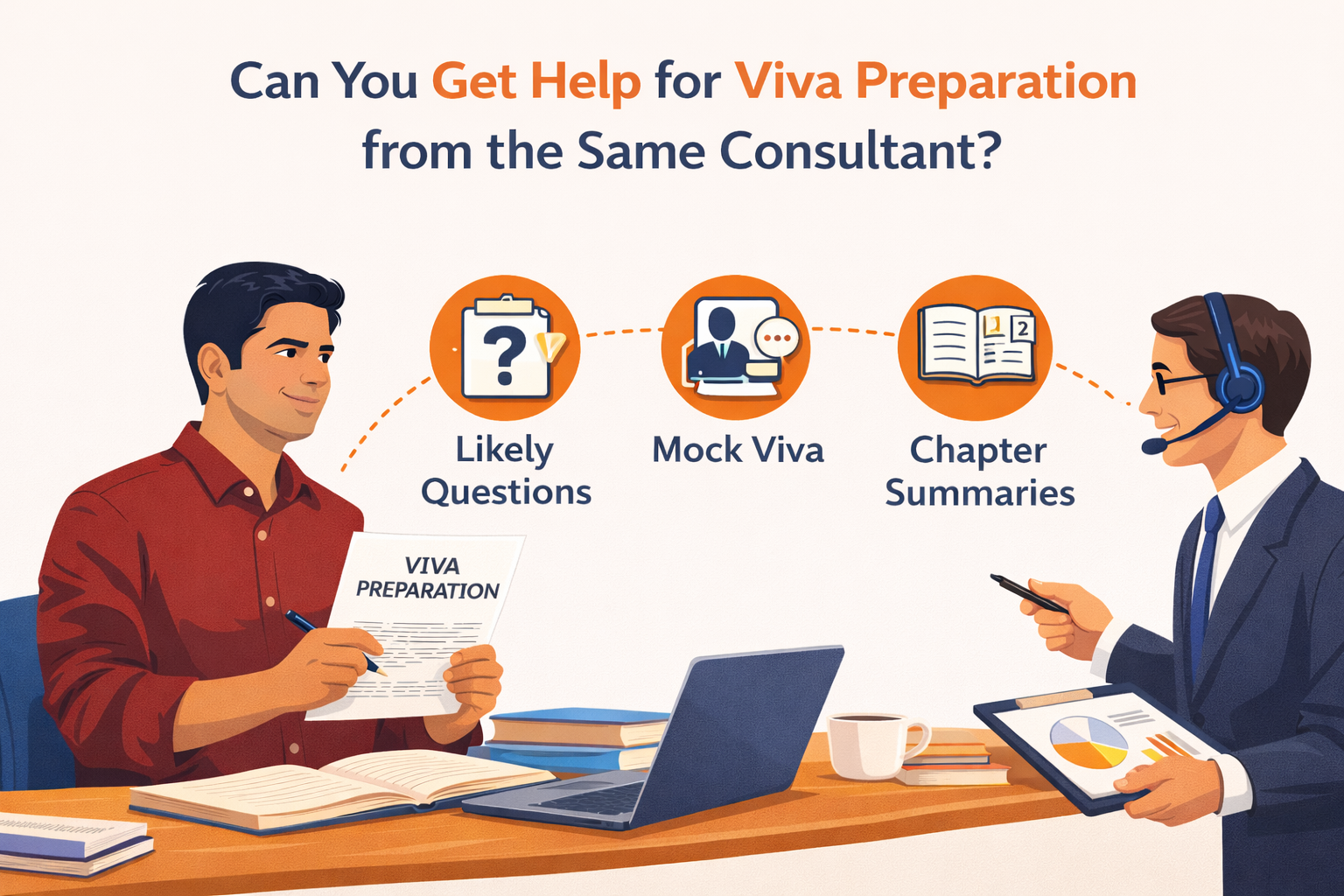
1. Creating Summaries of Each Chapter
Most scholars, by the end of a long writing journey, find it hard to remember every detail of what they wrote. A consultant can help create short summaries of each chapter — especially your objectives, key arguments, frameworks, and findings — so you have a quick reference guide to revise from.
2. Identifying Likely Questions
An experienced consultant knows the common themes examiners focus on: choice of methodology, justification of tools, gaps in literature, ethical clearance, or contribution to the field. They can create a list of potential questions based on your thesis, giving you a structured way to rehearse.
A psychology scholar in Bengaluru recalled how her consultant gave her a set of 20 likely viva questions. During the actual defence, she faced 12 of them — not word for word, but close enough that she felt confident in responding.
3. Conducting Mock Viva Sessions
Perhaps the most valuable support is a mock viva. This is usually done over a call or video meeting, where the consultant plays the role of an examiner and asks you questions in real time. It helps you get used to articulating your research orally, handling unexpected questions, and managing nervousness.
Many Indian scholars, especially those not used to academic presentations, find this rehearsal extremely useful. A consultant can point out where your explanations are too vague, too technical, or lacking clarity — and help you revise accordingly.
4. Clarifying Theoretical and Conceptual Frameworks
If your thesis used specific theories, frameworks, or models, you may need help recalling why you used them and how you applied them. The consultant who helped you choose or refine those frameworks can revisit them with you — not to re-teach, but to help you verbalise your reasoning with confidence.
5. Preparing Visual Aids and Abstracts
In some universities, scholars are asked to present slides or submit a viva abstract. A consultant can help condense the thesis into a clean presentation or fine-tune the abstract to reflect the core of your research. This ensures consistency between what you’ve written and what you say.
Things to Keep in Mind
While getting viva support from your thesis consultant can be helpful, there are boundaries to maintain:
- The preparation must be active — not scripted. The consultant should not prepare readymade answers for you, but instead guide you to build your own.
- You must participate fully. Passive preparation defeats the purpose. Practice out loud, take notes, and clarify what you don’t understand.
- It should never replace your responsibility. The consultant is a mirror, not a mouthpiece. You need to own your arguments, even if someone helped you shape them.
A PhD scholar from Rajasthan shared how she worked with her consultant two weeks before her viva. Instead of sending her written answers, he asked her to explain her methodology on a call — three times — until she could do it without hesitation. That process built her confidence more than any document could.
Conclusion
Your thesis might be written and submitted, but your PhD journey isn’t over until you face your viva. Getting help from the same consultant who supported your writing can make this final stretch smoother, more focused, and less overwhelming — as long as the support is transparent and interactive.
In India’s evolving academic landscape, where viva guidance is rarely formalised, external help can bridge the gap between written work and oral confidence. The key is to stay involved, ask for what you need, and rehearse until your research feels like second nature — not just on paper, but in conversation.
Because at the end of the day, the viva isn’t just about what you wrote. It’s about whether you can stand behind it. And with the right kind of preparation, you absolutely can.