Introduction
Many Indian PhD scholars — especially those writing in English as a second language — struggle with academic phrasing, citation norms, and literature reviews. In this pressure-filled environment, AI paraphrasing tools such as QuillBot or Spinbot often seem like a simple solution. These tools promise to “reword” content and make it sound original. At first glance, they feel like harmless assistants — fixing grammar, improving vocabulary, and reducing plagiarism scores.
But the reality is more complicated. Using AI paraphrasers in your PhD thesis can lead to serious academic, ethical, and intellectual risks. These tools don’t just polish your writing — they alter meaning, introduce inconsistencies, and may misrepresent source material. More importantly, they can compromise your academic credibility, especially in Indian universities where thesis evaluation includes close scrutiny of how you’ve engaged with literature.
Why Scholars Turn to Paraphrasing Tools — and What They Risk
The literature review is often the hardest chapter for Indian scholars. You are expected to read dense academic texts, extract key arguments, compare authors, and rewrite them in your own words — all while citing properly. For those new to academic writing, this task feels overwhelming. AI paraphrasers offer a shortcut: paste a paragraph, get a reworded version, and avoid plagiarism.
But this process ignores the core purpose of paraphrasing in research. Paraphrasing isn’t just about avoiding copied text — it’s about showing your understanding. When an AI tool rewords something for you, the resulting sentence might be grammatically correct, but intellectually shallow. Worse, it may distort what the original author meant.
A scholar from a private university in Hyderabad recalled how her supervisor questioned a line in her literature review. It sounded unusual, almost like a mistranslation. On checking, it turned out she had used an AI paraphraser, and the tool had replaced a key theoretical term with an unrelated synonym. What began as a harmless time-saving effort turned into a credibility issue.
In Indian academic settings — especially in viva voce or plagiarism checks — such errors are not just technical. They raise doubts about whether the scholar truly understood what they submitted.
Paraphrasers May Reduce Plagiarism Scores — But Not Ethically
One common reason scholars use AI paraphrasing tools is to reduce similarity scores. Tools like Turnitin are widely used across Indian universities, and students fear getting flagged even when they cite properly. AI tools appear to offer a quick fix: paraphrase the sentence until it looks different.
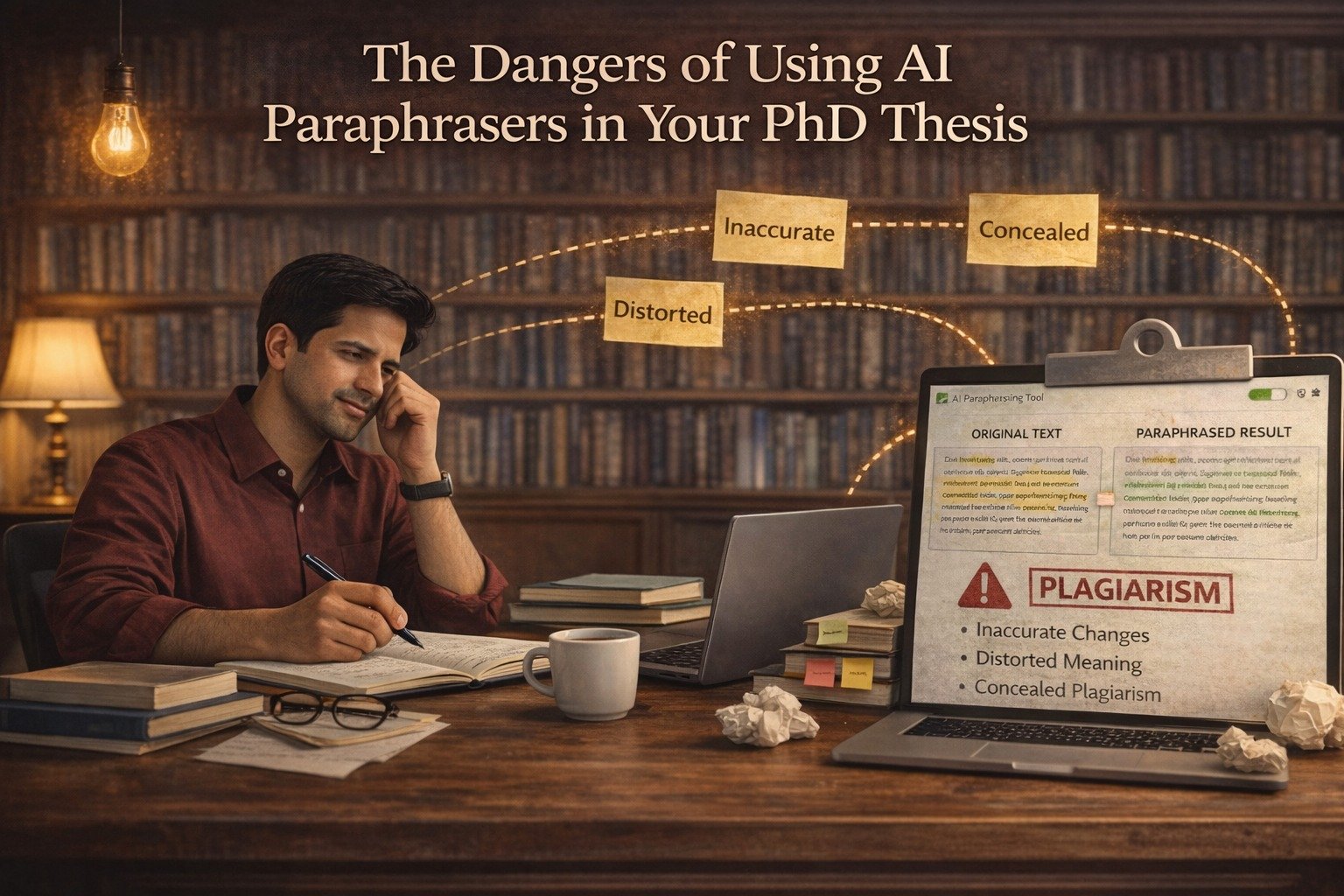
But lowering a similarity percentage using AI does not mean you’ve avoided plagiarism. If the idea is copied — even if the words are changed — and the original source is not acknowledged, it’s still considered unethical. Some Indian universities are beginning to train faculty to spot this kind of “concealed plagiarism,” where citations are missing but the thought process clearly mirrors a published source.
Additionally, AI paraphrasers often alter structure without improving clarity. The sentence may look original to a software, but sound awkward to a human reader — especially to an examiner who knows the subject well. When this happens repeatedly in a chapter, it signals academic immaturity or worse, intentional concealment.
Language Is Not Just Grammar — It Reflects Thought Process
PhD writing, particularly in Indian contexts where scholars come from diverse regional and linguistic backgrounds, is not expected to be perfect. Supervisors and examiners understand that English may not be your first language. What they expect is clarity, honesty, and an effort to express your argument in your own voice — however simple that voice may be.
When scholars use AI to “sound more academic,” they often lose their own tone. The writing becomes artificial, over-polished, or disconnected from the way the scholar actually speaks or thinks. This mismatch becomes visible during oral defences or chapter discussions.
A PhD scholar in public health from Kerala shared how she rewrote her literature review after her guide noticed a sudden shift in writing tone. The middle section, paraphrased using an AI tool, used vocabulary she herself didn’t understand. Her guide warned her gently: “If you can’t explain what you’ve written, don’t submit it.”
Academic writing improves through revision, feedback, and practice — not by hiding behind AI-generated sentences. Tools can support you, but they should not replace your own process of thinking and articulation.
Better Alternatives to AI Paraphrasing
If you’re struggling with literature reviews or rewriting, there are safer, more ethical ways to improve your thesis:
• Read, pause, and explain the source to yourself in simple language. Then try rewriting it in your words, followed by a proper citation.
• Use citation managers like Zotero or Mendeley to keep track of what you’ve read, so you avoid accidental plagiarism.
• Work with a thesis consultant or academic editor who can help you understand how to paraphrase and cite — without doing the thinking for you.
• Practice writing short summaries of articles in plain English. This builds your ability to engage with complex material in your own language.
• Ask your guide or seniors for samples of well-written reviews. Seeing how others structure their thoughts can guide your own phrasing.
Remember, paraphrasing is a skill — not a trick. It takes time to develop, but once you learn it, it becomes a powerful tool in your academic life.
Conclusion
AI paraphrasing tools may promise speed and convenience, but in the world of doctoral research, they come with hidden costs. The risk is not just academic — it’s personal. When you let a machine rewrite your ideas, you lose connection with your own voice. In the Indian PhD landscape, where research journeys are already full of complexity, taking shortcuts can create deeper problems than the ones you were trying to solve.
You don’t have to write perfect English. You don’t need to sound like a textbook. What you need is honesty, effort, and a willingness to grow as a scholar. And that growth can never be paraphrased.