
Introduction
With the rise of AI writing tools like ChatGPT, QuillBot, and other content generators, Indian PhD scholars have found a tempting shortcut: type a prompt, receive a neatly structured paragraph, and paste it into the thesis. For scholars juggling coursework, family duties, and unclear supervisor guidance — especially in private universities — the speed and polish of AI-generated writing can feel like a lifesaver.
But there’s a hidden risk most scholars overlook. AI-generated content and university plagiarism checks do not always go hand in hand. While such tools may not copy directly from published sources, they often produce material that lacks originality, consistency, or citation — all of which can raise red flags during thesis evaluation. For Indian researchers hoping to meet institutional standards and submit a thesis with integrity, it’s essential to understand how AI-generated writing can backfire during plagiarism checks and academic review.
Why AI Content Might Not Trigger Plagiarism – But Still Raise Questions
Most Indian universities now require PhD submissions to pass through plagiarism detection software such as Turnitin, Urkund, or similar platforms. These tools are designed to detect direct matches — that is, exact phrases or sentences found in previously published documents or student submissions. AI-generated content, however, does not always reuse existing sentences. Instead, it creates original-looking text by drawing from patterns in massive datasets.
This is where the confusion begins. Scholars assume: If the text is “new” and doesn’t match anything else, it must be safe. But originality in language is not the only standard in academic writing. Examiners and supervisors don’t just check plagiarism scores — they also assess quality, consistency, and voice.
In several Indian universities, guides have begun noticing when a thesis chapter suddenly shifts in tone or uses vocabulary the scholar has never used before. In such cases, even a low plagiarism score is not enough to guarantee acceptance. Some guides now run suspected sections through AI detection tools, or ask scholars to explain what they’ve written — line by line.
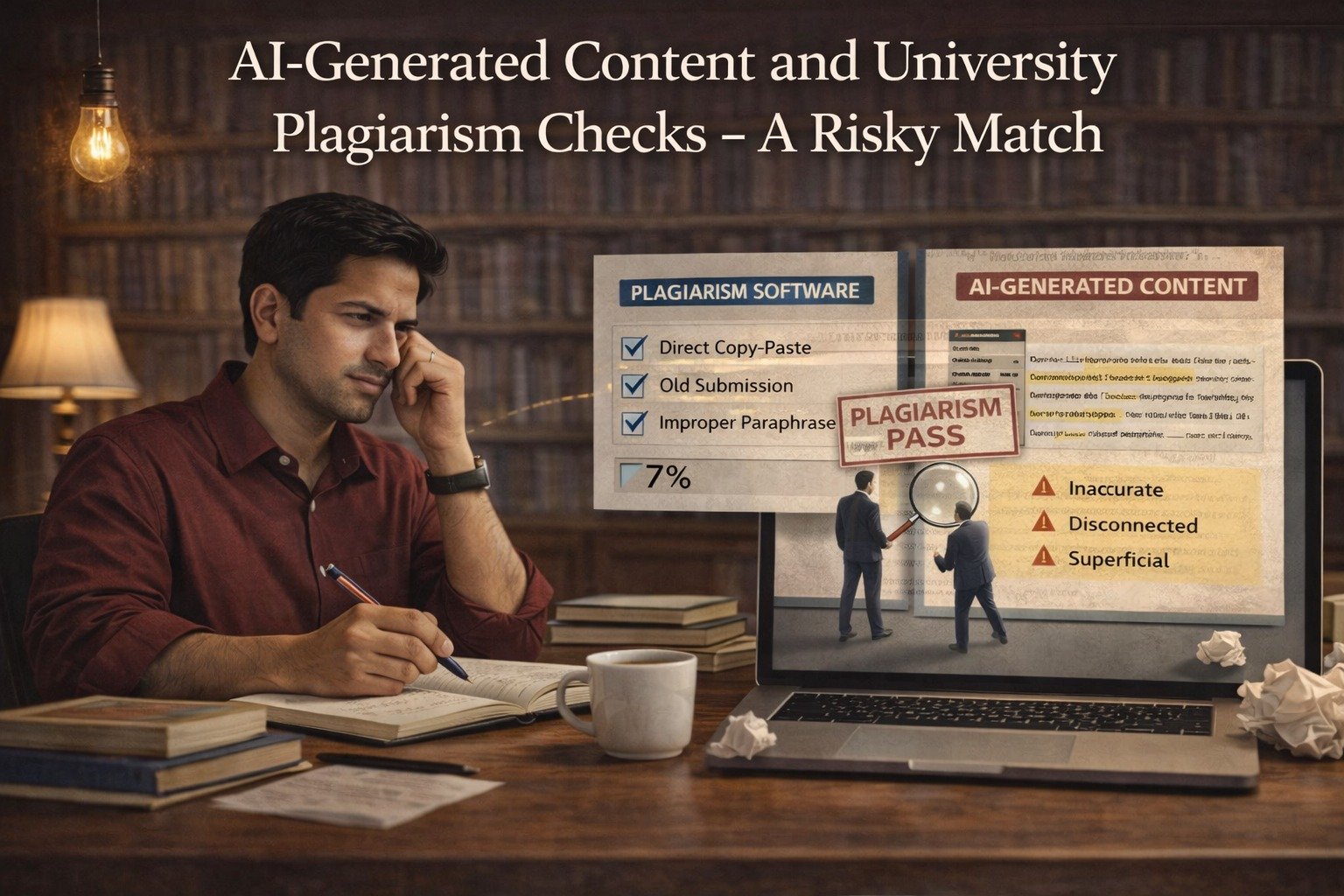
A PhD scholar from a private university in Pune shared how his thesis, though it passed Turnitin with a 7% similarity score, was flagged during viva for unclear arguments and strangely worded phrases. When asked to explain his reasoning, he admitted to using an AI tool to paraphrase multiple chapters. His degree was delayed by nearly a year due to mandatory rewriting.
What Plagiarism Software Can — and Can’t — Detect
Plagiarism software is only one piece of the evaluation process. It can catch:
• Direct copy-paste from online or published sources
• Improperly paraphrased content without citation
• Reuse of old student submissions (self-plagiarism)
• Unattributed quotes or data tables from previous research
However, it cannot reliably detect:
• AI-generated content that mimics academic writing
• Content that uses superficial rewording without understanding
• Incorrect or invented citations that don’t actually exist
• Gaps in argumentation or inconsistencies across chapters
This is where universities rely on human reviewers — guides, subject experts, and thesis committees — who look beyond percentage scores. They assess whether the scholar truly understands their work, whether citations are used meaningfully, and whether the research reflects critical thinking. In Indian academia, where viva sessions and chapter reviews are taken seriously, AI-generated writing may survive a software check — but not an oral defence.
The Cultural Gap AI Doesn’t Understand
A thesis written in India is not just a technical document. It is often deeply rooted in regional contexts, cultural issues, and policy-specific frameworks. AI-generated content, which is mostly trained on global, Western-centric data, struggles to capture this nuance. It may offer a grammatically correct explanation of “education inequality,” but it will not understand what that means in the context of rural Bihar, or how caste and access intersect in Tamil Nadu’s schooling system.
This cultural mismatch becomes obvious during review. A guide might ask: Why does this paragraph read like a Wikipedia article? Or, Where are the local references? If your content sounds too generic, too vague, or too internationalised without relevance to your topic, it will invite suspicion — even if the grammar is flawless.
How AI Affects the Scholar’s Own Voice and Understanding
One of the major risks of using AI-generated content is that it distances you from your own work. The more you rely on AI to phrase your arguments, the less connected you become to what you’re writing. This makes it harder to explain your logic during guide meetings or respond to committee questions later.
For Indian scholars who are already managing multiple roles — as teachers, parents, or working professionals — this disconnection can become a major liability. If you can’t confidently walk someone through your own chapter, it doesn’t matter how polished it looks on paper.
A researcher from a management institute in Bengaluru shared how she stopped using AI after realising she couldn’t explain the “theoretical framework” it had generated for her. She rewrote that section slowly, with help from a consultant — and finally felt ready for her viva.
Responsible Use Is Possible — But With Clear Limits
This doesn’t mean AI tools must be completely avoided. Used thoughtfully, they can assist in minor ways:
• Drafting outlines or sample prompts
• Helping with grammar corrections or basic editing
• Summarising dense articles (for your own understanding only)
• Suggesting alternative phrases (to clarify writing you’ve already done)
But using AI to write full chapters, paraphrase source material, or generate citations without reading is not only academically weak — it’s risky. It may pass a software test, but it won’t pass a conversation with your guide.
Conclusion
In a world where tools are evolving faster than rules, Indian PhD scholars need more than shortcuts — they need judgment. AI-generated content may appear to offer an easy path, especially under pressure. But when placed against the scrutiny of university checks, oral defences, and supervisor feedback, it often creates more problems than it solves.
Your thesis is not just a requirement — it’s a reflection of your intellectual journey. And that journey deserves your voice, your effort, and your full presence. Because in the end, academic integrity isn’t about passing a tool — it’s about facing your committee, your peers, and yourself with confidence.