
Introduction
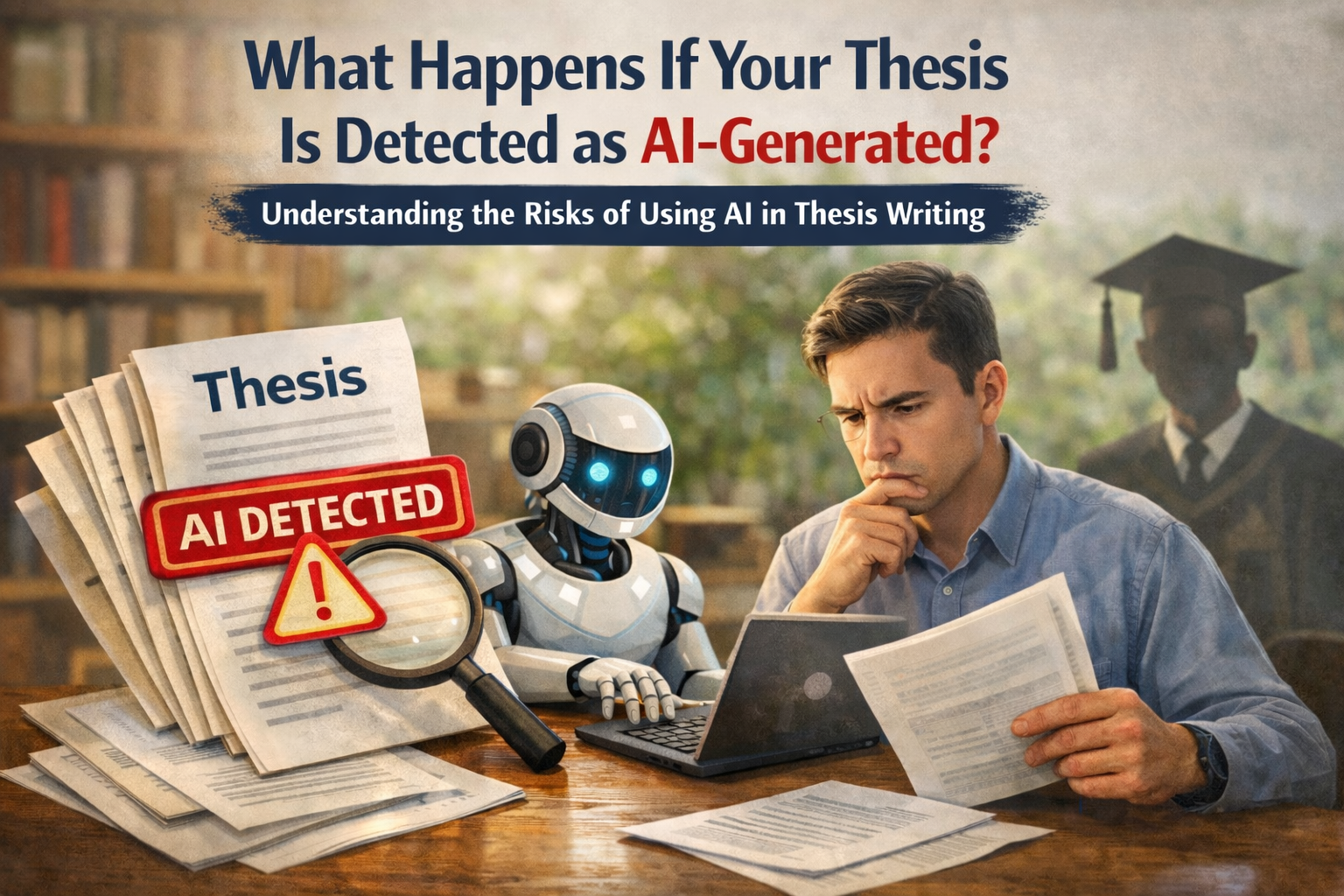
With the rise of tools like ChatGPT and AI-powered paraphrasers, more Indian PhD scholars are experimenting with artificial intelligence to speed up their thesis writing. Especially in private universities where guidance is inconsistent, and where scholars may also be working professionals, the temptation to “get help” from AI is understandable. But there’s a risk that many don’t fully consider: what happens if your university detects that your thesis — or parts of it — were written by AI?
It’s not just about plagiarism anymore. Many Indian institutions are now adding AI-detection tools to their submission process. And while these tools are still evolving, the real issue is not just technical detection — it’s how your work is perceived. A thesis that sounds artificial, lacks depth, or shows signs of generic automation raises red flags. For scholars who’ve worked hard to reach the final stage of their PhD, that kind of suspicion can bring serious academic and reputational consequences.
Detection May Not Be Perfect — But Doubt Is Enough
Most AI detection tools today — including GPT detectors and writing analysis software — are not 100% accurate. But that doesn’t mean you’re safe. In India’s thesis evaluation process, detection doesn’t have to come from software alone. Often, your guide or examiner can sense when a section lacks your personal academic voice.
For example, if earlier drafts submitted to your supervisor had simple, inconsistent grammar, and the final submission suddenly reads like a professionally edited document filled with academic jargon, it creates doubt. That doubt can lead to scrutiny — rechecking past submissions, oral questioning during viva, or even calls for resubmission.
One scholar at a private university in Madhya Pradesh shared how her examiner flagged her literature review as “robotic” in tone. Though she hadn’t used AI directly, she had relied heavily on paraphrasing tools and bulk copying from summaries. This led to delays, as she was asked to revise the chapter with clearer references and more personal understanding. She learned that “sounding polished” is not enough — sounding genuine matters more.
Consequences Go Beyond Rewriting — They Affect Credibility
When a thesis is suspected or confirmed to be AI-generated, universities may take different actions based on their internal policies. Some may simply ask for a rewrite. Others may reject the chapter. In severe cases, particularly when plagiarism is involved, your registration may be cancelled or your degree withheld.
But even when formal penalties don’t happen, there’s another cost — your academic credibility. Once a supervisor, examiner, or fellow scholar doubts your authorship, it becomes harder to establish trust. This can impact your future recommendations, publications, or teaching opportunities.
In Indian academia, where personal networks and verbal reputation matter, even a minor doubt can limit your professional growth. A candidate who once showed promise may no longer be seen as reliable — not because of a failed chapter, but because of a perceived shortcut.
Even during viva voce, the oral defence can expose AI-written content. If you cannot confidently explain a framework you used, or you fumble when asked to defend a paragraph you didn’t write yourself, examiners may ask for a second evaluation or written clarification. This adds months of delay — and a great deal of stress.
AI Can Assist — But Cannot Replace Your Thought Process
This doesn’t mean AI must be avoided entirely. It means you need to understand what kind of use is acceptable, and what crosses the line. Using AI to check grammar, restructure long sentences, or help summarise background reading is generally acceptable — especially when you later review and rewrite the content yourself.
But asking AI to write large sections of your thesis — like a full literature review or methodology chapter — leads to a lack of personal engagement. These are the very sections where your voice, your reasoning, and your research logic are supposed to be visible. When these are missing, your work feels hollow — no matter how well it reads.
A research scholar from Kerala said he once asked ChatGPT to write a conclusion chapter “just to see what it would say.” The result was generic, filled with vague sentences like “this study contributes to the existing body of knowledge.” It didn’t mention his findings, didn’t connect to his research problem, and offered no insight. He deleted the draft and decided to take more time — but in his own words.
Universities Are Catching Up — So Must the Scholars
It’s true that many Indian universities are still behind in technology. Not all have AI-detection tools, and not every supervisor is trained to spot AI-generated work. But that gap is closing. As more institutions upgrade their evaluation systems and use digital platforms for submission, scrutiny is increasing.
At the same time, research ethics guidelines are being updated. Scholars are now asked to declare the use of AI tools in some cases — just like software for statistical analysis or plagiarism checks. Transparency is becoming part of the process. If you hide your AI use and get caught, the consequences are harsher than if you had simply acknowledged using it for language support.
It’s not just about being careful. It’s about respecting the value of your degree. A PhD in India is still a symbol of deep work — of long reading hours, original thinking, and intellectual resilience. Replacing that with machine-generated text not only disrespects the process, it devalues your own journey.
Conclusion
AI can be a powerful assistant — but it is not a substitute for the scholar. When your thesis is detected as AI-generated, the issue is not just about rules or software — it’s about trust. Universities may forgive poor writing. They rarely forgive dishonesty.
For Indian scholars, especially those working within flexible but loosely guided private university systems, the pressure to finish quickly is real. But the shortcut of using AI to write your thesis often leads to longer delays, lower confidence, and deeper scrutiny. Staying present in your work — through the confusion, the drafts, the rewrites — is what builds real academic strength.