
Introduction
Artificial intelligence has made its way into almost every field — and academic research is no exception. For Indian PhD scholars, especially those studying in private universities or juggling doctoral work with jobs and family responsibilities, AI tools offer relief from some of the more tedious or technical parts of thesis writing. From grammar correction to summarising journal articles, the appeal of AI is clear.
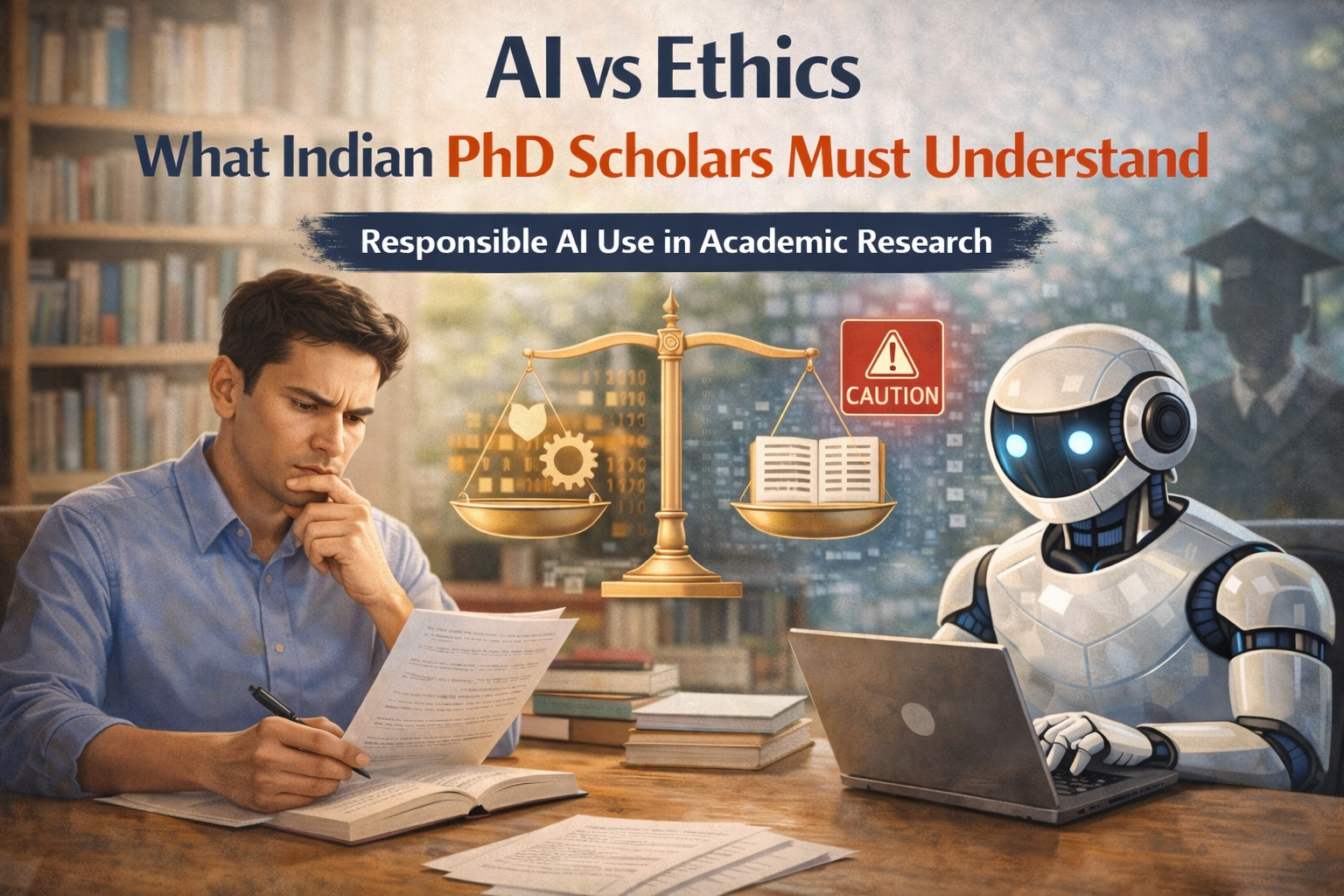
But there’s a growing concern that many researchers are not just using AI — they’re relying on it. And as these tools become more sophisticated, the line between assistance and academic misconduct becomes harder to see. The core question Indian PhD students must now ask themselves isn’t whether AI works — it’s whether using it in certain ways is ethically acceptable. AI vs. ethics is no longer a theoretical debate. It’s a daily decision that impacts the credibility of your work and your academic journey.
The Ethical Role of AI in Research – Support, Not Substitution
There are parts of the PhD journey where AI can serve as a useful companion — without crossing ethical lines. Scholars in India often come from diverse educational backgrounds, with varying levels of exposure to academic English. Using AI tools to improve grammar, suggest clearer sentence structures, or generate synonyms can help non-native speakers express themselves more clearly. In these cases, AI functions like an advanced spellcheck — refining what you’ve already written.
AI can also help summarise dense academic texts, extract key terms, or identify commonly cited references in a field. For scholars who feel overwhelmed by literature reviews or data presentation, this can provide a starting point — not a finished product, but a way into the work. Used like this, AI still leaves the core research thinking — the logic, the analysis, the conclusions — in the hands of the scholar.
An example from a business PhD candidate at a private university in Pune illustrates this balance well. She used Grammarly and ChatGPT to correct and polish her discussion chapter, but only after writing her full argument herself. The tools helped her streamline the language, but the core ideas, comparisons, and interpretations were her own. Her supervisor appreciated the clarity — and her work remained academically sound.
Where It Crosses the Line – And Why the Risk Isn’t Worth It
The problem begins when AI starts replacing thought instead of supporting it. Asking an AI tool to write entire paragraphs, suggest arguments, or create a methodology can lead to major ethical violations. Many AI-generated texts are grammatically correct but logically weak. They may include fake references, vague theories, or unsupported claims. If inserted into a thesis without careful review, they not only damage your credibility — they also confuse your own understanding of the subject.
Worse, you may end up submitting work you don’t fully understand. And in the Indian context, where the viva exam is often oral and unpredictable, not being able to explain what you’ve written can be disastrous. Guides and external examiners are increasingly alert to the tone, structure, and depth of submitted chapters. They may not use AI detectors — but they can often tell when something feels out of sync with the scholar’s previous work.
Ethical concerns go beyond just detection. A PhD is supposed to be a reflection of your original thought process. If large parts of your thesis are generated by a machine, you’re misrepresenting your role in the research. This isn’t just poor judgment — it can be considered academic fraud. While Indian universities are still developing formal policies on AI misuse, the broader principle remains clear: the scholar must remain the author of their own ideas.
The Indian Research Landscape – Pressures Are Real, But So Are Choices
In Indian academia, particularly in private institutions, scholars face unique challenges: lack of writing support, inconsistent supervisor engagement, and pressure to complete degrees within tight timelines. These pressures can create an environment where shortcuts seem like the only option.
But ethics isn’t just about following rules — it’s about honouring your learning process. A rushed thesis written with AI may help you meet a deadline, but it can’t teach you how to defend your work, publish research, or mentor others in the future. These are skills built through genuine effort, feedback, and revision — not automation.
There’s also the cultural aspect. In many Indian families, pursuing a PhD is a matter of pride, often seen as a contribution to the community’s intellectual progress. When a scholar cuts corners through unethical AI use, it doesn’t just affect their degree — it affects their role as a knowledge contributor.
Some scholars are now turning to ethical consultants — professionals who guide rather than ghostwrite — as a middle path. This is particularly useful for those who feel lost but want to remain within academic boundaries. A consultant can help interpret feedback, improve clarity, or offer sample structures — without replacing the scholar’s original thought.
Conclusion
AI isn’t inherently unethical. It becomes a problem when it replaces the human responsibility of research. For Indian PhD scholars, the challenge is not just about resisting AI — it’s about using it wisely, without losing the personal voice and academic honesty that a thesis demands.
The tension between AI and ethics is real, but it’s also manageable. Scholars who stay mindful of their role, their learning, and their long-term goals can use AI as a tool — not a crutch. In the end, your degree is not just a certificate. It’s a reflection of your integrity, your resilience, and your willingness to learn. No algorithm can replace that.