
Introduction
With AI tools becoming more accessible in India, many PhD scholars are turning to platforms like ChatGPT or GrammarlyGO to assist with writing. The appeal is clear — these tools are fast, articulate, and available 24/7. For overburdened researchers in Indian universities, especially those juggling coursework, teaching duties, or family life, the temptation to rely on AI for thesis writing feels justified.
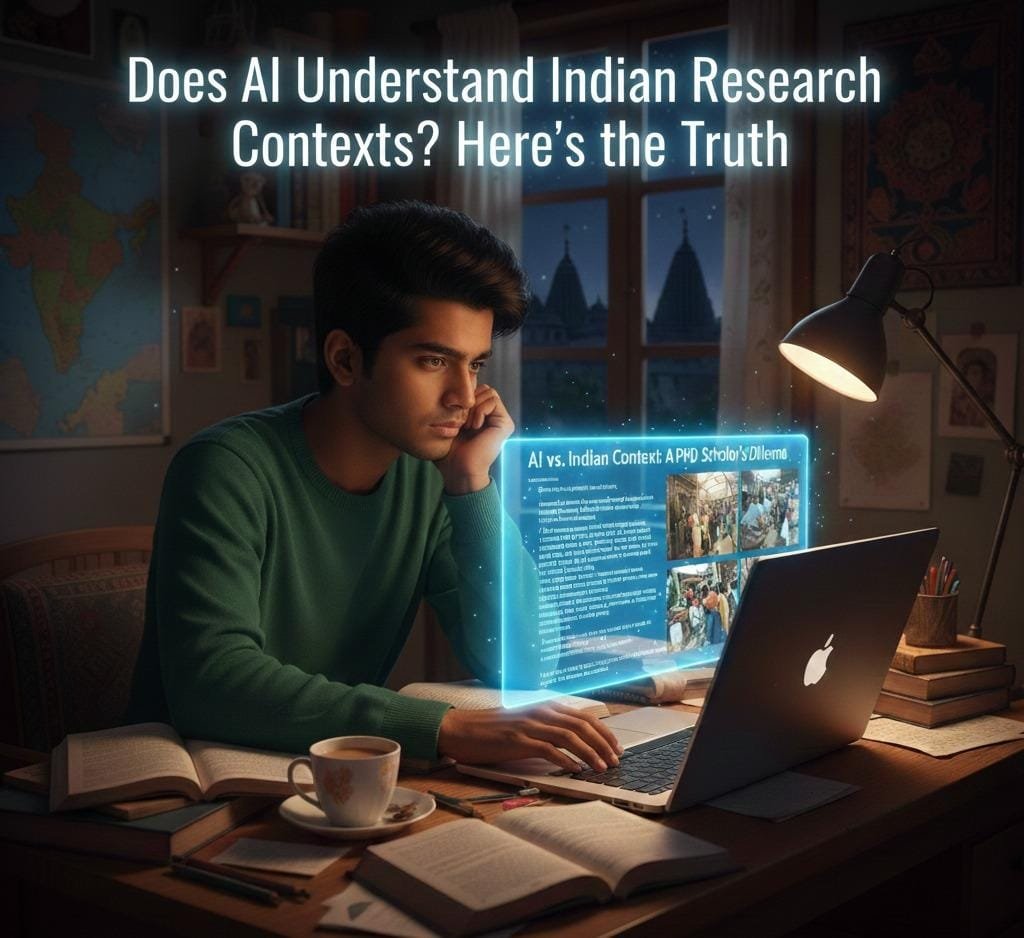
But there’s a deeper question that scholars must ask: Does AI truly understand the Indian research context? Can it grasp the socio-political nuances, regional diversity, and layered realities that define most Indian doctoral work — especially in humanities, education, development studies, or social sciences? The truth is, AI works well with generic content. But when your research is rooted in Indian realities, AI’s limitations become obvious. And if you’re not careful, your work may start sounding global — but feel shallow, disconnected from the ground it was meant to represent.
Why Indian Research Requires Cultural Grounding
PhD research in India often begins with a lived experience — a village, a school, a policy failure, a community initiative. Scholars bring personal insight, language familiarity, and regional understanding into their work. Whether it’s studying rural entrepreneurship in Gujarat, gender roles in Tamil Nadu, or sanitation schemes in Bihar, Indian doctoral projects are rich in context. They demand local examples, social awareness, and deep interpretation.
This is where AI falls short. Most AI tools are trained on vast internet datasets — much of it from Western academic writing. So, when you ask an AI tool to discuss “women’s leadership in Indian panchayats” or “challenges of implementing NEP 2020 in tribal areas,” it will offer well-structured but context-light responses. It may mention “rural India” as a broad concept, but it won’t capture caste dynamics, language barriers, or ground-level resistance — unless you supply that detail first.
A PhD scholar in sociology from a private university in Pune shared how she used AI to draft a summary of her fieldwork. The language sounded fine — but the panel rejected the chapter, stating that it lacked sensitivity and depth. She later rewrote it in her own voice, integrating actual observations and regional terms, and received appreciation for authenticity. AI couldn’t do that — because it didn’t experience what she did.
Examples of Where AI Breaks Down in Indian Contexts
AI-generated content often fails in four specific ways when applied to Indian research:
- Misrepresentation of Concepts: When asked about “jugaad innovation” or “guru-shishya parampara,” AI tools either generalise the concept or misinterpret it entirely. These culturally specific terms require lived knowledge, not just semantic matching.
- Surface-Level Analysis of Policies: AI may generate a paragraph on schemes like Beti Bachao Beti Padhao or MGNREGA, but often misses ground-level implementation gaps, local adaptations, or state-wise variations — which are critical in Indian policy research.
- Lack of Language Sensitivity: Many Indian scholars incorporate regional language interviews, idioms, or culturally rooted expressions into their qualitative data. AI cannot process these accurately. In fact, it may erase the very flavour that gives your research authenticity.
- Inappropriate Citations or Sources: AI sometimes suggests Western studies or irrelevant citations when asked to support Indian topics. If you don’t cross-check, you may end up citing a paper on education in California for a thesis on Kerala’s school system.
These may seem like small lapses, but in academia — especially at the PhD level — they raise red flags. Reviewers, guides, and external examiners expect you to engage deeply with your topic. When your writing sounds disconnected from the context you claim to study, your credibility suffers.
Why Contextual Integrity Matters in Indian PhD Work
In Indian academia, especially within private universities, students are often given thematic freedom but face structural ambiguity. There may be minimal research training, uneven supervisor guidance, or unclear expectations about formatting and tone. This makes it tempting to use AI as a crutch. But when you lean too heavily on it, you risk losing your academic identity.
A thesis that reflects real understanding stands out — not because it’s perfectly written, but because it’s grounded. If you’re studying urban migration in Delhi, you should be able to speak about actual neighbourhoods, lived experiences, policy tensions, and language diversity. If you’re writing about informal economies in West Bengal, your work should reflect familiarity with local terms, seasonal work patterns, and gendered labour roles. These details can’t be invented by AI — they have to come from you.
And when the time comes for your viva, or when you submit a paper based on your thesis, that depth will be tested. A good examiner doesn’t just look at grammar. They look at your voice, your framing, and your ability to connect theory with lived reality. AI can help polish your sentences, but it cannot give your work this kind of integrity.
Conclusion
AI tools have a place in the modern academic journey — no doubt. They can help you improve clarity, catch repetition, or rephrase long sentences. But they cannot think like you. And they certainly cannot understand the complex, layered, and highly specific nature of Indian research contexts.
If your thesis is about India — its policies, people, languages, or systems — then your writing must reflect that. Not just in facts, but in framing, voice, and intent. AI doesn’t know the streets you walked during fieldwork. It doesn’t carry the weight of your language, your caste experience, or your observations. Only you do.
So use AI with care — not as your writer, but as your assistant. Let the research remain yours. Because in Indian academia, context is not just a background. It is the core of your work.