
Introduction
In India’s rapidly evolving PhD ecosystem—particularly within private universities and distance-learning programmes—doctoral scholars face intense pressure to demonstrate originality, meet submission deadlines, and comply with strict academic standards. Limited supervisory access, language challenges, and administrative expectations often push scholars to seek assistance from AI writing tools for editing, paraphrasing, or structuring their thesis.
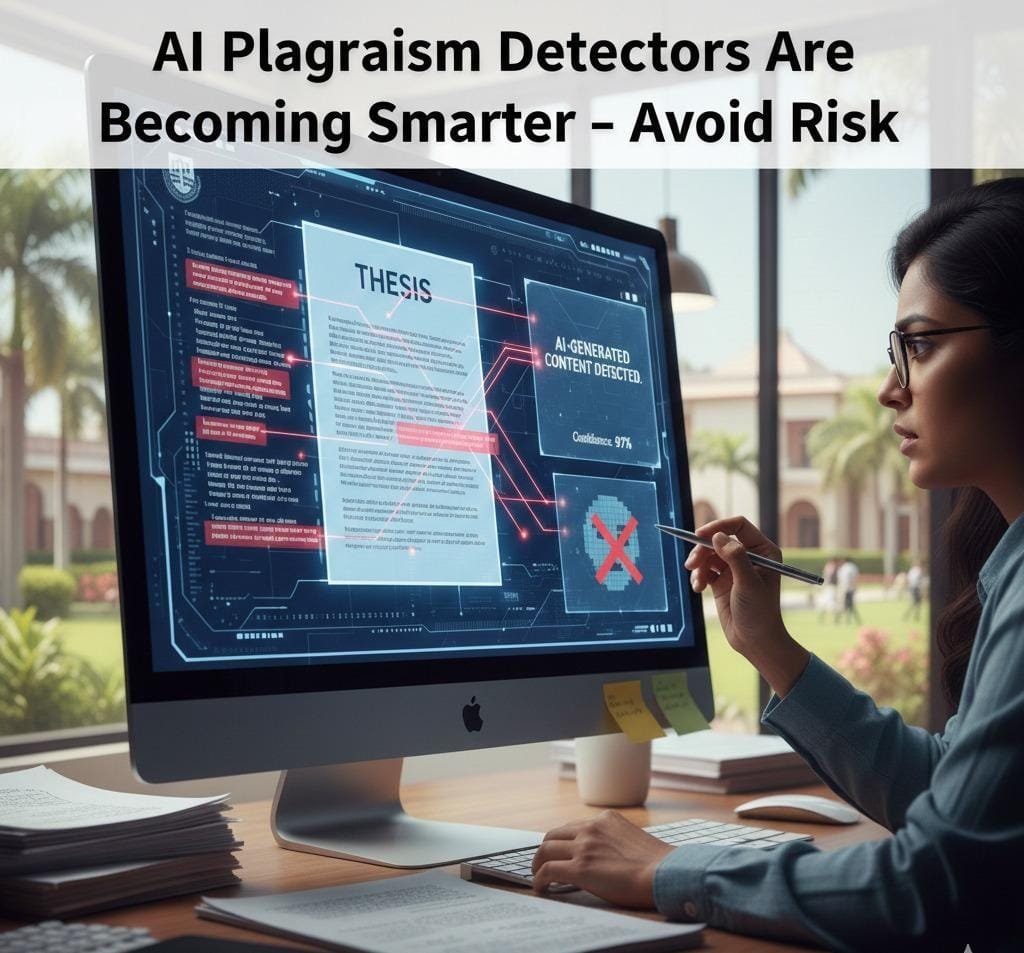
While these tools may appear helpful, they introduce a growing risk. AI plagiarism detectors are becoming increasingly sophisticated, and Indian universities are now actively screening theses for both plagiarism and AI-generated content. What once seemed like harmless language polishing can now raise serious academic concerns. For Indian PhD scholars, understanding how these detection systems work—and how to stay within ethical boundaries—is essential for protecting academic credibility and ensuring smooth thesis approval.
How AI Plagiarism Detection Has Changed in Indian Universities
Traditionally, plagiarism checks in Indian institutions focused on similarity matching. Tools such as Turnitin and URKUND compared submitted text against published literature and online sources, with most universities allowing similarity thresholds between 10% and 20%. Earlier, basic paraphrasing techniques were often enough to avoid detection.
Today, this approach has evolved. Universities now use AI-detection systems that analyse writing patterns rather than source matches. These tools identify text that appears overly uniform, generic, or algorithmically generated. Platforms such as Turnitin’s AI detection feature and GPT-based analysis tools can flag content that lacks authorial voice, contextual depth, or discipline-specific expression.
For example, a section discussing rural education policy in Bihar that reads like a generic global overview—without regional terminology, field insights, or policy nuance—may be flagged as AI-generated even if it is technically original. The issue is no longer copying, but authenticity.
Real Academic Risks for Indian PhD Scholars
Many Indian universities—especially private institutions—now require both plagiarism and AI-detection reports during thesis screening. These reports are examined by supervisors, research committees, and ethics boards. If concerns arise, a thesis may be returned for rewriting, subjected to additional review, delayed in submission, or flagged for academic misconduct in serious cases.
This risk is heightened for scholars writing in English as a second language. AI tools are often used to “polish” language, but excessive rewriting can erase disciplinary specificity and create stylistically artificial text. When examiners notice uniform phrasing or a mismatch between written work and oral explanations during viva, concerns about authorship naturally arise.
There have already been cases where Indian PhD scholars were asked to resubmit chapters after AI usage was detected—not because the research ideas were incorrect, but because the writing lacked individual academic voice and depth.
Using AI Responsibly in Thesis Writing
AI tools do not need to be avoided entirely, but they must be used with caution and clarity. Their role should be supportive, not generative. Scholars can safely use AI for grammar checks, sentence clarity, or identifying repetition—but the thinking, framing, and final wording must remain their own.
Maintaining multiple drafts, saving research notes, and documenting revisions helps establish authorship if questions arise. For language refinement, working with experienced academic editors is often safer than relying on automated rewriting tools. Most importantly, scholars should understand their university’s policies regarding AI use, as many institutions now explicitly address this in research guidelines.
Conclusion
Doctoral research is meant to reflect independent thinking, contextual understanding, and scholarly responsibility. In an environment already shaped by deadlines and institutional pressure, AI tools may feel like convenient shortcuts. However, as AI plagiarism detectors become more advanced, careless usage can undermine months—or years—of research effort.
Originality today is not measured only by similarity scores, but by voice, depth, and academic ownership. A strong thesis does not sound perfect—it sounds real. By using AI ethically and intentionally, Indian PhD scholars can protect their credibility and ensure their research stands up to scrutiny, both during evaluation and beyond.