
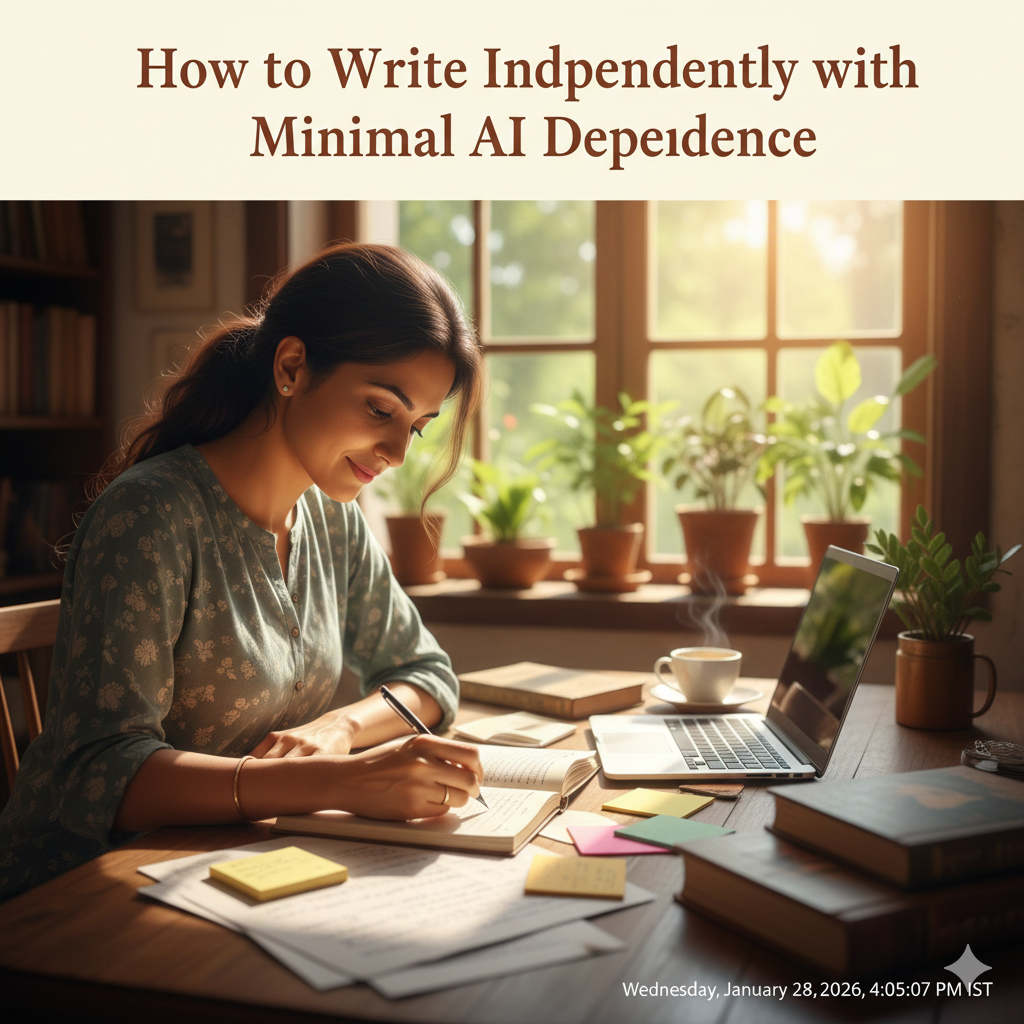
Introduction
In today’s academic environment, especially across Indian private universities and distance PhD programmes, artificial intelligence tools have become common companions. From grammar suggestions to entire paragraph generation, the support these tools offer can be tempting — particularly for scholars managing multiple responsibilities or returning to academics after a long break. Yet as universities begin to scrutinise AI-generated content more closely, the question becomes urgent: how do you write independently while still navigating the pressures of academic life?
Writing a PhD thesis is not just about completing a document — it’s about developing a scholarly voice. And that voice can easily get diluted when AI tools take over too much of the writing process. This blog explores how Indian researchers can preserve their independence in writing, reduce reliance on AI, and still produce clear, rigorous, and well-structured work.
Understanding Where AI Can Help — and Where It Shouldn’t
The first step to minimal AI dependence is clarity about what the tools are meant for. Grammar checkers like Grammarly or language suggestions from editing apps can be helpful for surface-level clarity. They point out sentence errors, flag repetition, or suggest clearer phrasing. Used sparingly, these tools improve readability — without replacing your thought process.
But the trouble begins when AI becomes the generator instead of the editor. Tools that write introductions, reword paragraphs, or summarise research articles for you take away the very work that a PhD thesis is supposed to demonstrate. For Indian scholars, particularly those writing in English as a second language, the pressure to sound “international” or “fluent” sometimes leads to overuse. The result is a thesis that sounds polished but lacks personal depth or disciplinary specificity.
To write independently, scholars must stay at the centre of their own thinking. AI should assist, not lead. A thesis that reflects your logic, your reading, and your way of expressing academic thought will always stand stronger — not only during submission but especially at the viva, where you must defend your choices in your own words.
Strategies for Independent Writing in the Indian Academic Context
Independent writing is not a gift — it’s a skill that grows with practice and intention. For Indian scholars managing time constraints, linguistic challenges, or interdisciplinary topics, here are grounded ways to build that skill while keeping AI use minimal and purposeful.
1. Build your argument offline first
Before opening a document or drafting a chapter, use a notebook to outline your main points. Think through your argument, make bullet points for each section, and jot down specific examples from your fieldwork or readings. This handwritten or offline planning keeps your thoughts original — and acts as a safeguard against digital overreliance.
2. Translate from your mother tongue if needed
If English feels like a block, start by writing short passages or explanations in your regional language. Then translate them into English in your own words. This method keeps your ideas authentic and rooted in your thought process — not in borrowed or machine-generated phrasing.
3. Use summaries, not full automation
When engaging with academic literature, write your own 3–4 sentence summaries of each paper you read. Avoid tools that summarise for you. This forces you to engage deeply with the material, understand it, and reframe it in a way that makes sense to you — which is key to developing your literature review chapter.
4. Revisit your own writing voice
Go back to earlier papers, assignments, or reports you’ve written — even if they are in simpler English. They remind you of your natural tone and thought structure. AI often disrupts that voice by introducing a style that sounds global but feels generic. Reconnecting with your own writing helps preserve your academic identity.
5. Use human feedback wisely
Instead of relying on AI to rephrase your work, get feedback from a real academic editor or mentor. Human reviewers understand nuance, context, and tone — things AI often misses. They can suggest improvements without erasing your thinking.
6. Limit AI to proofreading, not content
When your draft is complete, it’s okay to run it through a proofreading tool for spelling or clarity. But resist the urge to rewrite entire paragraphs based on AI suggestions. Even small rephrasings can alter the meaning or create inconsistency in tone — especially if used across chapters.
Why This Matters More Than Ever
With Indian universities increasing their scrutiny through AI-detection tools, independent writing is not just about ethics — it’s about academic safety. Chapters that feel too polished or overly uniform in tone can raise red flags, leading to revision requests or suspicion. But more than that, independent writing gives scholars confidence. When you write something in your own words, you understand it better, you remember it more clearly, and you can defend it during your viva.
Many PhD candidates today come from non-traditional academic paths — they may be schoolteachers, corporate professionals, social workers, or researchers returning after years. For them, building writing confidence matters even more. A thesis full of AI-generated language might pass some checks, but it robs you of the learning and growth that this journey is supposed to offer.
Conclusion
Academic writing is not about perfect English. It’s about meaningful expression. In a time when AI tools offer tempting shortcuts, Indian PhD scholars must remember that clarity, originality, and personal insight are more valuable than robotic fluency. Writing independently — even with some human guidance or minimal tool support — ensures that your thesis reflects you.
Your thesis should not sound like a machine wrote it. It should sound like a real scholar — thinking, learning, and articulating ideas with sincerity. And that begins by keeping AI in its place: not at the centre of your writing, but quietly in the background.