Introduction
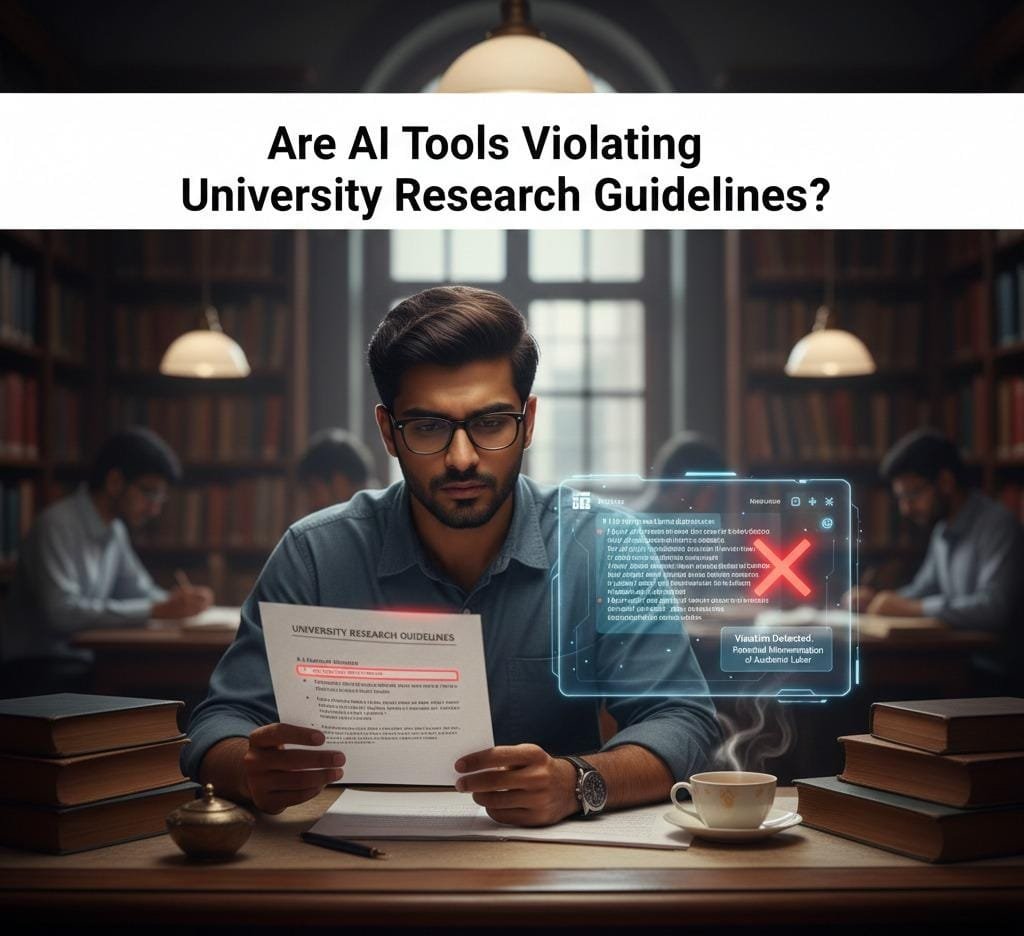
Across Indian campuses — from central universities to private research institutes — PhD scholars are facing a new kind of uncertainty: where do AI tools fit into university research rules? Tools like ChatGPT, GrammarlyGO, QuillBot, and others are now widely used by students to paraphrase, polish, or even generate sections of their thesis. But as these tools grow more powerful, so do concerns among academic committees. Many universities are now updating their guidelines to specifically address the role of AI in research writing.
This shift raises real questions for Indian scholars: Are we unintentionally violating rules by using these tools? Is running your paragraph through a rephrasing app the same as plagiarism? What if the university hasn’t said anything clearly yet?
These concerns are valid — and timely. Understanding how AI usage intersects with academic integrity is no longer optional. For researchers who want to stay on the right side of university policy, it’s essential to read between the lines of what these tools offer — and what your institution expects.
What University Guidelines Actually Say (and Don’t Say)
Many Indian universities are still in the process of updating their research handbooks to account for AI. This creates a grey area. While plagiarism policies are usually clear — forbidding copied content or unattributed ideas — they may not yet mention AI tools explicitly. However, this absence does not mean unrestricted permission.
Several universities, particularly private ones aiming for international standards, have started including AI detection reports along with plagiarism checks. Some now require scholars to submit declarations confirming that no part of their thesis was generated by AI. Others advise students to avoid automated tools unless they are used for grammar correction or reference management.
Here’s the key issue: intent and disclosure. If you use AI to correct grammar or suggest sentence clarity, and the content remains yours, it’s often seen as acceptable. But if you rely on AI to generate, paraphrase, or construct original sections — and do not disclose this — then you may be crossing into academic misconduct, even if no official rulebook says so yet.
In India, where research guidelines differ widely between institutions, the lack of clarity puts the burden on the scholar to act ethically — not just legally.
How AI Tools Can Quietly Cross Ethical Boundaries
AI does not copy in the traditional sense, but it does create content based on patterns it has seen. When you feed it your thesis topic and ask it to write a paragraph, it gives you language that’s grammatically correct but often shallow or disconnected from your research context.
This becomes a problem in three ways:
- Loss of authorship: If you can’t fully explain what you’ve written or how you arrived at a particular conclusion, reviewers may question whether the work is truly yours.
- Violation of the research process: A PhD is about the development of thinking, not just the delivery of content. When AI shortcuts that process, it undermines the point of the degree.
- Misrepresentation of academic labour: Universities assess your thesis based on the assumption that you read, analysed, interpreted, and wrote your work. AI writing breaks that chain of effort — and can lead to questions during viva or peer review.
Even something as simple as paraphrasing using AI tools can be risky. These tools may unintentionally distort meaning, misrepresent sources, or create sentences that sound sophisticated but lack academic logic. If caught, this can be treated as either plagiarism or falsification — both serious offences under most PhD codes of conduct.
Why Institutions Are Moving Towards Tighter Control
There’s growing pressure on universities to protect the credibility of their degrees. With AI-generated content flooding online platforms, academic institutions are concerned about maintaining standards — especially when their scholars apply for international fellowships, publish in peer-reviewed journals, or submit to global rankings.
In this context, AI-generated theses present a reputational risk. If a university confers a doctorate based on AI-written content, it may later be accused of academic negligence. This is why many universities now require scholars to submit AI-authorship declarations, and some even run content through AI-detection software as part of pre-submission review.
Moreover, thesis guides and review panels are learning to identify AI tone. A submission that suddenly improves in fluency or shifts in academic voice raises suspicion — especially when the scholar struggles to explain their arguments or use discipline-specific terminology during viva.
For Indian PhD scholars, this means that using AI without awareness or disclosure is becoming increasingly risky — even if it doesn’t trigger a plagiarism flag immediately.
What You Can Do to Stay Within Guidelines
Until university policies catch up fully, the responsibility lies with the scholar to stay within safe ethical territory. Here’s how:
- Use AI only for language clarity: Tools like Grammarly can help with grammar, but avoid using AI to rewrite or generate content.
- Document your writing process: Maintain drafts, outlines, and notes that show how your thesis developed over time. This is helpful if you’re ever asked to justify your work.
- Ask your guide or department: Don’t assume silence means approval. If unsure, ask directly whether AI tools are acceptable for your intended use.
- Use human academic editors: If you need help improving your writing, consider human editorial support. It’s ethical, contextual, and far less risky than relying on AI paraphrasing tools.
- Prepare for viva with full ownership: Even if your draft was edited or reviewed, make sure you understand every line. Viva panels can easily detect a scholar who doesn’t recognise their own work.
Conclusion
As universities tighten their research guidelines to address AI, PhD scholars must adapt thoughtfully. Tools are evolving, policies are evolving — but the core principle of research hasn’t changed. A thesis must reflect your thinking, your words, and your process.
AI can be a helpful assistant — but when it begins to replace your authorship, it stops being a tool and starts becoming a threat. Indian scholars don’t need perfect English or flashy phrasing to pass. What they need is sincerity, ownership, and respect for the process. That’s what universities are protecting when they warn against AI — and that’s what every researcher should aim to protect, too.