
Introduction
The arrival of AI chatbots like ChatGPT, Bard, and others has transformed how information is accessed and processed. For Indian PhD scholars, especially those managing full-time jobs, family commitments, or returning to academics after a long break, these tools often feel like a lifeline. With the ability to summarise, paraphrase, and even generate sample text, chatbots promise speed and ease — two things most researchers crave during the exhausting thesis journey.
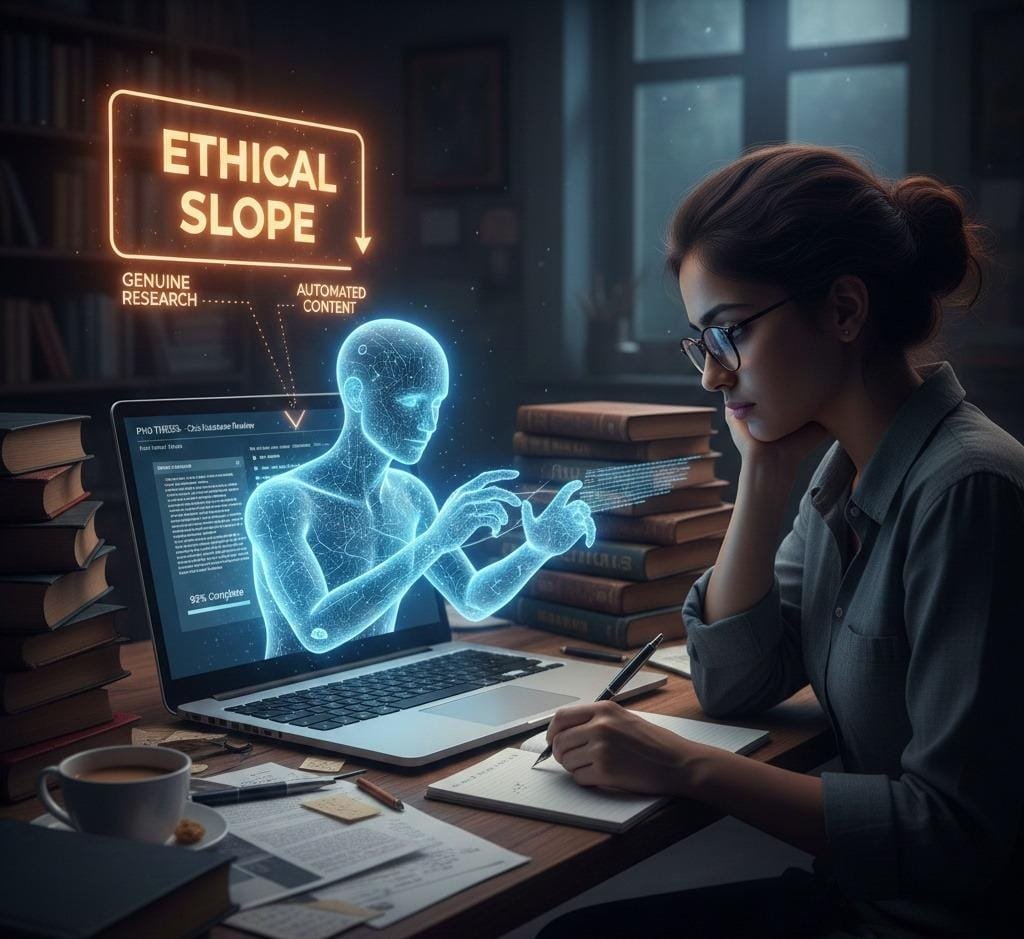
But beneath that convenience lies a growing ethical dilemma. While using a chatbot to check grammar or suggest references may seem harmless, relying on it to generate arguments, analyse literature, or write sections of a thesis can quickly cross the line. As more scholars begin to quietly explore AI help, the academic community is forced to confront an uncomfortable question: Are we replacing genuine research effort with automation — and is it even ethical to do so?
The use of chatbots in thesis writing is not just a technological question. It’s a question of academic integrity. And for Indian scholars working within evolving university norms, it’s important to understand where the slope begins to tilt.
Where the Line Begins to Blur
Most Indian universities, especially private institutions, are still building their policies on AI use. Some have begun issuing broad advisories, others are integrating AI-detection into their plagiarism systems, and many guides now raise concerns when a thesis feels “too polished” or inconsistent with a scholar’s usual writing style.
The problem with chatbot-generated content is not just that it’s external — it’s that it’s invisible. Unlike hiring a consultant or a language editor, where there’s a traceable interaction and scope of support, chatbot use leaves no obvious record. A scholar may feed a prompt, receive a neatly written paragraph, and insert it into their chapter — all within minutes, and all without credit.
This makes it difficult for institutions to monitor and difficult for scholars to self-regulate. A small paragraph for “inspiration” can turn into full sections copied with minor tweaks. The result is a thesis that may pass similarity checks — but fails the test of academic authorship.
What starts as casual support can quietly become over-dependence. And that’s where the slope begins.
The Illusion of Ownership and Effort
A thesis is not just about content. It’s about the process of forming research questions, reading existing scholarship, making decisions about design, and slowly shaping a coherent argument. Chatbots disrupt this process by delivering readymade answers — which may seem insightful but are often shallow or generic.
Many Indian scholars come from multilingual backgrounds, and writing in academic English is already a challenge. In this context, chatbots feel like a shortcut to fluency. But fluency without depth is misleading. It gives the illusion that the scholar has done the interpretive work — when in fact, much of it has been outsourced to an algorithm trained on internet data.
Even worse, chatbots can generate factual errors, fake citations, or simplified explanations that sound plausible but lack nuance. Scholars who submit such content risk being caught off guard during viva — where they may struggle to defend positions that they didn’t fully understand or even write themselves.
Over time, this damages not only the credibility of the thesis, but the confidence of the scholar.
Cultural and Academic Expectations in India
In Indian academic culture, particularly in private universities, there is an increasing emphasis on self-directed work. Even when scholars hire support for editing or formatting, there is a shared understanding that the thinking must be their own. Guides, reviewers, and external examiners often expect scholars to “own” their thesis — to explain the logic behind every section and defend it during viva.
This is why chatbot use becomes ethically complex. Unlike a consultant or mentor, the chatbot does not check for discipline-specific alignment, nor does it respect institutional expectations. It gives output — not insight. Yet when this output appears in your thesis, it creates a false impression of understanding.
Moreover, many Indian scholars pursue research not just for academic reasons but for social and professional respect — to be recognised as contributors in their field. Submitting chatbot-written work may save time, but it also denies the scholar the intellectual journey that the PhD is meant to represent.
How Scholars Can Stay Grounded
Avoiding the ethical slope does not mean rejecting all digital tools. It means understanding what kind of help is allowed — and what crosses into academic fraud. Grammar checkers, citation tools, and even basic idea prompts can be used ethically, as long as the scholar remains in charge of the content.
If you’re unsure whether chatbot use in a particular instance is acceptable, ask yourself:
- Did I generate this idea myself?
- Can I explain and defend this paragraph without external help?
- Have I read and understood the sources behind this section?
If the answer is no, then the chatbot is not assisting — it’s replacing you. And that is a step too far.
For scholars who need writing support, there are safer alternatives — human academic editors, chapter-specific guidance, or even peer reviews. These options offer feedback and improvement, without compromising ownership.
Conclusion
The rise of chatbots in academic writing presents a quiet but serious challenge — especially for Indian PhD scholars under pressure to perform, meet deadlines, and write in a second language. While these tools may feel like harmless assistants, they carry the risk of crossing ethical boundaries without warning.
A thesis must reflect the mind behind it. When that mind is replaced by a machine, the research loses its meaning — and the scholar loses their voice. Staying grounded, seeking human support where needed, and avoiding the slide into chatbot dependency is not just about following rules. It’s about honouring the journey of learning that a PhD truly represents.