
Introduction
For many Indian PhD scholars, especially those submitting to private or semi-autonomous universities, one question becomes central during final submission: What is an acceptable plagiarism percentage? While the emphasis on originality is well known, the exact threshold of similarity — and what counts as a violation — remains unclear for many students. Some receive vague instructions from their departments. Others depend on consultants or editing services to reduce the percentage, without understanding what the number actually means.
In recent years, universities across India have tightened their plagiarism policies, largely due to UGC recommendations and the increased availability of software like Turnitin and URKUND. But in practice, the rules differ from one institution to another, and so does the interpretation of the similarity score. For scholars already anxious about formatting, citations, and submission delays, this adds another layer of confusion.
This blog breaks down what Indian scholars need to know about plagiarism percentages — not just as a number, but as an academic standard rooted in clarity and responsibility.
What the Percentage Really Measures — And What It Doesn’t
A plagiarism report generated by tools like Turnitin, Ouriginal (URKUND), or iThenticate gives a similarity index — a percentage showing how much of your text matches existing sources. But this number doesn’t automatically mean you’ve plagiarised.
Here’s how it typically works:
- If you’ve used proper in-text citations, quotations, and references, matching text may still appear — especially in the literature review.
- Software does not “understand” context. It flags repeated phrases, standard definitions, or even your own previously published work unless exclusions are set.
- The report is a starting point, not a judgment. It must be interpreted by a human reviewer — usually your supervisor or university committee.
So when scholars ask “What’s the allowed percentage?”, the real answer is: It depends on where the similarity is coming from and how it’s been cited.
Common University Policies in India
Although there is no uniform policy across all Indian institutions, most universities — especially private ones — tend to follow UGC guidelines as a baseline. These are not legal limits, but recommended standards for higher education.
Typically:
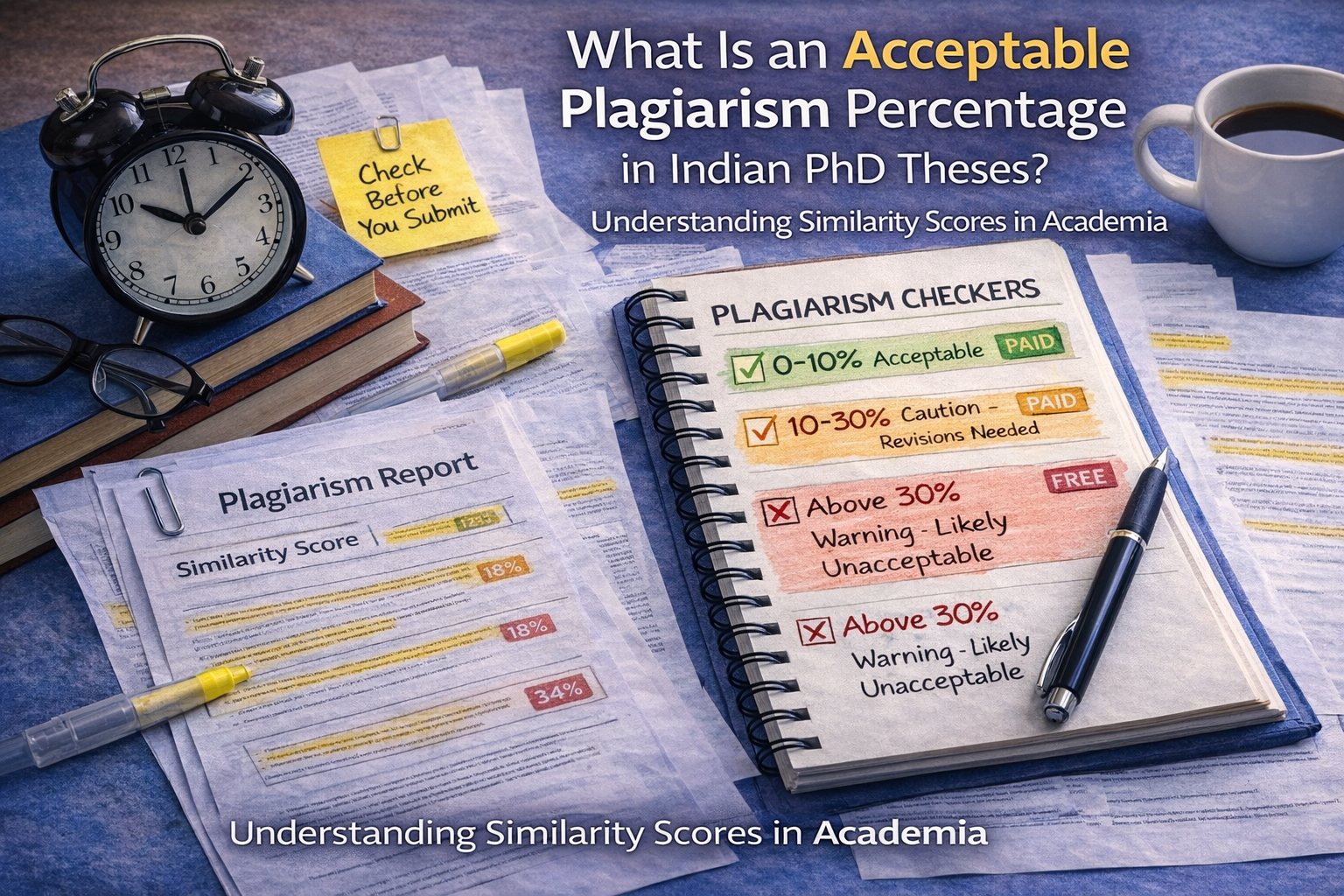
- Below 10–15%: Considered safe and acceptable for final submission, especially if most matches are from references or well-cited material.
- 15–30%: Often flagged for review. Scholars may be asked to revise specific sections or explain high matches in the discussion or results chapters.
- Above 30%: Usually considered problematic. Submission may be rejected or delayed. Scholars may be asked to revise thoroughly and submit a fresh report.
Many institutions now require a certified plagiarism report during pre-submission — and won’t accept a thesis until the similarity percentage is brought within the acceptable range.
However, the interpretation still varies. Some supervisors may allow higher percentages in the literature review. Others may object to even 12% if the matches appear in critical chapters. That’s why knowing your university’s expectations — and not just relying on the tool — is essential.
What Indian Scholars Often Misunderstand About Plagiarism Scores
A recurring issue in Indian academia is the overfocus on reducing the number, rather than improving the content. Scholars sometimes:
- Delete useful quotations or references just to lower the percentage
- Use AI-based paraphrasers to change words but not structure
- Submit to unknown online tools that store their thesis, causing false matches later
- Assume a “low” score means their work is original — without checking what matched
But plagiarism is not just about the number. It’s about whether the thesis shows independent thinking, proper source acknowledgment, and clear writing practices.
A 9% report could be worse than a 19% one if the 9% includes copied results or uncited discussion material. That’s why supervisors and reviewers read the report closely — not just for how much matched, but what matched.
How to Aim for an Acceptable Score — Without Misleading Tactics
If your university expects a plagiarism report, it’s best to work towards that benchmark honestly. For most Indian PhD students, especially those writing in English as a second language, this involves revising with both technical and ethical care.
Here’s what helps:
- Understand paraphrasing properly: Don’t just replace words. Change sentence structure and write in your own academic voice, while citing the source.
- Use citation tools: Zotero, Mendeley, and other free tools can help manage references correctly, reducing unintentional duplication.
- Focus on your original contribution: Keep background sections shorter and develop your analysis, findings, and interpretations in your own language.
- Run internal checks: Before submitting your final thesis to the university software, use a reliable external checker — but make sure it doesn’t save your document in its database.
And most importantly, if a consultant or editing service promises to reduce your similarity to “below 5% guaranteed,” be cautious. It’s not the number but the placement, accuracy, and citation that matter.
Conclusion
Understanding what plagiarism percentage is acceptable in Indian PhD submissions is more than a technical detail — it’s a reflection of how seriously a scholar takes their research ethics. While most universities allow up to 10–15%, what truly counts is whether your thesis expresses your own work, thinking, and voice.
A similarity score can be helpful. But it’s just a tool — not a certificate of originality. Indian PhD scholars, especially in private universities where systems may be less standardised, benefit most when they treat plagiarism reports as part of academic accountability, not as a hurdle to jump over.
In the end, a clean report means not just fewer matches — but deeper honesty in how the research was built. That’s what academic integrity looks like, and that’s what earns genuine respect at the viva table.