
Introduction
Plagiarism is one of the most common reasons for delay or rejection during PhD thesis submission in Indian universities. With software like Turnitin and Urkund now being widely adopted, even unintentional overlaps in language, definitions, or citations can be flagged — causing stress, confusion, and repeated revisions. For many Indian scholars, especially those from non-English backgrounds or interdisciplinary fields, writing a clear, well-cited thesis becomes a daily struggle.
This is where thesis editors often come in — not to write the work, but to review, refine, and support the scholar in meeting academic expectations. Yet the role of editors is often misunderstood. Some students fear it’s unethical. Others expect them to “fix” the thesis entirely. The truth lies somewhere in between: when done right, ethical thesis editing can significantly reduce plagiarism while keeping the scholar’s work intact and respected.
Why Editing Support Is Needed in the Indian PhD Context
In Indian private universities and even some public institutions, PhD guides are often overloaded, and students come from diverse academic and linguistic backgrounds. A mid-career professional returning to research after a decade may feel lost in citation styles. A first-generation scholar may write in Indianised English that lacks formal academic tone. Even those who understand their topic well might unintentionally paraphrase poorly or forget to cite appropriately.
Editing support becomes a bridge here. But it’s not about rewriting. It’s about polishing language, correcting formatting, identifying accidental overlaps, and ensuring proper citation. A good editor does not replace your work — they help present it more clearly and ethically, so that what you’ve written is both academically strong and plagiarism-safe.
Indian scholars increasingly recognise this need, especially during the final submission stage. But the key is choosing the right kind of editor, and understanding what they should — and should not — do.
What Ethical Thesis Editors Actually Do
An ethical editor focuses on support, not substitution. Their work respects the student’s voice, intent, and ownership of the research. Here’s how they help reduce plagiarism without crossing lines:
1. Language Polishing Without Rewriting Core Ideas
Instead of changing arguments, editors correct grammar, syntax, sentence flow, and vocabulary to improve readability. For example, if a scholar writes, “This result suggest correlation but maybe not causation,” an editor might revise it to: “The result suggests a correlation, but not necessarily causation.” The idea remains the same, but the language is cleaner and more academic.
2. Citation Correction and Completion
One of the biggest sources of accidental plagiarism is poor or incomplete citation. Editors help spot where citations are missing, improperly formatted, or misaligned with the content. They don’t invent references — they prompt scholars to check their source and cite properly. This is especially important in Indian universities, where citation norms (APA, MLA, Chicago) are now closely monitored.
3. Flagging Problematic Sections Early
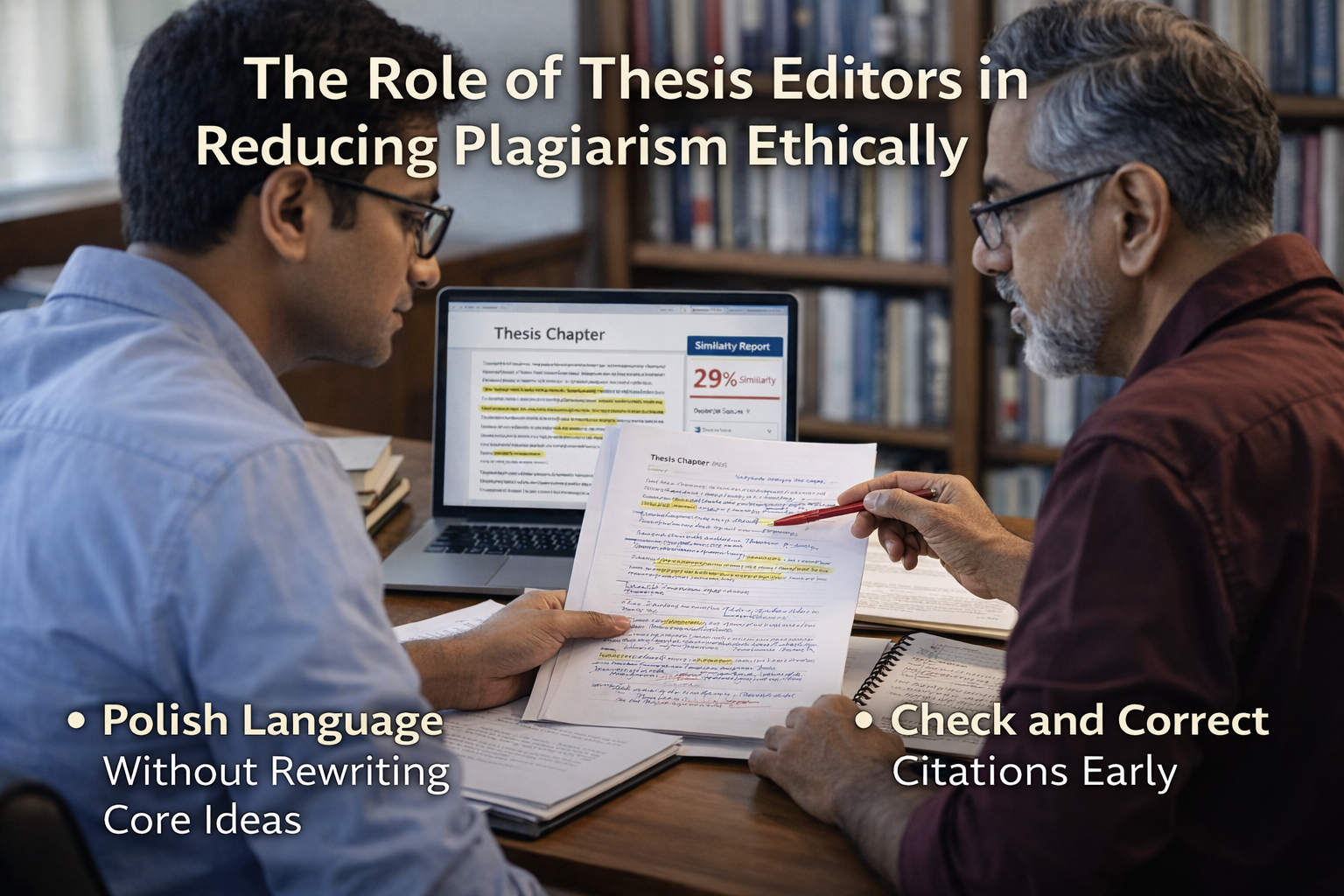
Before a thesis is submitted to Turnitin or Urkund, an experienced editor can highlight paragraphs that are likely to raise red flags. This gives the scholar time to rephrase or cite more clearly — preventing rejections at a much later stage.
4. Helping Scholars Understand Similarity Reports
Some editors offer support after similarity reports are generated. They help scholars interpret the results — identifying which overlaps are acceptable, which need rephrasing, and how to revise without overediting. This prevents scholars from panicking or making unnecessary changes.
5. Preserving Voice While Improving Structure
In interdisciplinary research — common in Indian private universities — scholars often struggle to maintain consistent tone or flow. Editors help structure chapters logically, improve transitions between sections, and ensure that your ideas are communicated clearly — without losing your unique perspective.
What Ethical Editors Never Do — And What You Should Avoid
With the rise of thesis services across India, not all editing is ethical. Some providers promise to “remove 100% plagiarism” or “re-write your entire thesis.” These are red flags. They may:
- Use AI paraphrasing tools that distort meaning
- Rewrite content without understanding the subject
- Fabricate or alter citations
- Remove important content just to reduce similarity
- Leave the scholar disconnected from their own thesis
A genuine editor will never:
- Write research content on your behalf
- Choose your arguments or conclusions
- Misrepresent your work as theirs
- Bypass your involvement in revisions
The right editor works with you — not for you. They respect the academic journey, and understand that every thesis is a personal intellectual contribution, not a product to be delivered.
If you’re seeking editing support, especially in the Indian PhD environment, look for someone who:
- Asks for your prior drafts and sources
- Communicates revision suggestions clearly
- Works chapter-wise or in phases
- Charges transparently, not per plagiarism percentage
- Encourages your participation in every change
Conclusion
Reducing plagiarism is not about shortcuts — it’s about clarity, honesty, and care. In India, where academic pressures are high and support is often limited, thesis editors play a valuable role. But their contribution should be grounded in ethics. A good editor doesn’t erase your mistakes quietly — they help you understand them, and correct them in your own voice.
For PhD scholars navigating tight deadlines, institutional norms, and the challenge of writing in formal academic English, this kind of editing support can make the journey less lonely — and more academically sound.
At the end of the day, it’s still your thesis. A good editor simply helps it speak more clearly — without compromising its meaning or your integrity.