
Introduction
Rewording — or paraphrasing — is one of the most difficult skills to master during a PhD. For many Indian scholars, especially those writing in English as a second language or pursuing research in social sciences and humanities, the challenge is not just about avoiding plagiarism. It’s about expressing academic ideas in their own words without losing the value and nuance of the original content.
When working on literature reviews, theoretical frameworks, or even methodology explanations, many researchers feel stuck. They understand the material, but rewriting it feels risky — what if the meaning changes? What if they oversimplify? What if it no longer sounds “academic” enough?
These are real and valid concerns. But the ability to reword content clearly and ethically is what allows a thesis to reflect the scholar’s true understanding. It’s not just about avoiding red flags in plagiarism reports — it’s about showing that you grasp the work deeply enough to explain it in your own voice.
Why Indian PhD Scholars Struggle with Rewording
In many Indian universities — especially private ones — PhD candidates come from diverse academic and professional backgrounds. Some are mid-career professionals with industry experience, while others come straight from coursework. A significant number are first-generation researchers. And for many, English is not the language they use at home or in day-to-day thinking.
This results in a common pattern: scholars understand research content but hesitate to paraphrase it. They fear that their rewritten version won’t sound as sophisticated as the original. In some cases, they even rely on online paraphrasing tools or AI rewriters — which often produce awkward, inaccurate, or flagged content.
But universities don’t expect scholars to copy published phrases. They want evidence that the student has read, reflected, and responded. That means expressing existing knowledge in a way that fits your research — not just repeating someone else’s.
Strategies to Reword Without Losing Meaning or Value
Ethical rewording doesn’t mean dumbing down ideas. It means restating them with clarity and personal understanding. Here’s how Indian PhD scholars can do this with confidence:
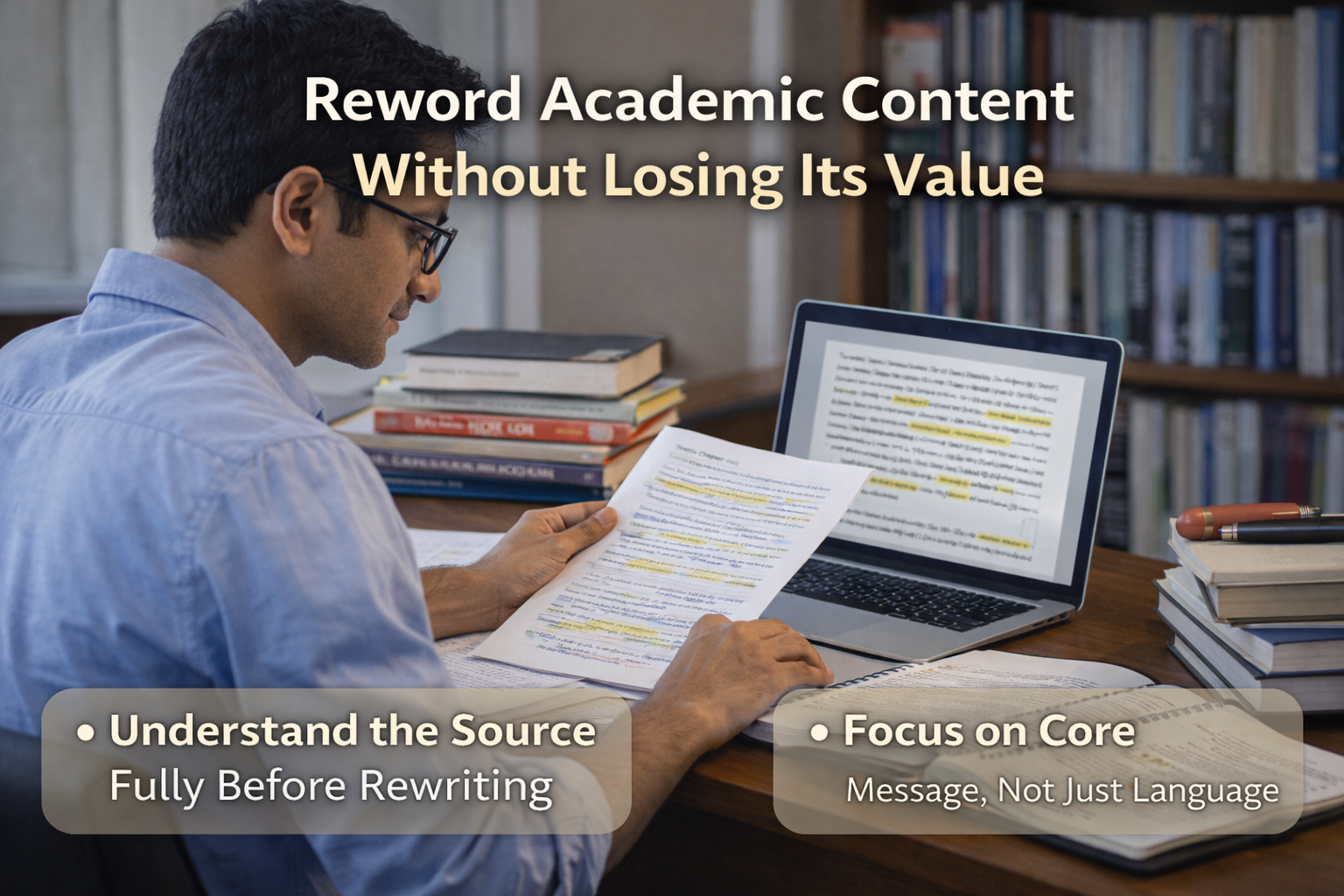
1. Understand the Source Fully Before Rewriting
One of the biggest mistakes is trying to rephrase sentence by sentence. This leads to superficial changes or broken logic. Instead, read the full paragraph or section. Close the book or browser. Then write a few lines in your own language — as if explaining it to a peer or junior scholar. Once you’re sure of your understanding, refine it to match academic tone.
2. Focus on the Core Message, Not the Language
Ask yourself: What is this author trying to say? What is the core finding, theory, or argument? Once you isolate that idea, you can build your own sentence around it — using your structure, vocabulary, and context. This helps you keep the value of the content intact while making the expression original.
3. Use Contextual Anchoring
In many cases, integrating the idea into your own research context helps with rewording. For instance, instead of saying:
“According to Hofstede’s cultural dimensions theory, India scores high on power distance,”
you might write:
“Hofstede’s framework suggests that hierarchical relationships are common in Indian organisational settings — an idea that aligns with the power distance score assigned to India.”
The second version reflects the same idea, but is clearly situated within your voice and context.
4. Be Comfortable With Simpler Language
There’s a myth in academia — especially in India — that complex vocabulary equals better scholarship. But clarity is always valued more than showy language. If you can say something simply and correctly, you should. Reviewers and viva panels appreciate scholars who prioritise understanding over imitation.
5. Cite Even When You Paraphrase
Rewording doesn’t mean removing credit. Whenever you summarise or paraphrase someone else’s work — even if it’s fully in your words — you must cite them. This keeps your thesis both ethical and academically strong.
6. Avoid AI Tools That “Spin” Content
Online rewording tools may promise quick results, but they often miss nuance. They might change words without understanding the sentence, leading to strange or incorrect phrasing. Worse, they may make your work sound like AI-generated content — a red flag during reviews and plagiarism checks. Instead, rely on your reading and reflection.
When Rewording Is Most Important in the Thesis
Rewriting skilfully becomes crucial in several chapters of the Indian PhD thesis:
- Literature Review: You must explain past research in your words, not just list it. This is where most similarity issues arise — and where careful rewording is most necessary.
- Theoretical Framework: You may be describing existing models or theories. Rather than copying textbook language, try connecting the theory to your study’s aims and location.
- Methodology: Scholars often borrow phrasing from earlier theses. But your research design, sample justification, and tool explanation should be described with your own clarity.
Even in your Conclusion or Discussion, using your language shows maturity — it indicates you’ve internalised the research journey and can speak about it independently.
Conclusion
Rewording academic content isn’t just a technical task. It’s a reflection of how well you’ve understood what you’ve read. For Indian PhD scholars — who often balance multiple languages, disciplines, and responsibilities — learning to express complex ideas in their own way is both a challenge and a strength.
If you’ve understood the value of an idea, you can always express it again — clearly, ethically, and in your voice. That’s what academic research is all about: not just repeating knowledge, but engaging with it, building on it, and adding your own layer of thought.
A thesis written with care, comprehension, and honest effort will always hold more value than one that simply mimics existing texts. In the end, it’s not about rewriting words — it’s about representing your mind.