
Introduction
In Indian academia, maintaining a low similarity score has become a crucial part of the research submission process. With plagiarism detection software now integrated into thesis and journal submission workflows, scholars are increasingly alert to how similarity scores can affect the acceptability of their work. But what many first-time researchers often overlook is that it’s not always intentional plagiarism that raises these scores—it’s common mistakes. Especially among PhD students who are either new to research writing or juggling jobs and family responsibilities, these errors are easy to make but difficult to undo later.
Understanding what contributes to high similarity can help researchers not only avoid academic penalties but also improve the originality and quality of their work. In this blog, we explore the most common mistakes that lead to elevated similarity scores in research papers, with a specific focus on Indian academic settings.
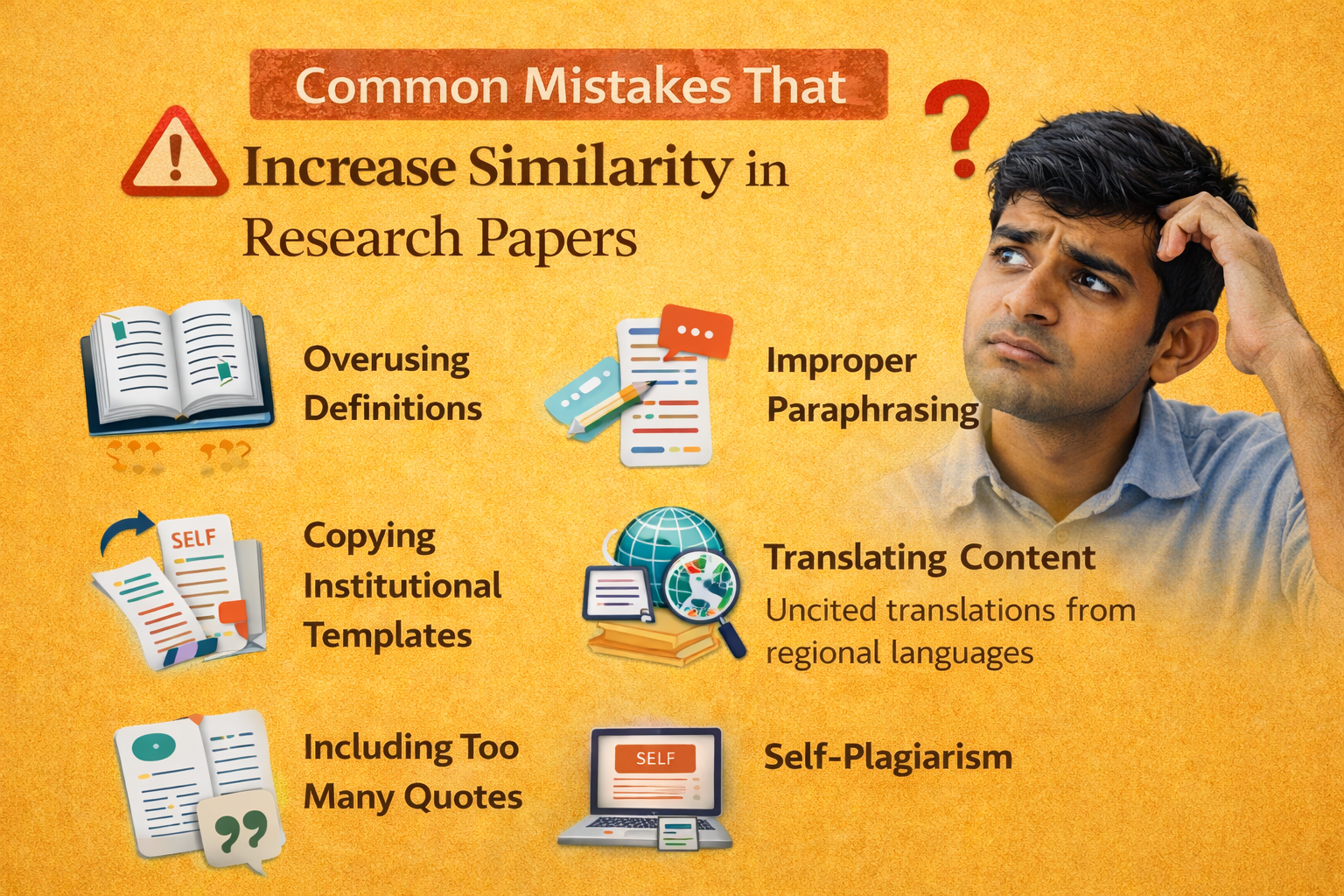
Overusing Definitions and Theoretical Explanations
While it is important to define concepts and refer to established theories, directly lifting definitions from textbooks or previous papers without paraphrasing or proper citation is a major similarity trap. This often happens in literature reviews or introductory chapters, especially in disciplines like education, psychology, or law. Even if properly cited, word-for-word reproduction still contributes to a high similarity score.
Improper Paraphrasing
Paraphrasing is not about changing a few words here and there—it requires complete sentence restructuring while preserving the original meaning. Many scholars, especially those unfamiliar with academic writing conventions, tend to do partial paraphrasing, which plagiarism software easily detects. Worse still, using synonyms without understanding the context can lead to both similarity and loss of clarity.
Copying Institutional Formats and Templates
Indian universities often share previous theses or departmental templates with new scholars for guidance. While using these for formatting is acceptable, copying content like aims, objectives, or even acknowledgment sections verbatim from someone else’s work can increase similarity. Templates must be used only for structure, not content.
Including Too Many Direct Quotes
While quoting authors is academically acceptable, over-reliance on quotations, especially without critical analysis, inflates the similarity percentage. This is common in subjects like literature and political science, where students feel compelled to include many quotes to sound scholarly. However, too many quotes with little original commentary can make a paper look derivative.
Failing to Cite Common Knowledge Correctly
Not everything that appears obvious is “common knowledge.” For instance, saying “India became independent in 1947” doesn’t need a citation. But referencing specific economic data or policy initiatives does. Many researchers wrongly assume that if something is widely known, it doesn’t need attribution, leading to citation gaps and unintentional similarity.
Translating Content from Regional Languages
A growing number of Indian researchers are working in multilingual environments. Translating ideas or phrases from Hindi, Telugu, or Bengali sources into English—without citing the original—is a hidden form of content reuse. Plagiarism detection tools may still flag these if the translated content closely resembles existing English materials online.
Reusing One’s Own Work Without Disclosure
Self-plagiarism is another issue. Using previously published work, or even a conference paper you’ve written, without citing yourself, is considered a form of duplication. Many Indian researchers are unaware that their own earlier work can raise similarity scores if reused in a thesis or another journal article without disclosure.
Submitting Without Pre-Check or Feedback
Many private universities and institutions offer one-time access to tools like Turnitin. Submitting your research without first doing a pre-check or asking your guide for feedback increases the risk of rejection. This is especially risky when students are unaware of institutional rules regarding acceptable similarity percentages.
Using Online Paraphrasing Tools Blindly
There’s a growing trend of using online paraphrasing tools or AI rewriters. While these can help reduce similarity on the surface, they often result in awkward, grammatically incorrect sentences that software still flags as close matches. Indian scholars, especially those short on time, often fall into this trap.
Conclusion
Avoiding a high similarity score is not just a technical requirement; it’s part of ethical research conduct. In Indian academia, where thesis writing is already a complex process involving multiple layers of evaluation, avoiding common mistakes can save both time and credibility. By understanding how these errors occur—and taking simple steps to prevent them—researchers can focus on creating meaningful, original work that reflects their academic contribution honestly. The goal is not to beat the software, but to write with integrity and clarity from the start.