
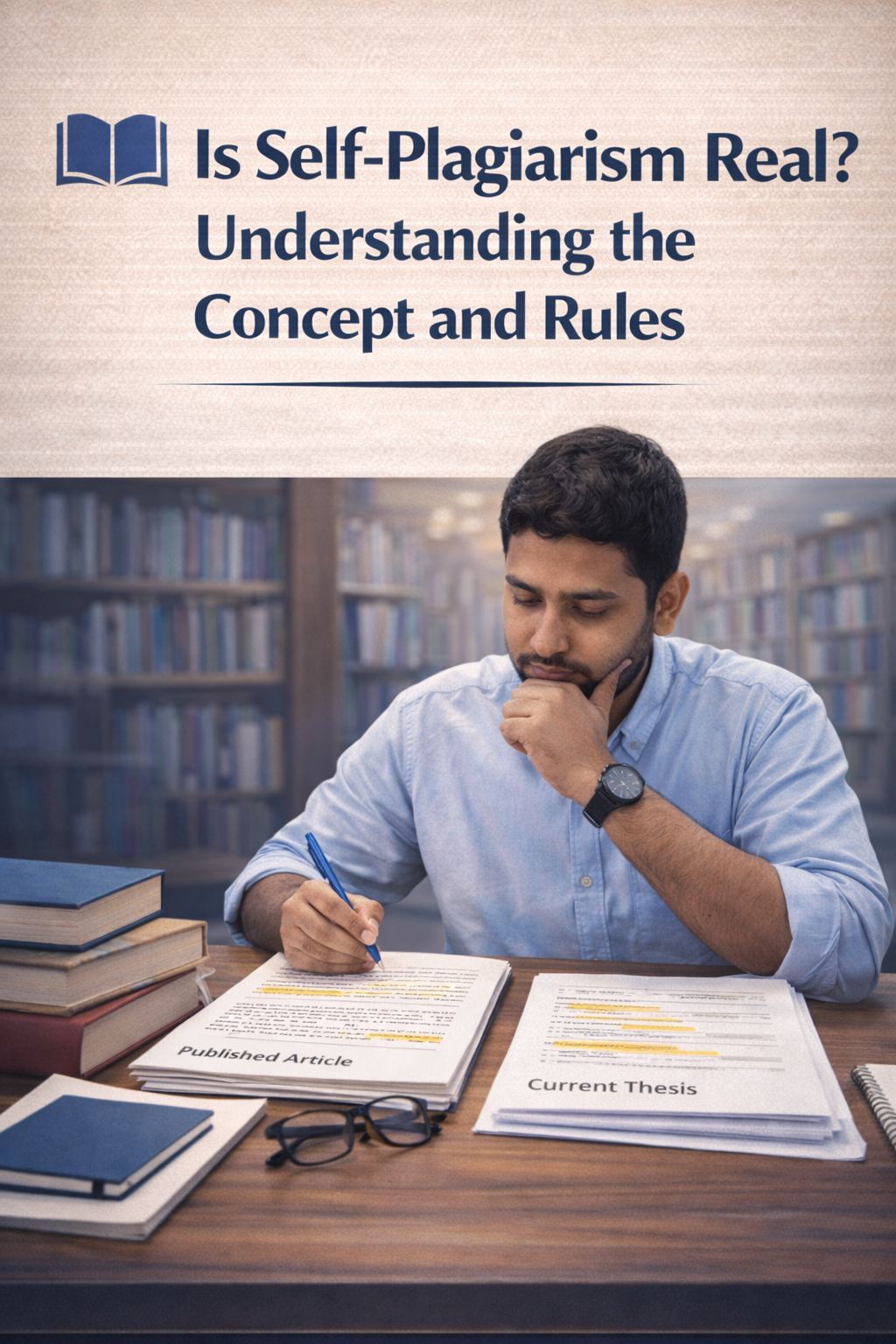
For many PhD scholars in India, especially those balancing research with jobs or family commitments, writing efficiency becomes a practical necessity. Reusing parts of earlier assignments, published papers, or even proposal drafts can seem like a time-saving approach. But this often leads to a misunderstood and under-discussed issue in academic writing—self-plagiarism. Many students are surprised to learn that one can plagiarise their own work. This blog explores what self-plagiarism actually means, how it is treated in Indian universities, and why it matters in the broader academic landscape.
What Is Self-Plagiarism and Why Does It Matter?
Self-plagiarism occurs when an individual reuses their previously written content without proper acknowledgment. This includes copying sections of your own published article into your thesis without citation, submitting the same paper to multiple journals, or repurposing material from past coursework into a new assignment. While it may not seem unethical at first—after all, the content is your own—the academic community views it differently.
The core idea behind this rule is that academic work must be original and specific to the context in which it is submitted. Each thesis, article, or chapter is expected to represent fresh intellectual effort. Reusing older material without disclosure can mislead the reader into believing that the content was produced uniquely for that purpose. This violates the principle of academic honesty and transparency, even if there is no intention to deceive.
In Indian private universities, where PhD scholars are often encouraged to publish early and regularly, this issue becomes more complex. A scholar may publish a part of their literature review or methodology before their thesis is completed. Later, when incorporating this work into the thesis, failing to cite the original article—even if authored by the same person—can trigger accusations of self-plagiarism. Some institutions allow a limited amount of such reuse with proper permissions and cross-references, but others treat it with the same seriousness as conventional plagiarism.
How Indian Universities Handle Self-Plagiarism
Although the UGC’s 2018 regulations primarily focus on plagiarism from external sources, most institutions—especially private universities with international partnerships—have started applying the same standards to self-plagiarism. Turnitin and other plagiarism detection tools do not differentiate between plagiarised and self-plagiarised content. As a result, content from your past submissions, if not cited, will appear in the similarity report.
Some universities now require scholars to submit a list of their published work alongside their thesis, clearly mentioning which sections have been previously published and where. Supervisors are expected to review this list and help scholars cite themselves correctly. However, this process isn’t always clearly explained to students, and many first-time researchers only become aware of it at the final stage of submission.
There is also confusion around whether certain sections—like definitions, theoretical frameworks, or standard explanations—can be reused without citation. While limited overlap is usually accepted for such cases, the guiding principle remains: if the text is taken verbatim, it should be cited, regardless of who wrote it. In institutions where doctoral admission in India is becoming more competitive, maintaining high standards of originality helps reinforce the credibility of the university’s research output.
For working professionals pursuing a PhD part-time, the situation can be particularly tricky. They may have written company reports, white papers, or internal documents and wish to use those as part of their research. Even if unpublished, this material must be referenced and contextualised properly. Just because the material was created by the scholar doesn’t make it automatically exempt from academic norms.
Responsible Reuse and Ethical Writing
Self-plagiarism can be avoided through conscious writing practices and institutional support. One key strategy is citation—even of your own work. When including sections from a published paper or a seminar presentation, mention the original source with appropriate referencing. Most universities permit this if the reuse is limited, justified, and clearly acknowledged.
Institutions can also help by offering clear guidelines on what counts as acceptable reuse. This includes providing templates for self-citation, offering examples of permissible overlap, and training supervisors to check for ethical consistency—not just formatting errors. These steps are especially important in private universities, where faculty-student ratios are often high, and scholars may not receive individualised attention unless they ask for it.
Ethical writing is not just about avoiding penalties. It helps scholars build a reliable academic identity. When you cite your earlier work, you are showing how your thinking has evolved, how ideas connect, and how your research contributes to the larger discourse. It also protects you from accidental duplication, which is becoming easier to detect as plagiarism software archives more content year after year.
As research expectations increase in India, and as more PhD students seek recognition through publications, understanding self-plagiarism becomes part of professional academic growth. It’s not a rule to be afraid of—it’s a principle that helps structure your work honestly and confidently.
Conclusion
Yes, self-plagiarism is real—and it matters. For Indian PhD scholars, particularly those in private universities or mid-career roles, it is essential to understand that originality includes proper acknowledgment of one’s own prior work. Ethical research is not just about avoiding copying others—it’s about maintaining clarity, context, and transparency, even when reusing your own content. By being mindful of how and when to cite yourself, you strengthen both your thesis and your academic reputation. In a research environment that values credibility as much as creativity, responsible writing is the path forward.