
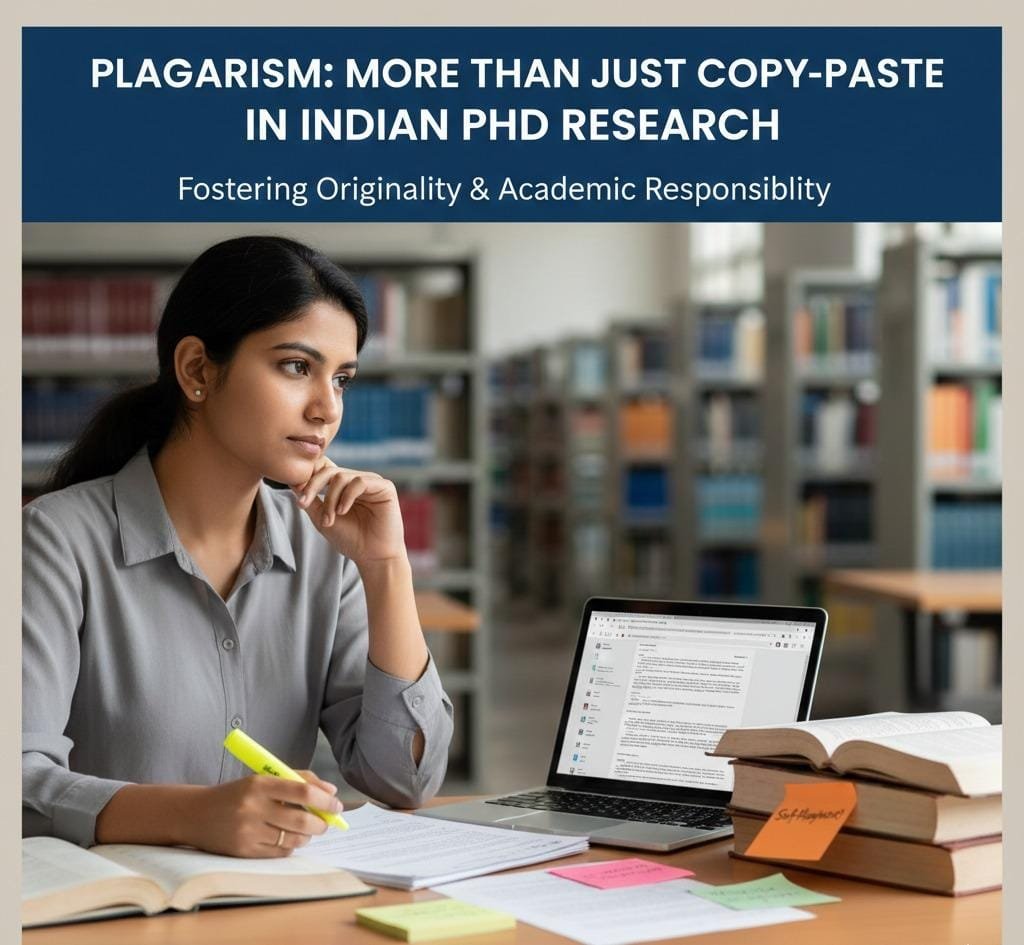
For many Indian PhD scholars, especially those entering research after years of coursework-focused education, plagiarism is often reduced to one idea: copying and pasting content from the internet without permission. This narrow understanding, while not entirely incorrect, fails to capture the full academic meaning of the term. In today’s research environment—where originality, citation practices, and intellectual transparency are crucial—plagiarism is more than just using someone else’s words. It involves a broader responsibility toward how knowledge is used, acknowledged, and represented. Recognising this complexity is essential for scholars working in Indian private universities, where pressure to publish and complete research within strict timelines can sometimes overshadow ethical clarity.
The Many Forms of Academic Misuse
Plagiarism exists on a spectrum. At one end lies direct copying—lifting text word-for-word without citation. But at the other end are subtler forms: paraphrasing without credit, reusing one’s own previously published content (self-plagiarism), submitting the same material to multiple courses or journals, and failing to properly cite sources consulted during the research process. These are not simply technical oversights—they raise serious ethical concerns within the academic community.
For instance, consider a PhD scholar writing a literature review. If they collect summaries of previous studies but paraphrase too closely or forget to cite properly, the originality of their work becomes questionable—even if nothing was copied directly. Or, if a working professional pursues a PhD in a private university and uses material from an old project report, assuming that personal authorship removes the need for citation, they might unknowingly violate institutional rules on self-plagiarism. These scenarios are not uncommon in Indian research settings, where guidance on academic writing is often limited or informal.
Plagiarism detection software like Turnitin may flag direct overlaps, but it cannot assess context or intent. That responsibility falls on the scholar—and increasingly, institutions are holding students accountable not just for the final text, but for the ethics behind it. When research is viewed as a process of building on others’ work while adding original insight, any misstep in attribution becomes more than a formatting error—it becomes a question of academic trust.
Academic Integrity in the Indian Research Landscape
In India, especially in private universities that are building their research reputation, plagiarism policies have grown stricter. Institutions aligned with UGC guidelines now require similarity reports for thesis submissions and often enforce penalties if plagiarism crosses certain thresholds. But simply managing similarity percentages isn’t enough. Students must understand that writing ethically involves more than avoiding detection—it means knowing what kind of writing practices count as acceptable in the first place.
Unfortunately, many scholars are introduced to these norms only late in their research journey. In earlier education, Indian students are rarely taught how to summarise, paraphrase, or cite in formal academic style. As a result, by the time they begin writing their thesis or first research paper, many rely on models they find online or from past students. These may not always follow ethical writing practices, and without proper guidance, students unintentionally repeat the same mistakes.
Moreover, in disciplines like management, computer science, or pharmacy—popular choices among private university scholars—the pressure to produce results or publish quickly may lead to over-reliance on sample reports or existing templates. This creates an environment where academic shortcuts become normalised, even though they carry long-term risks. Universities must therefore ensure that their policies on plagiarism are matched by support structures—writing workshops, accessible citation guides, and feedback-based mentorship.
Building a Broader Understanding of Originality
Understanding plagiarism as more than just copy-paste allows students to engage more deeply with their work. It encourages them to read critically, interpret findings thoughtfully, and contribute to conversations in their field rather than just repeat what others have said. For Indian PhD scholars, particularly in private universities, this mindset is essential. A thesis is not merely a checklist of chapters—it is a demonstration of one’s ability to think independently while respecting the work that came before.
Developing this habit requires small but consistent steps: taking proper notes with citations, learning referencing styles early, avoiding excessive dependence on sample material, and seeking feedback on drafts. Supervisors, too, have a role in broadening this understanding. Discussing plagiarism not only as a compliance issue but as a question of intellectual honesty can change how students approach their writing.
It is also important to view writing as part of the research journey, not just a final hurdle. Many instances of unethical writing happen when students are rushed, anxious about deadlines, or unsure how to express complex ideas. Recognising that academic writing improves through revision and reflection can ease this pressure and reduce the temptation to take shortcuts. And most importantly, acknowledging sources is not a sign of weak thinking—it shows the depth of your engagement with the field.
Conclusion
Plagiarism is not just a matter of copying and pasting—it is a broader issue of academic ethics, shaped by how we read, write, and share knowledge. For Indian PhD students, especially in private universities where research culture is still evolving, understanding this complexity is a key part of becoming a responsible scholar. When originality is understood not just as producing new ideas, but also as giving credit where it’s due, plagiarism becomes easier to avoid—not through fear, but through awareness. In a thesis, a journal article, or any piece of research, the integrity of your words reflects the integrity of your work.