
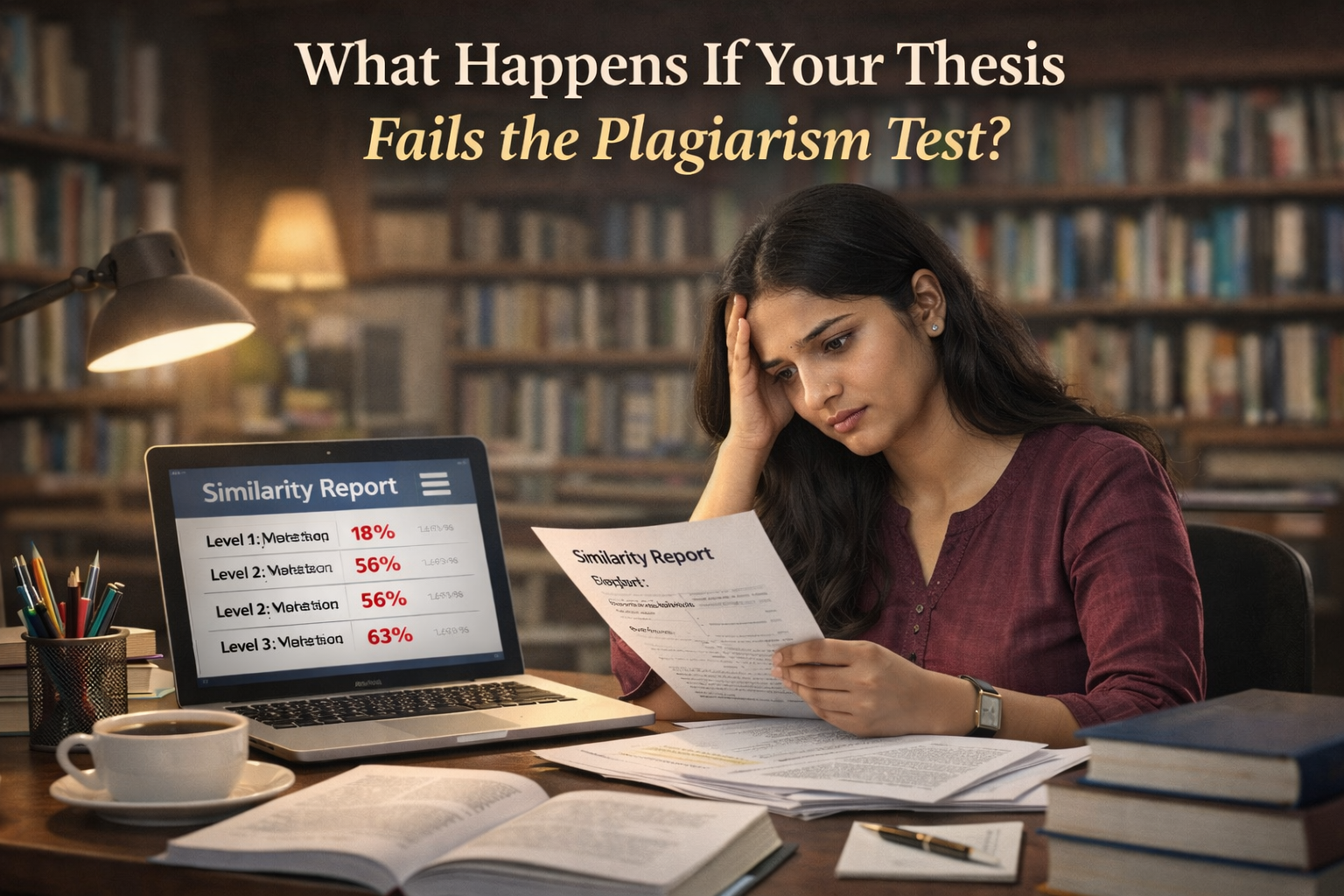
For every PhD scholar, submission day is filled with both relief and anxiety. Among the most dreaded outcomes is the possibility that your thesis might fail the plagiarism test. In India, particularly in private universities, plagiarism checks are a standard part of the submission process, often carried out using UGC-approved software like Turnitin or Urkund. But what exactly happens if your similarity report crosses the acceptable threshold? Is it the end of the road? This blog explains the realistic outcomes and what you can do if your thesis fails the plagiarism test.
Understanding UGC Guidelines on Plagiarism
In 2018, the University Grants Commission (UGC) of India issued clear regulations on academic plagiarism. According to these guidelines, similarity levels in a thesis are divided into four categories:
- Level 0 (Similarity up to 10%) – Acceptable; considered minor overlap.
- Level 1 (10–40%) – Revision required; resubmission allowed after correction.
- Level 2 (40–60%) – Major revision required; penalties may include suspension.
- Level 3 (Above 60%) – Serious offense; thesis is rejected, and disciplinary action may be taken.
Private universities are expected to follow these standards, though enforcement varies across institutions. The similarity percentage includes both copied and improperly paraphrased content—so even if you’ve rewritten something, it still needs proper citation.
Immediate Consequences of Failing the Test
If your thesis fails the plagiarism test, the consequences depend on how high your similarity percentage is and your university’s internal policies. Generally, the following may happen:
- You’ll receive a plagiarism report from your research supervisor or ethics committee.
- You’ll be asked to revise and resubmit your thesis within a defined period—anywhere from two weeks to three months.
- In cases of high similarity (over 60%), your thesis might be outright rejected, and you may face disciplinary proceedings or suspension.
- If the plagiarism is found to be intentional, some institutions may bar you from submitting again for a certain time.
Keep in mind that your university may also conduct an internal hearing to determine whether the plagiarism was accidental or deliberate.
Common Reasons for High Similarity
Many scholars are shocked when their thesis fails the test—not because they copied content, but due to technical or accidental plagiarism. Some common causes include:
- Improper paraphrasing without citation
- Reuse of your own previously published work (self-plagiarism)
- Use of common phrases from methodology or literature review sections
- Copying content from websites or research papers assuming “everyone does it”
In private universities, the rush to meet submission deadlines, combined with limited guidance on citation practices, often leads to these issues. That’s why understanding plagiarism beyond just using software is crucial.
What You Should Do Next
If your thesis fails the plagiarism test, don’t panic. Here’s what to do:
- Read the Similarity Report Carefully
Identify which sections are flagged. Are they direct quotes? Are they paraphrased but uncited? Or are they from your own earlier work? - Meet with Your Supervisor Immediately
Honest communication is critical. Share your side, seek clarity, and ask for specific guidance on rewriting or citing flagged parts. - Revise Strategically, Not Hastily
Avoid the temptation to just “rewrite for the software.” Instead, focus on correctly citing sources, quoting appropriately, and improving clarity. - Use Citation Tools Wisely
Referencing tools like Zotero, Mendeley, or EndNote can help format citations properly and track your sources. - Ask for a Pre-Submission Check
Some universities allow you to run a pre-check using plagiarism software. Use it to catch issues before the final submission.
Institutional Support and Scholar’s Responsibility
Many private universities in India are now offering academic writing workshops, plagiarism awareness programs, and library support services. However, the ultimate responsibility lies with the scholar. You are expected to uphold academic integrity—regardless of the pressure, workload, or lack of training.
Unfortunately, many institutions still treat plagiarism as a technical issue, ignoring the ethical dimension. A thesis that passes the software check but is poorly paraphrased without understanding or originality still weakens your academic credibility.
Conclusion
Failing a plagiarism test is not the end of your PhD journey—but it is a wake-up call. It reminds you that thesis writing is not just about completing a formal requirement, but about contributing original, ethical scholarship. If your thesis is flagged, don’t just “beat the software”—go deeper. Revise with honesty, cite with care, and submit a document that reflects your true effort. After all, a thesis should not only pass a test—it should earn your name in the academic world with dignity and trust.