
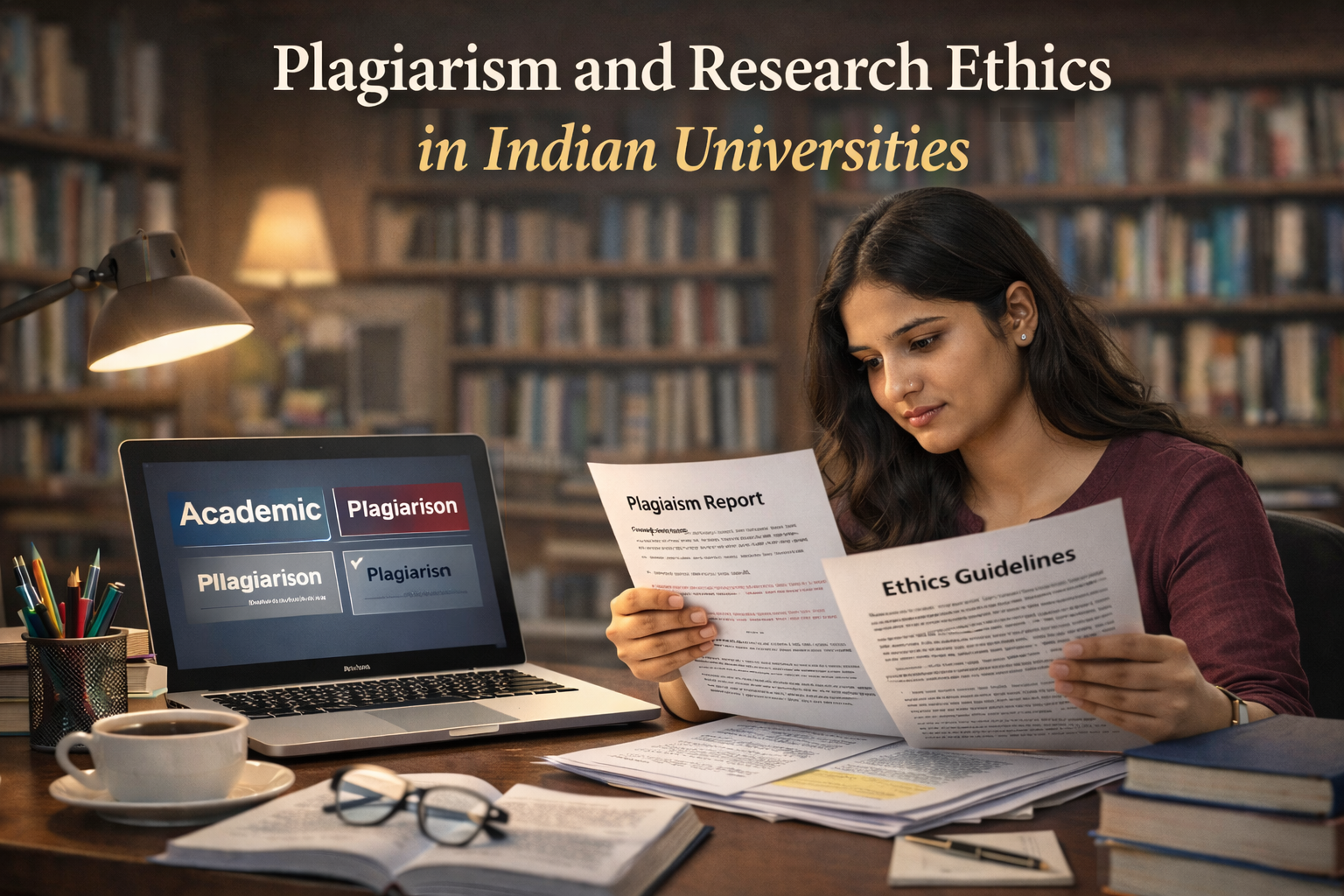
In Indian higher education, especially within the framework of PhD programs in private universities, the question of research ethics is often overshadowed by the more immediate concern of plagiarism detection. While most scholars are aware that copying text without credit can lead to disciplinary action, fewer understand that plagiarism is just one symptom of a deeper issue—the erosion of ethical thinking in academic research. This blog examines the intersection of plagiarism and research ethics in Indian universities, and why both must be addressed together for genuine scholarly progress.
Understanding Research Ethics Beyond Compliance
Research ethics is more than just avoiding plagiarism—it involves principles like honesty, transparency, accountability, and respect for intellectual property. It governs how data is collected, how sources are acknowledged, and how findings are presented. Yet, in many Indian PhD programs, especially those in private universities, research ethics is rarely taught with depth. Workshops may be held for the sake of compliance, but the moral reasoning behind ethical research often remains unexplored.
When ethics are seen as a box to tick rather than a guiding philosophy, plagiarism becomes more likely—not always out of malice, but due to ignorance or pressure to meet deadlines and expectations.
Plagiarism as an Ethical Breach, Not Just a Technical Fault
Plagiarism is usually framed in Indian academia as a problem of similarity percentage. If your Turnitin or Urkund report is below the threshold, you pass. If it’s above, you’re told to rewrite. But what often gets missed is that plagiarism is not only about detection—it’s about intent and understanding.
Copying someone’s words, paraphrasing without acknowledgment, or even reusing your own earlier work without citation (self-plagiarism) are all violations of research ethics. Even if software fails to detect them, they undermine the originality and trustworthiness of your thesis.
Moreover, ethical breaches in writing often reflect deeper issues in the research process—fabricated data, manipulated results, or careless referencing. All of these compromise the integrity of research and reduce the academic value of a PhD.
Why Indian Universities Struggle with Enforcing Research Ethics
Despite UGC’s 2018 guidelines on plagiarism and academic integrity, many universities, especially private institutions, face challenges in enforcing ethical standards. Some of the key reasons include:
- Lack of early training in ethical research practices, especially for students coming from coursework-heavy master’s programs.
- Pressure to publish quickly, driven by career demands, institutional ranking goals, and mandatory publication requirements.
- Faculty overload and lack of consistent mentorship, leaving PhD students to rely on shortcuts or outsourced thesis writing services.
- Cultural normalization of copying, where “borrowing” content is seen as harmless, especially if no one gets caught.
In this environment, the ethical dimensions of plagiarism are often lost, and the conversation is reduced to manipulating software checks rather than building responsible research habits.
Steps Toward a Culture of Ethical Scholarship
Solving the problem of plagiarism in Indian PhD programs requires more than just better detection tools—it demands a shift toward ethical awareness and scholarly responsibility. Here are some ways institutions and scholars can begin that shift:
- Incorporate Ethics Training in Research Methodology Courses
Every PhD student should undergo structured training in academic ethics—not just in citation styles, but in the values that underpin scholarly work. - Provide Mentorship on Writing and Referencing
Supervisors need to guide students not just on what to write, but how to write it ethically. This includes discussing issues like paraphrasing, quoting, and data transparency. - Create Safe Spaces to Acknowledge Mistakes
Students should be able to admit confusion or seek help without fear of judgment. Learning ethics is a process, not a one-time instruction. - Reward Original Thinking
Institutions should value quality over quantity, recognising work that reflects independent thought rather than formulaic or derivative writing. - Discourage Thesis Writing Services and Ghostwriting
Ethical breaches often begin when students outsource their work. Universities must take a strong stance against third-party writing services and promote academic ownership.
Conclusion
Plagiarism and research ethics are inseparable. Tackling one without the other is like treating a symptom without addressing the illness. For Indian universities—especially private ones striving to build academic credibility—the goal must be to foster a culture where originality is not just demanded but understood, practiced, and respected. A truly ethical scholar doesn’t write to beat a software check—they write to contribute honestly to the body of knowledge. In the long run, it’s this integrity that defines the worth of a PhD.