
Introduction
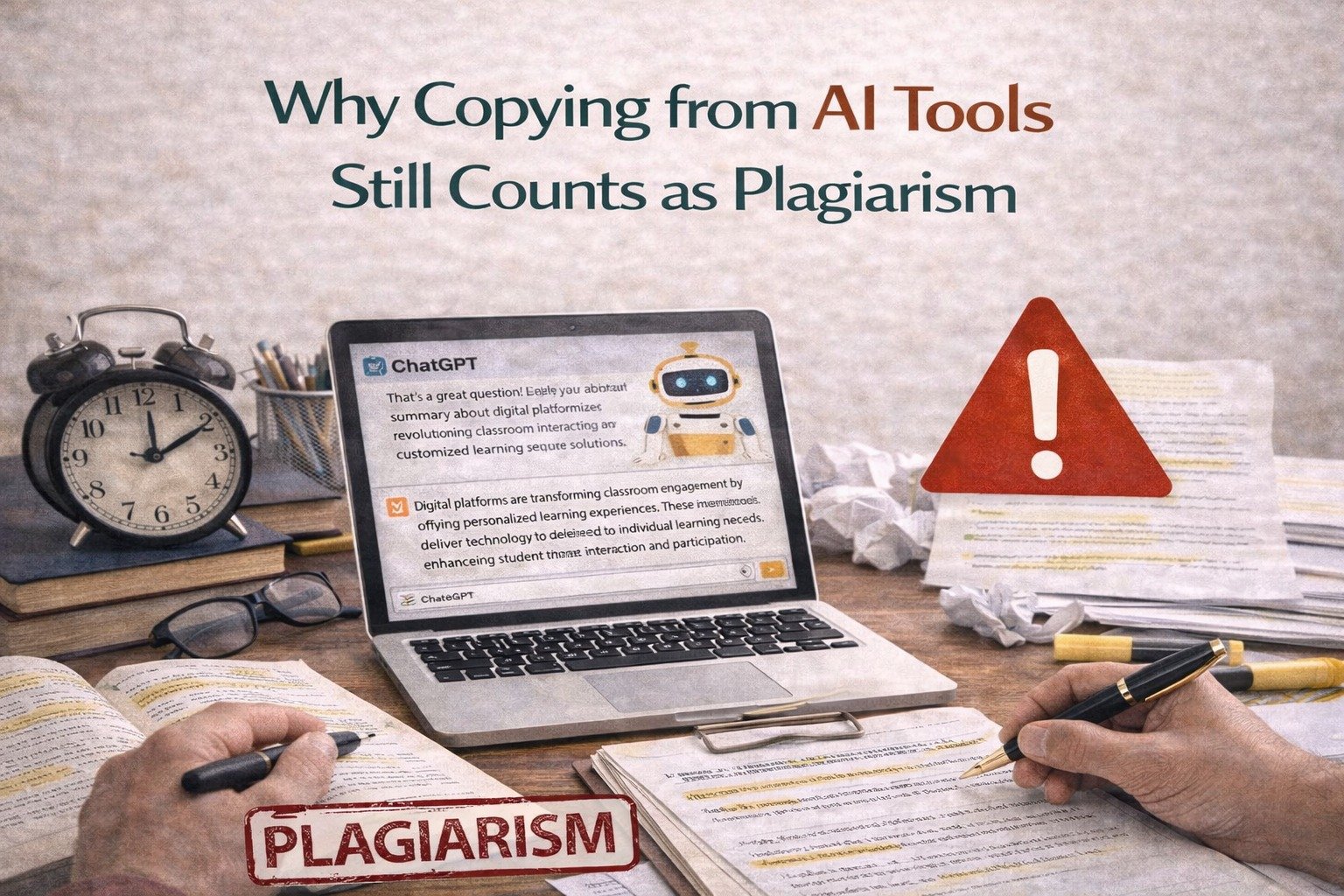
In recent years, AI writing tools have transformed the way students and researchers create content. From drafting essays to summarising articles, these tools promise quick, polished text with minimal effort. For a busy PhD scholar, especially in a private university where time pressure and administrative expectations are high, the temptation to copy directly from AI tools can be strong. However, this convenience hides a serious risk — using AI-generated text without proper acknowledgement is still plagiarism. Just because a machine produced the words does not mean they are automatically yours to claim. Understanding why AI copying falls under plagiarism is critical for protecting academic integrity.
AI-Generated Content Is Not Automatically “Original”
One common misconception is that AI-generated text is entirely new and therefore cannot be plagiarised. While AI tools do not directly copy and paste from a single source, they are trained on vast amounts of existing human-created content. The ideas, phrasing, and structures they produce can closely resemble existing works. If a scholar presents AI-generated text as their own without citation or modification, they are still misrepresenting the authorship, which is the core definition of plagiarism.
Ethical Responsibility in Research Writing
PhD research is not only about producing content — it is about developing original thought, analysis, and critical engagement with existing literature. Copying from AI bypasses the process of intellectual contribution. In Indian private universities, where the academic reputation of the institution depends heavily on the quality of student research, such shortcuts harm both the scholar and the university. A plagiarism-free thesis is not just a regulatory requirement but a matter of academic pride.
UGC Guidelines on Plagiarism and AI
Although UGC’s plagiarism regulations do not specifically mention AI tools yet, their definitions of plagiarism cover “unauthorised use of others’ work without proper attribution.” Since AI output is based on collective knowledge created by countless human authors, claiming it without disclosure fits within this definition. In the coming years, UGC is likely to include AI-specific clauses, but even in the absence of explicit rules, universities are already treating AI misuse as plagiarism.
The Problem of Overreliance on AI Tools
Many scholars use AI tools for language correction, grammar improvement, or summarisation, which can be legitimate if acknowledged. The problem arises when AI is used to write entire sections of a thesis, especially the literature review or discussion, without any personal input. This overreliance dilutes the originality of the work. Moreover, AI-generated references can be inaccurate or fabricated, putting the scholar’s credibility at further risk.
Best Practices for Using AI in Research Writing
Rather than banning AI entirely, scholars can use it as a support tool — much like a grammar checker or brainstorming aid — while maintaining full ownership of the academic content. This includes:
- Clearly citing AI assistance where relevant.
- Using AI outputs only as a starting point, then rewriting and integrating them with personal analysis.
- Verifying every fact, statistic, and reference produced by AI.
- Avoiding AI use in sections that require critical interpretation of research findings.
Why This Matters for Indian PhD Scholars
In private universities across India, plagiarism cases can result in thesis rejection, academic suspension, or reputational damage. The rise of AI has made plagiarism detection more challenging but also more necessary. Institutions are now investing in AI-detection tools alongside traditional plagiarism checkers. By adopting responsible AI use, scholars not only protect themselves from penalties but also strengthen their research credibility in an increasingly competitive academic environment.
Conclusion
Copying from AI tools may feel like a harmless shortcut, but in the academic world, it is a breach of trust. PhD scholars are expected to contribute to the knowledge economy through original thought, not just polished words. Whether writing in a public or private university, the principle remains the same — academic integrity is non-negotiable. AI can assist in the research journey, but the thinking, analysis, and authorship must come from the scholar. In the end, what matters most is not how quickly the work was written, but how authentically it represents the researcher’s own intellectual contribution.