
Introduction
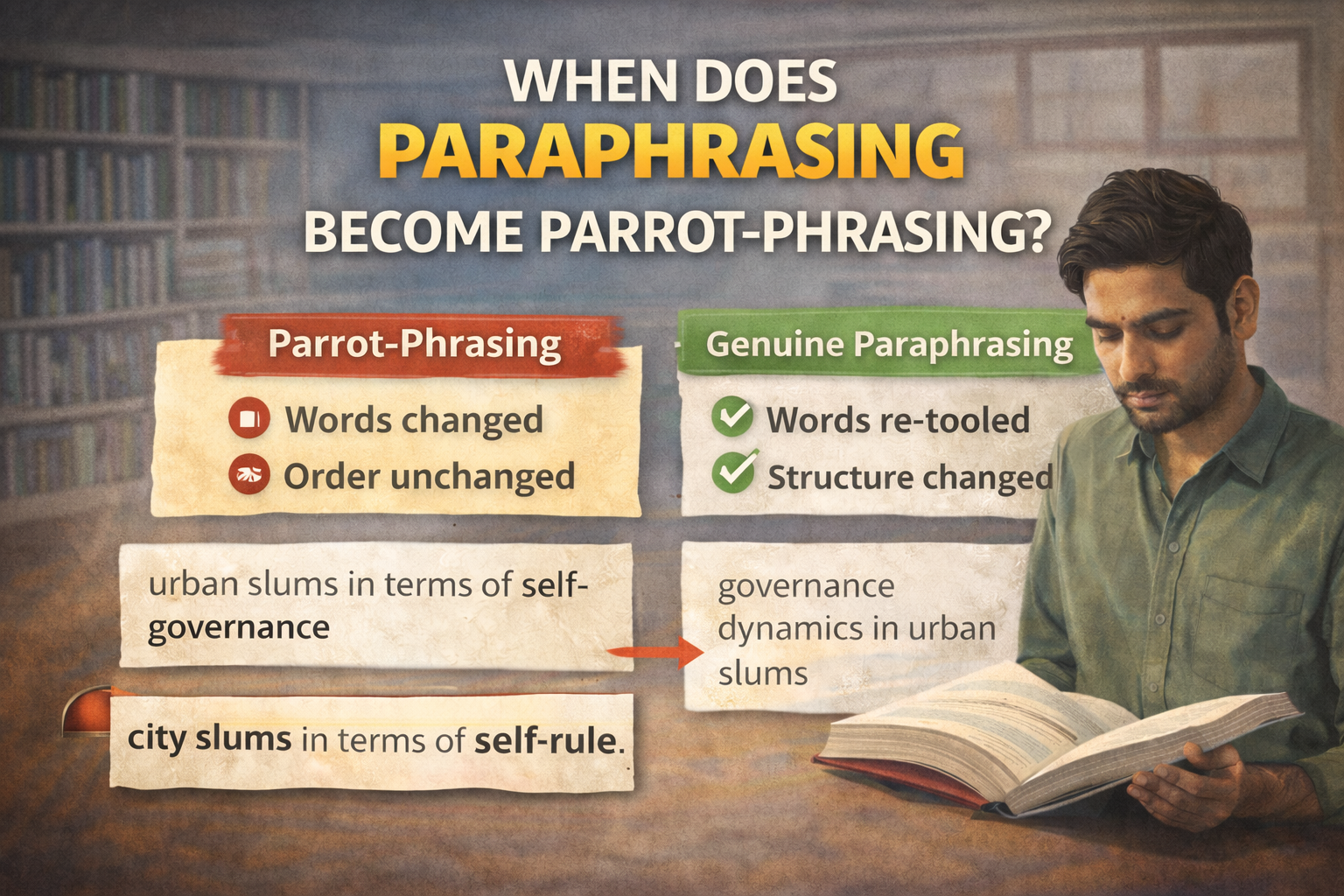
Paraphrasing is a key skill for any PhD scholar in India, especially with universities enforcing strict plagiarism checks before thesis submission. At its best, paraphrasing demonstrates that the researcher has understood the source material and can express it in their own words while preserving the original meaning. But there is a fine line between genuine paraphrasing and what could be called “parrot-phrasing” — a mechanical rewording of the text without adding independent thought or a fresh structure. In doctoral work, where originality is the foundation of academic credibility, crossing that line can weaken the quality of research even if the similarity percentage is low.
This distinction matters across both public and private universities, where doctoral admission in India now comes with clear expectations about originality. Supervisors are increasingly alert to the difference between authentic engagement with literature and superficial rewriting. Understanding when paraphrasing slips into parrot-phrasing helps scholars maintain academic integrity and produce work that reflects their own intellectual contribution.
Recognising the Signs of Parrot-Phrasing
Parrot-phrasing occurs when the original sentence structure remains intact, and only individual words are swapped for synonyms. The result is a piece of text that may bypass basic plagiarism detection but still mirrors the source too closely in flow and arrangement. For example, a candidate working on a business management thesis might take a paragraph from a journal article and replace “organisation” with “company” or “employee” with “staff,” without altering the overall sentence design. The meaning may remain, but so does the original blueprint, leaving little evidence of independent thinking.
This is particularly common when scholars depend heavily on paraphrasing tools rather than engaging deeply with the source material. Such tools often produce output that reads awkwardly and lacks the coherence that comes from true understanding. While it might reduce the similarity score in a plagiarism report, it does not meet the academic expectation of originality in research writing.
Paraphrasing as Interpretation, Not Substitution
Genuine paraphrasing begins with comprehension. It requires the scholar to fully understand the original text, reflect on its relevance to their research, and then restate it in a way that integrates their perspective. For instance, a student in environmental science may read about climate policy frameworks and then summarise the main points through the lens of their own study’s geographical context. This not only changes the wording but reshapes the structure and emphasis, making the writing uniquely their own while keeping the original meaning intact.
This process also allows for selective emphasis. By deciding which parts of the original idea are most relevant to their argument, scholars create content that is more targeted and analytical, avoiding the pitfall of reproducing the source material’s priorities without question.
Why Parrot-Phrasing Weakens a Thesis
A thesis built on parrot-phrasing may technically avoid plagiarism penalties, but it often lacks depth and originality. Examiners and supervisors can quickly identify sections where the candidate has simply reworded without rethinking. Such passages tend to read flat, offering little new insight or synthesis. In the Indian PhD context, where research is expected to contribute something original to the field, this approach risks undermining the candidate’s scholarly credibility.
Moreover, parrot-phrasing limits the ability to connect literature to one’s own research findings. Without restructuring the content and integrating personal analysis, the thesis becomes a patchwork of reworded statements rather than a cohesive argument. This is especially detrimental in interdisciplinary research, where the value lies in connecting diverse sources in new ways rather than repeating them in altered form.
Balancing Accuracy and Originality
There are cases where the meaning must be preserved exactly — such as when describing a standard research method or defining a well-accepted concept. In these situations, the originality lies not in changing the content but in placing it within a new narrative. A sociology student, for example, might describe a classic survey method exactly as it appears in the literature but follow it with commentary on how it applies to their specific research setting. This approach ensures academic accuracy while keeping the work grounded in the candidate’s unique perspective.
Developing Genuine Paraphrasing Skills
Moving from parrot-phrasing to genuine paraphrasing is a skill developed through consistent practice. It starts with breaking away from the sentence structure of the source and reorganising the information in a way that reflects personal understanding. Reading multiple sources on the same concept before writing also helps, as it encourages synthesis rather than reliance on one author’s wording. In Indian private universities, where PhD candidates often balance research with professional work, developing this skill can make the writing process more efficient and reduce last-minute similarity issues.
Using Feedback to Avoid Repetition
Supervisors play a crucial role in helping scholars identify unintentional parrot-phrasing. Early drafts that are reviewed for both content and originality can highlight where the text is too close to the source in structure. By actively seeking feedback and making iterative improvements, scholars can gradually align their work with the standards of genuine academic writing. Access to plagiarism reports during the drafting stage, now offered in many institutions, also serves as a useful tool for self-correction.
Conclusion
The difference between paraphrasing and parrot-phrasing lies in the depth of engagement with the source material. While both may preserve meaning, only genuine paraphrasing reflects the scholar’s intellectual processing of the idea. For a PhD thesis, this distinction is not just about meeting plagiarism thresholds but about demonstrating academic maturity. By approaching sources as a foundation for interpretation rather than a template for rewording, doctoral candidates in India can ensure their research is both original and faithful to its scholarly roots.