
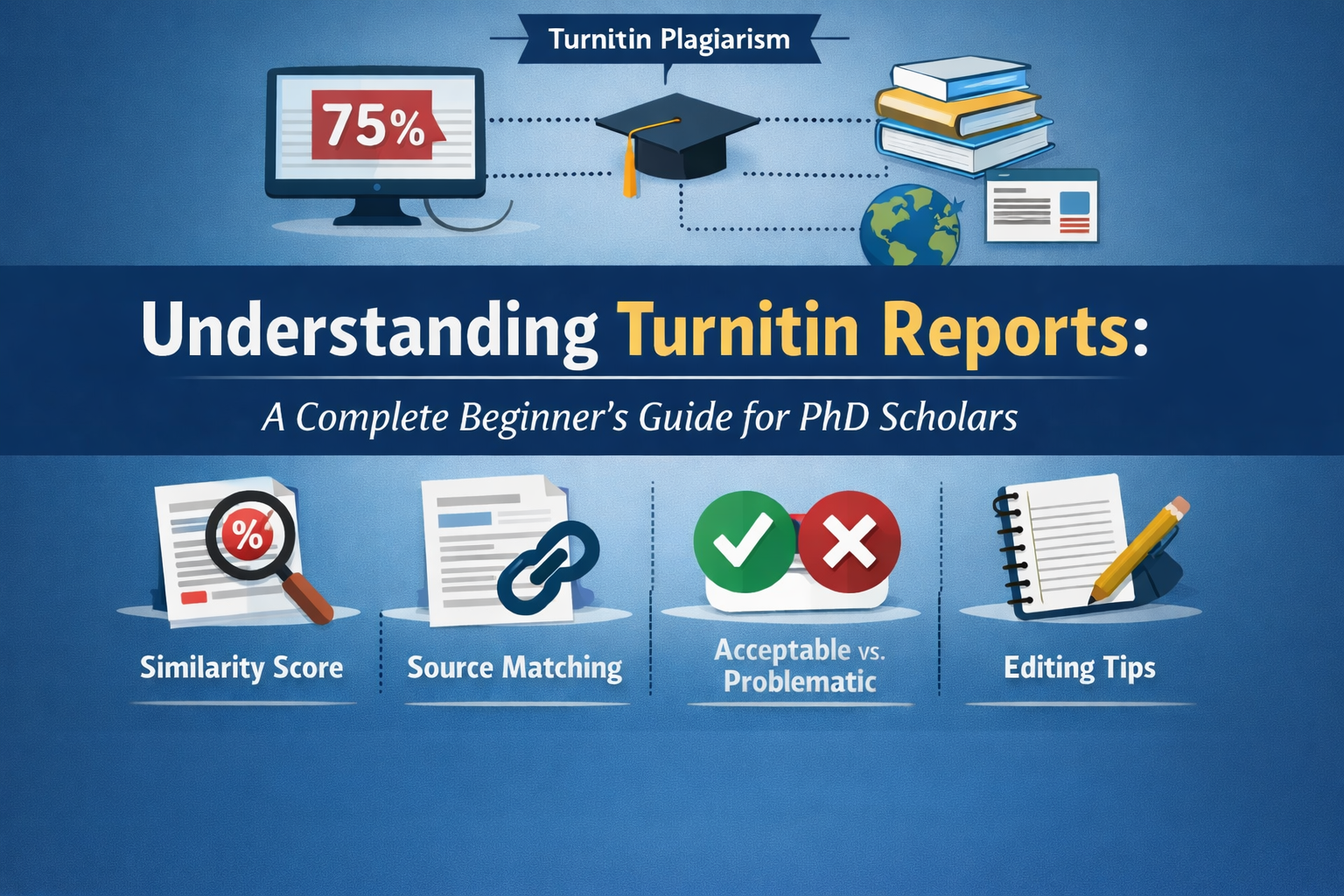
Introduction
For many PhD scholars in India—especially those enrolled in private universities—Turnitin has become the standard tool for checking plagiarism and maintaining academic integrity. While submitting a document to Turnitin is straightforward, interpreting the similarity report often feels confusing for beginners. A single percentage figure can be misleading if you don’t understand what lies behind it.
This guide explains how Turnitin reports work, what similarity percentages really mean, and how to improve your report without compromising your academic voice.
What Is a Turnitin Similarity Report?
When you upload a document to Turnitin, the software compares your text against a vast database that includes:
- Published journal articles and books
- Online sources such as websites and reports
- Previously submitted student papers stored in Turnitin’s repository
The result is a similarity report that highlights text matching these sources and provides links to where the matches were found.
Understanding the Similarity Percentage
One of the biggest misconceptions among research scholars is that a lower percentage automatically means a better report. In reality, the similarity score is only an indicator—not a final judgment.
For example:
- 15–20% similarity may be acceptable if it consists of properly cited quotations, references, and standard terminology.
- 5% similarity can still be problematic if it includes uncited ideas or copied sentences from a single source.
Universities usually focus less on the number itself and more on how and why the matches occur.
Colour Codes and Highlighted Matches Explained
Turnitin uses different colours to identify matches from different sources. Each colour corresponds to a specific source listed in the similarity panel.
By clicking on highlighted text, you can:
- View the original source
- Compare your wording with the source text
- Decide whether revision, quotation, or citation is required
This feature is especially useful for identifying repeated phrases, definitions, or technical terms that are common and often unavoidable in academic writing.
Acceptable vs. Problematic Matches
Not every highlighted section needs correction. Understanding the difference is crucial.
Acceptable Matches
- Properly quoted text with correct citations
- Common phrases or standard definitions in your discipline
- References, bibliography entries, and methodology descriptions
Problematic Matches
- Paraphrased content that closely follows the original sentence structure
- Unique ideas presented without citation
- Large blocks of copied text without quotation or attribution
Focusing on these problematic areas will help you make meaningful improvements.
How to Improve Your Turnitin Report Without Losing Originality
When revising your work, avoid the temptation to simply replace words with synonyms. This approach often leads to poor academic quality and may still trigger similarity flags.
Instead:
- Read and fully understand the source material
- Rewrite concepts in your own academic style
- Support rewritten sections with appropriate citations
- Maintain a consistent tone and flow throughout your thesis
This method not only reduces similarity but also strengthens your scholarly voice.
Why Turnitin Should Be Treated as a Learning Tool
Rather than viewing Turnitin as a hurdle, consider it a diagnostic tool. It helps you:
- Identify weak paraphrasing
- Improve citation practices
- Strengthen originality in your research writing
For Indian PhD scholars, particularly in private universities with strict UGC guidelines, learning to interpret Turnitin reports early can save significant time and stress during final submission.
Conclusion
Turnitin reports are more than just similarity percentages—they offer valuable insights into your writing practices. By understanding how to read the report carefully, you can make informed revisions that improve quality without over-editing.
For PhD scholars, mastering Turnitin interpretation ensures compliance with university regulations while preserving your academic integrity and original research voice. When used wisely, Turnitin becomes a powerful ally in your doctoral journey—not an obstacle.