
Introduction
For many PhD candidates in India, one of the trickiest parts of plagiarism removal is dealing with definitions and theoretical concepts. These are often taken directly from seminal works or standard textbooks, and changing them too much can risk distorting their meaning. Yet, leaving them exactly as they are can push similarity scores above the UGC plagiarism threshold. In private universities, where doctoral admission in India attracts candidates from diverse academic and professional backgrounds, the challenge is even greater—balancing originality with fidelity to the original source.
Definitions are more than just sentences; they often represent the distilled essence of an entire theory or framework. A small shift in wording can alter the scope or emphasis of the concept. This is why rephrasing them requires a nuanced approach that goes beyond simple synonym replacement. Scholars must capture the essence of the original while expressing it in language that reflects their own understanding and research context.
Why Definitions Require Extra Care
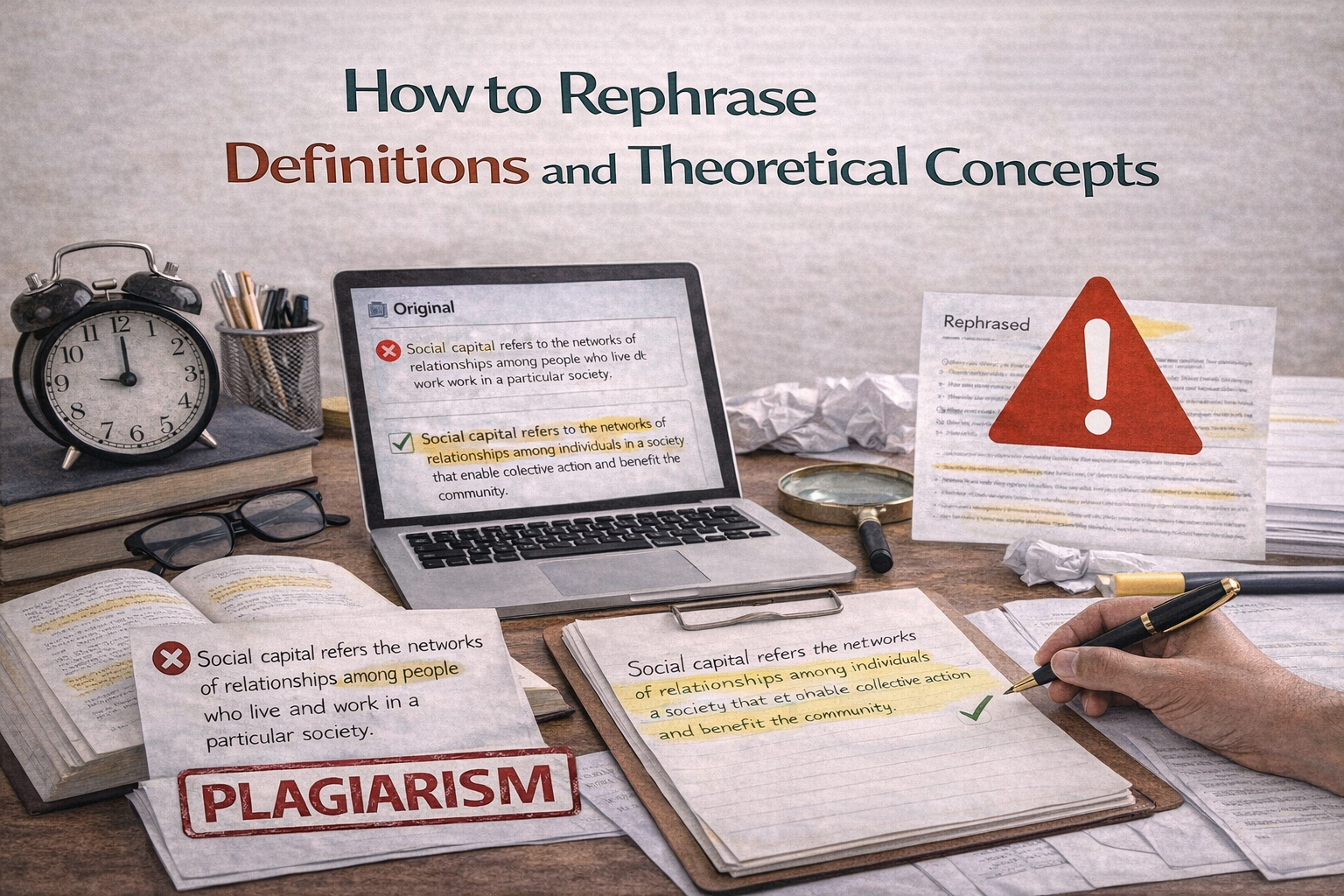
The difficulty with rephrasing definitions is that they are typically crafted with precision by experts in the field. For example, changing “Social capital refers to the networks of relationships among people who live and work in a particular society” to “Social capital means the connections between individuals in a community” might appear harmless but can inadvertently narrow or broaden the meaning.
In the Indian doctoral context, evaluators often look for a demonstration that the scholar understands the definition rather than merely reproducing it. For instance, a student in a private university researching management sciences might take a widely used definition of “transformational leadership” and adapt it by explaining how it applies to the Indian corporate environment. This method both reduces similarity and localises the concept for the research setting.
Techniques for Safe and Accurate Rephrasing
One reliable approach is interpretive paraphrasing—first, explain the concept in your own words as you would to someone outside your discipline, then refine it into academically appropriate language. This ensures the definition reflects your own cognitive processing rather than mechanical rewording.
Another effective technique is contextual framing, where the definition is embedded within a sentence that links it to your study. For example, instead of writing a stand-alone definition of “resilience,” you could write: “In the context of educational leadership, resilience can be understood as the capacity of school administrators to adapt constructively to ongoing challenges.” This way, the definition becomes part of your research narrative, lowering similarity while retaining accuracy.
Quoting directly is also valid in certain cases—especially for highly technical or universally accepted definitions—but it should be followed by a brief explanation in your own words. This dual method demonstrates comprehension and satisfies the expectation for originality in PhD-level work.
Avoiding Common Pitfalls
The most frequent mistake is over-simplification. In an effort to rephrase, students may strip away key qualifiers that are essential to the concept’s meaning. For instance, removing phrases like “mutually beneficial” or “systematically structured” can weaken the accuracy of definitions in sociology or organisational studies.
Another issue is excessive reliance on synonyms without restructuring. Plagiarism detection tools can still flag such changes if the sentence structure remains identical. Faculty in Indian private universities often remind scholars that originality is not about avoiding familiar words entirely but about presenting ideas in a form that reflects individual thinking.
Indian Academic and Cultural Considerations
In India, definitions and theoretical concepts are often given significant weight during viva examinations. Examiners expect candidates to be able to explain them confidently, often in relation to local contexts. This means that when rephrasing, it can be advantageous to weave in culturally relevant examples or applications. For example, a definition of “entrepreneurship” might incorporate references to micro-enterprise models common in rural India, adding both originality and relevance.
Private universities, with their flexible mentoring systems, allow faculty to spend more time guiding students through this process. This can be particularly helpful for mid-career professionals returning to academia, who may have practical knowledge of a concept but need support in expressing it academically and in an original form.
Conclusion
Rephrasing definitions and theoretical concepts in a PhD thesis is an exercise in precision and understanding. For Indian scholars working within UGC plagiarism guidelines, the key lies in demonstrating personal comprehension while respecting the integrity of the original meaning. When done with care, this process not only reduces similarity scores but also deepens the scholar’s engagement with the material, ensuring the concepts are fully integrated into their own research voice.