
Introduction
For many PhD scholars in India, the first draft of a thesis can return a higher-than-expected similarity score, even when there was no intention to copy. This often happens because the writing includes material from published sources without clear in-text citations. In private universities, where doctoral admission in India attracts both fresh postgraduates and working professionals, supervisors frequently highlight that correct and consistent citations are as important for plagiarism control as they are for academic credibility.
Using in-text citations does more than acknowledge the source—it signals to evaluators that the scholar is engaging with existing literature rather than claiming it as original thought. However, the benefit is only realised when citations are applied thoughtfully, linked with paraphrased content, and aligned with a recognised referencing style. This is where many researchers struggle, especially those returning to academia after years in industry or government service.
How Citations Influence Similarity Scores
Plagiarism detection tools compare thesis content with a large database of academic and non-academic texts. When they detect a match, the similarity report indicates the source. If the matching section is accompanied by an accurate in-text citation, evaluators usually treat it differently from uncited matches. In some cases, the matched text may still appear in the percentage calculation, but the presence of a citation shows academic honesty.
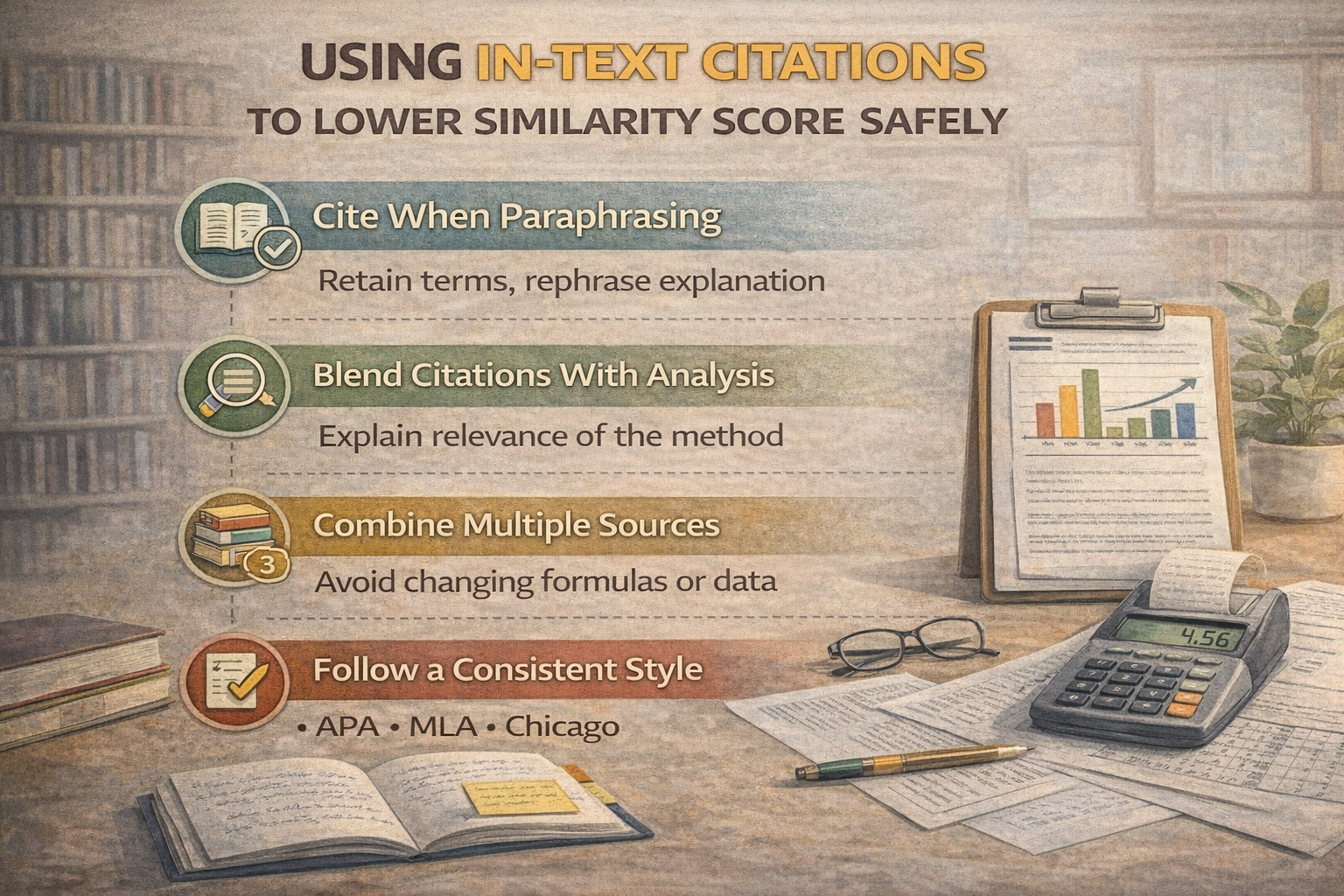
This is why relying solely on citations without rephrasing is risky. Directly quoting large portions of text, even with citations, may still produce a high similarity percentage. Instead, a balanced approach works best—summarising or paraphrasing the source material in the scholar’s own words, followed by a clear in-text citation. For example, rather than reproducing a full definition from a textbook, the researcher can express it in a way that fits their study and then credit the original author.
Practical Approaches for Safe Citation Use
One effective strategy is integrating the author’s name into the sentence. Instead of writing, “Leadership is the ability to influence others (Northouse, 2019),” a scholar could write, “Northouse (2019) explains leadership as the ability to influence others, particularly in settings where…” followed by their own context. This method blends citation with personal interpretation, lowering the match with the original source.
Another approach is to draw from multiple sources in the same section. When a concept has been discussed by several researchers, combining two or more citations shows that the scholar has reviewed the literature more broadly. For instance, “Both Northouse (2019) and Yukl (2013) describe leadership as involving influence, vision, and interpersonal skills,” offers a richer, more original framing than relying on one definition.
In Indian PhD work, especially in interdisciplinary research, concepts often have variations in meaning depending on the field. This makes it possible to use citations while also contextualising the concept for a specific discipline—something that naturally lowers similarity and increases relevance.
Avoiding Common Errors
A common mistake is using a citation as a shield for long, unchanged text. While it may look correct, evaluators and software can still identify the section as heavily borrowed. Overuse of direct quotes can create a similar problem. In most cases, it is better to quote selectively and keep the majority of the explanation in the scholar’s own language.
Inconsistent citation styles can also create confusion. Switching between APA, MLA, or Chicago formats within the same thesis suggests a lack of attention to detail. Private universities in India often have clear formatting guidelines, and following them closely can save time during the review process.
Over-citing is another pitfall. Some scholars add a citation after almost every sentence, which can disrupt the flow of reading. The more effective approach is to group related points from a source and cite them together, making it clear where the influence ends and the researcher’s own contribution begins.
Indian Academic Considerations
In India, giving credit to original authors is not just a procedural requirement—it aligns with the cultural value placed on acknowledging contributions. In viva examinations, examiners often ask candidates to explain cited ideas in their own words, testing both comprehension and authenticity. For mid-career professionals pursuing a PhD in a private university, correct citation habits can bridge the gap between workplace knowledge and academic expectations.
Workshops on citation styles, offered by many private institutions, are particularly useful for those unfamiliar with referencing norms. They not only reduce plagiarism risks but also strengthen the scholar’s ability to engage in academic discussion, both in writing and during oral defences.
Conclusion
Accurate and consistent in-text citations are a practical tool for keeping similarity scores within UGC’s acceptable range while maintaining the integrity of scholarly work. When paired with genuine paraphrasing and critical analysis, citations transform from a formality into a visible sign of academic engagement. For Indian PhD scholars, mastering this skill early can make the thesis process smoother, more credible, and ultimately more rewarding.