
Introduction
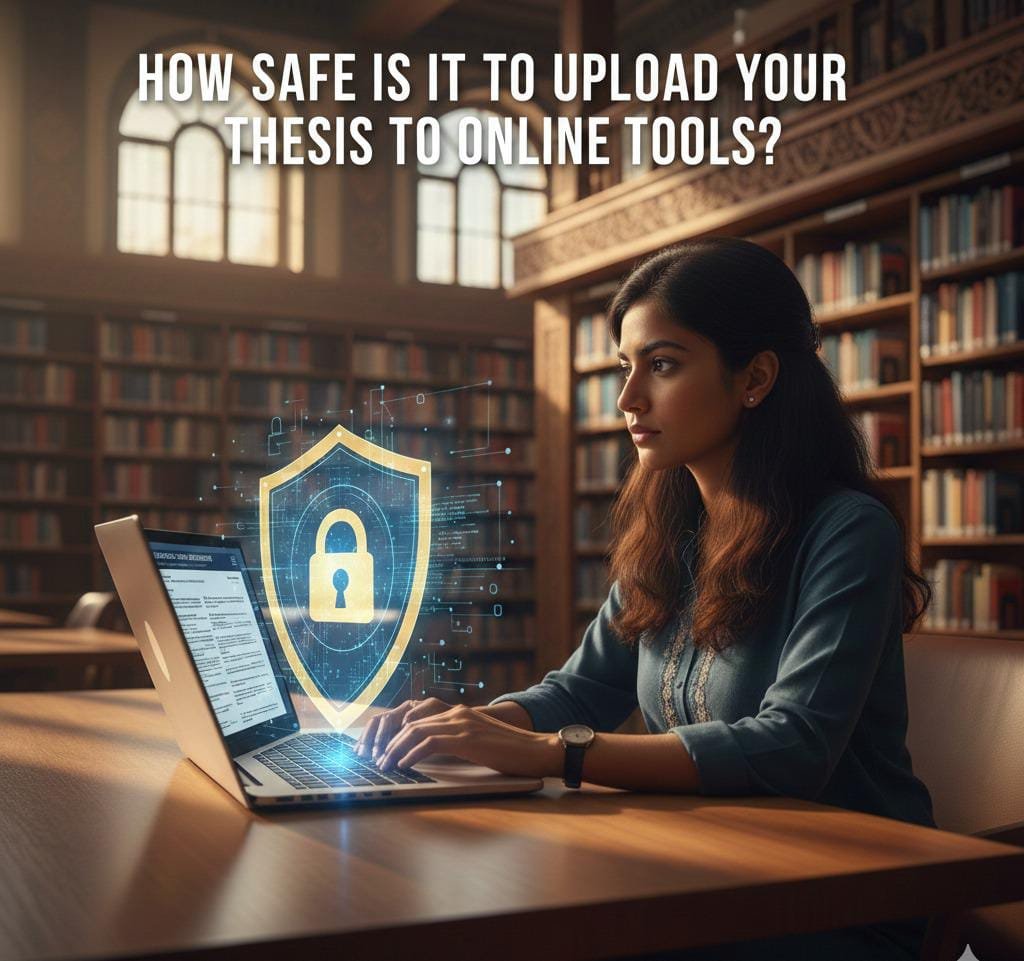
In the age of technology, checking your thesis for plagiarism has become as common as proofreading. Many Indian PhD scholars, especially in private universities, rely on online tools to ensure their work is original before submission. However, a question often lingers—how safe is it to upload your thesis to these platforms? While plagiarism checkers can be a useful safeguard, they can also pose risks if you do not understand how they work and what they do with your content. For a scholar who has spent years crafting research, the security of your thesis is not just a technical concern—it’s about protecting your intellectual property, your academic integrity, and your career.
Understanding How Online Tools Work
When you upload your thesis to a plagiarism detection tool, the software scans it against a massive database of books, journals, web pages, and previously submitted work. Some tools perform this process instantly and delete the file afterward, while others store a copy in their database for future comparisons.
For example, platforms like Turnitin keep submissions in their repository to detect plagiarism in future papers. This means your thesis becomes part of their internal database. While this can help protect your work from being copied by others, it also raises questions—what happens if the tool’s database is hacked, sold, or used in a way you didn’t expect?
The Risk of Free Online Tools
Many students are tempted to use free plagiarism checkers to save costs. However, most free tools do not clearly state their privacy policy. Some may sell or share your data with third parties. Others may even display your work publicly without your permission. In the worst cases, predatory websites can take your thesis and resell it to content farms or essay-writing services.
If you are pursuing a PhD in a private university in India, where research topics can be unique and marketable, losing control of your thesis can have severe consequences. Not only does it threaten your originality score, but it can also affect your chances of publishing your research in reputable journals.
University-Provided Tools vs. Public Platforms
Many Indian universities—especially private institutions—provide access to licensed plagiarism checkers like Turnitin or Urkund (now known as Ouriginal). These are generally safer because your institution manages the account and ensures compliance with data protection rules.
However, when you use a public version of the same software (such as Turnitin through a free trial link you found online), you cannot guarantee where your data will be stored. The safest approach is to always use the official tool provided by your university or research guide.
Legal and Ethical Concerns
Indian copyright laws give you the right to protect your original work from misuse. Uploading your thesis to an insecure platform without knowing its terms of service can unintentionally grant them certain rights over your content. Some tools mention in their user agreement that by uploading your document, you “grant permission” for them to store, share, or reproduce it for their operations.
This can become an ethical issue if your research contains confidential data, especially in fields like medicine, education policy, or social sciences where sensitive participant information is involved. Private universities in India are increasingly strict about safeguarding research confidentiality, and an accidental data breach can damage both your academic reputation and your institution’s standing.
How to Protect Your Thesis Before Uploading
To minimise risks, follow these safe practices:
- Read the Privacy Policy – Always check how the tool stores and uses your document. If the policy is vague, avoid the platform.
- Use Institutional Access – Prefer tools provided by your university or research department.
- Remove Sensitive Data – If possible, delete personal identifiers, unpublished survey responses, or confidential case details before uploading.
- Check for Local Alternatives – Some Indian universities have in-house plagiarism checkers that do not store data on international servers.
- Save Proof of Upload – Keep screenshots or receipts of where and when you uploaded your thesis, in case of future disputes.
A Real-Life Scenario
Consider the case of a PhD student in a private university in Maharashtra who uploaded her unfinished thesis to a free plagiarism checker. Months later, when she submitted her final version to the university’s official tool, it showed a high similarity score. Upon investigation, it turned out that her earlier draft had been stored in a public database and was now being flagged as “existing content.” This not only delayed her viva but also forced her to rewrite entire sections to reduce the similarity percentage.
Such cases underline the importance of being cautious before sharing your work with unknown platforms.Conclusion
For a PhD scholar, the thesis is more than just an academic requirement—it is the result of years of dedication, research, and intellectual labour. Uploading it to unsafe online tools can jeopardise your originality, your publishing opportunities, and even your legal rights. While plagiarism detection is essential in today’s academic world, it must be done with a clear understanding of the risks involved. The safest path is to use official, university-approved tools and be vigilant about where your research is stored. Protecting your thesis is not just about avoiding plagiarism—it’s about safeguarding the very heart of your scholarly identity