
Introduction
Paraphrasing is one of the most common strategies Indian PhD scholars use to bring down similarity scores and align with UGC plagiarism guidelines. In theory, it seems simple—read a sentence, change its wording, and keep the meaning intact. In practice, it is far more complex. There are moments when repeated attempts to reword still result in high matches on Turnitin, or worse, subtle changes end up distorting the concept entirely.
For doctoral admission in India, especially in private universities where students may come from non-academic professional backgrounds, this challenge can become a stumbling block. Paraphrasing failure is not just a technical issue—it often signals that the scholar has not fully internalised the idea they are trying to express. In such cases, going back to the original source and deepening one’s understanding can be the most effective way forward.
Recognising the Signs of Failed Paraphrasing
One of the clearest signs that paraphrasing has failed is a persistent similarity match despite several rewrites. This usually happens when sentence structure remains the same, even if some words are swapped. For example, replacing “economic liberalisation opened new markets for Indian businesses” with “market liberalisation created opportunities for Indian companies” might still trigger a match because the phrasing pattern is too close to the source.
Another sign is unintentional distortion of meaning. This can occur when a scholar changes individual words without fully grasping the concept. A definition in educational psychology, for instance, might lose its precise scope if key qualifiers are removed or substituted inaccurately. Such errors are not just a plagiarism risk—they weaken the academic credibility of the thesis.
The Role of Comprehension in Successful Rewriting
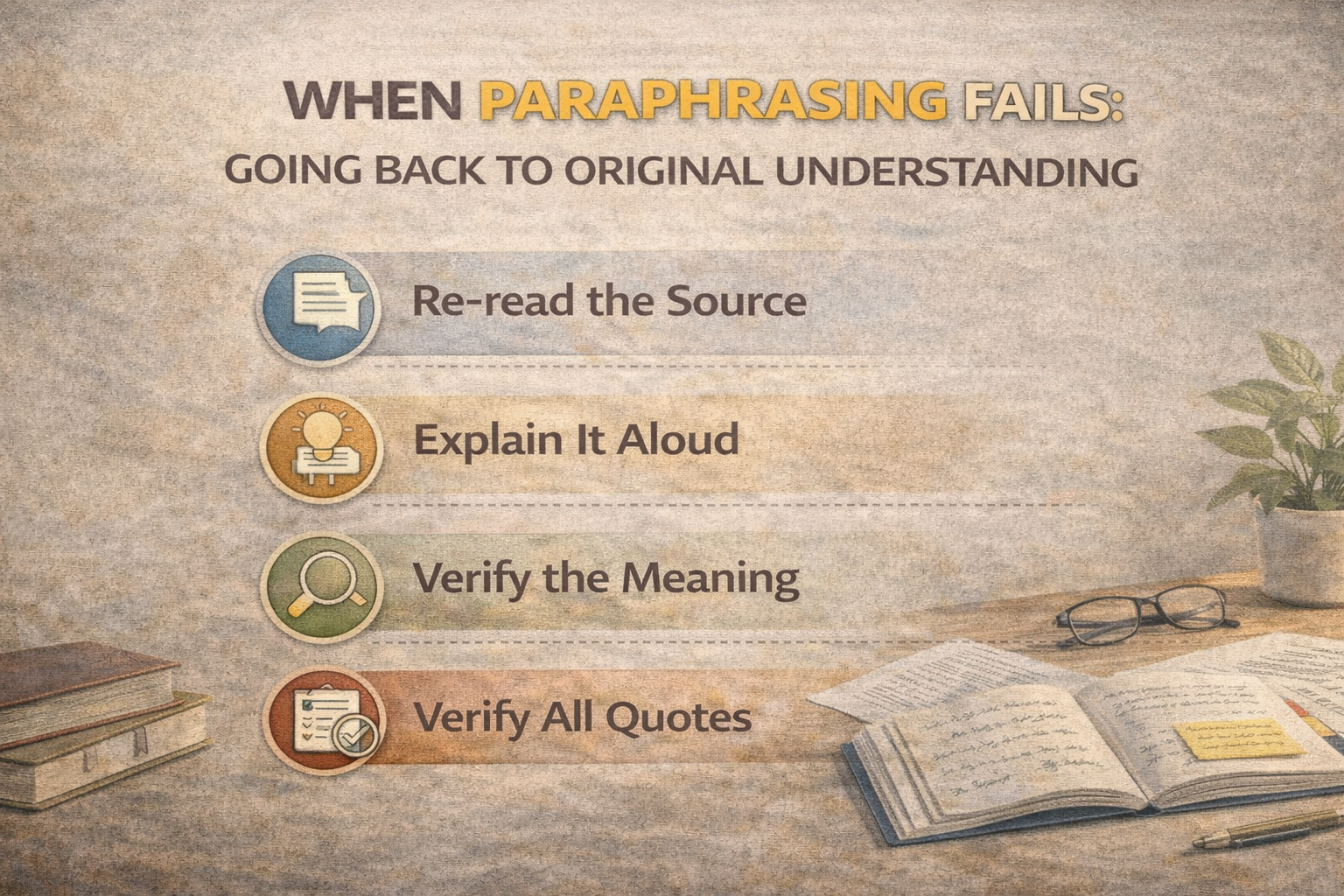
Paraphrasing is most effective when it reflects the writer’s own mental processing of the information. If you find yourself relying on the source sentence as a “template,” it may indicate that you have not yet fully digested the content. In these moments, stepping away from the text and trying to explain the idea aloud—as if to a peer or mentor—can help clarify your understanding.
For example, a doctoral scholar in a private Indian university researching climate policy might read a dense, technical definition of “carbon sequestration.” Instead of attempting to reword it line by line, they could first summarise it in plain language, then rebuild it into an academic form that fits their thesis. This method reduces dependence on the original sentence structure and naturally produces a more original paraphrase.
Returning to the Original Source Material
When paraphrasing consistently fails, revisiting the original source—sometimes multiple times—can reveal nuances that were missed in earlier readings. This is especially important in theoretical frameworks or statistical interpretations where precision matters. Reading related literature on the same concept can also help build a richer mental model, making it easier to express the idea independently.
In Indian academic culture, particularly in doctoral programs, faculty often advise students to “own” their literature review by understanding each source deeply enough to discuss it without looking at notes. This is not just about avoiding plagiarism—it is about developing the intellectual confidence that underpins quality research.
Avoiding Over-Reliance on Paraphrasing Tools
Digital paraphrasing tools can be useful for generating alternative sentence structures, but they cannot replace genuine comprehension. Their output often contains subtle inaccuracies or awkward phrasing that can misrepresent the original meaning. Moreover, Turnitin and similar tools are increasingly effective at detecting mechanically reworded content.
Mid-career professionals returning to academia may be especially tempted to use such tools due to time constraints, but investing time in re-reading and reflecting will yield better results both for originality and for the strength of the thesis argument.
Indian Higher Education Context
Private universities in India, with their flexible research supervision models, often allow for more one-on-one guidance in paraphrasing and literature synthesis. This can be invaluable for students from diverse disciplines who may not have prior experience in academic writing. Supervisors sometimes encourage students to write “concept notes” on each major source before attempting to integrate it into the thesis. This practice not only improves paraphrasing outcomes but also enriches the scholar’s critical engagement with the material.
PhD candidates in India must remember that UGC’s plagiarism threshold is a safeguard for academic integrity, not a mere number to be achieved. When paraphrasing fails, returning to a full, clear understanding of the original work often results in writing that is both more authentic and more defensible during evaluation.
Conclusion
Paraphrasing failures are not simply a sign of weak writing skills—they often point to gaps in comprehension. For Indian PhD scholars, the most reliable solution is to step back, revisit the original source, and engage with the material until it can be expressed naturally in one’s own words. In doing so, the resulting work not only meets plagiarism standards but also reflects a depth of understanding that strengthens the thesis as a whole.