
Introduction
In Indian academia, plagiarism is treated as a serious academic offence, with strict consequences outlined by the University Grants Commission (UGC) and most private universities. While many research scholars know they must submit a plagiarism-free thesis or paper, they often overlook a crucial detail — plagiarism checks should not be a one-time activity. The frequency of these checks can make the difference between a smooth submission and a stressful rejection. For those pursuing a PhD in a private university, regular plagiarism monitoring is essential to maintain originality throughout the writing process.
Why Checking Only Once Is Risky
Many scholars make the mistake of running a plagiarism check only when their work is complete. This approach is risky because multiple drafts, literature reviews, and collaborative edits can introduce unintended similarities over time. If these issues are detected only at the end, revising a large portion of the work under submission pressure becomes difficult. A single check at the final stage may also miss earlier opportunities to correct paraphrasing or citation mistakes.
Best Practice – Stage-Wise Plagiarism Checks
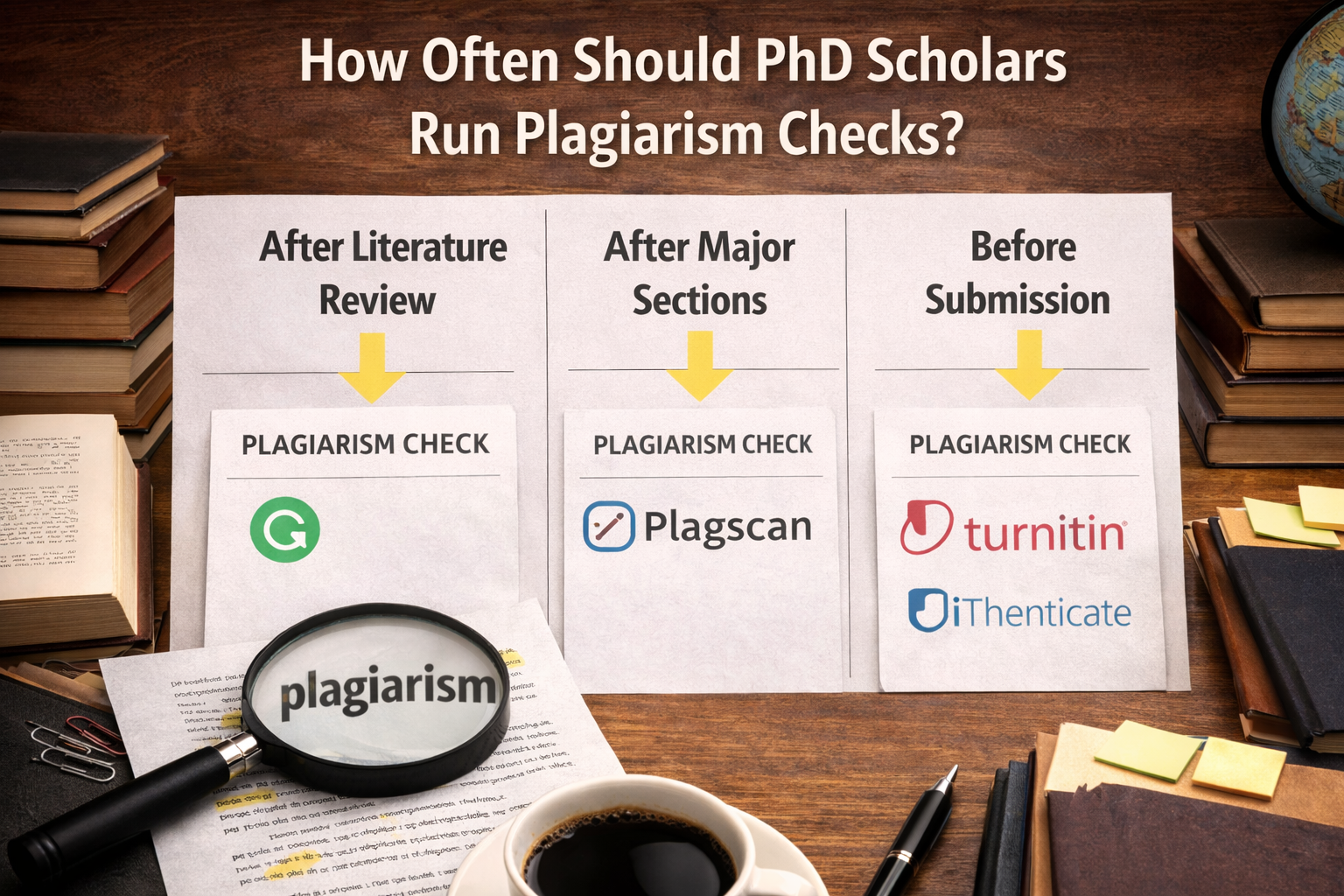
The most effective approach is to run plagiarism checks at different stages of writing:
- After completing the literature review – This ensures that paraphrased sections are properly cited and no direct copying has slipped through.
- After completing each major chapter – Running chapter-wise checks helps identify potential overlaps early and reduces workload later.
- Before final submission – The final check should be with the UGC-approved or journal-recognised tool, ensuring complete compliance.
UGC and Journal Expectations
UGC guidelines mandate that plagiarism must be below the accepted similarity threshold (usually 10% for journals, 20-30% for theses). Many Scopus-indexed and UGC CARE-listed journals require an official plagiarism report dated close to submission. If the report is too old, editors may reject it and ask for a fresh check. This means even if you checked earlier, you may still need another scan before sending your final version.
The Role of Ongoing Self-Checks
For early drafts, scholars can use secondary tools like Grammarly Premium, Quetext, or Plagscan for quick feedback. These help in identifying citation gaps, overused phrases, and accidental text matches. However, these self-checks should supplement — not replace — the official scan with Turnitin, Urkund, or iThenticate at later stages.
Balancing Cost and Accuracy
One reason some scholars avoid multiple plagiarism checks is the cost of paid tools. A practical solution is to use free or affordable tools for early-stage reviews, and reserve the official UGC-approved check for the final submission. Some private universities also allow a limited number of free Turnitin or Urkund scans — using these strategically can help maintain quality without overspending.
Conclusion
Plagiarism checking should be a continuous quality-control process rather than a last-minute hurdle. For a PhD in a private university, the safest practice is to run checks at key writing stages — after the literature review, after major sections, and before submission. This approach not only ensures compliance with UGC and journal standards but also reduces stress, saves time, and protects your academic credibility. In research, originality is not a one-time achievement; it’s a habit maintained throughout the writing journey.