
Introduction
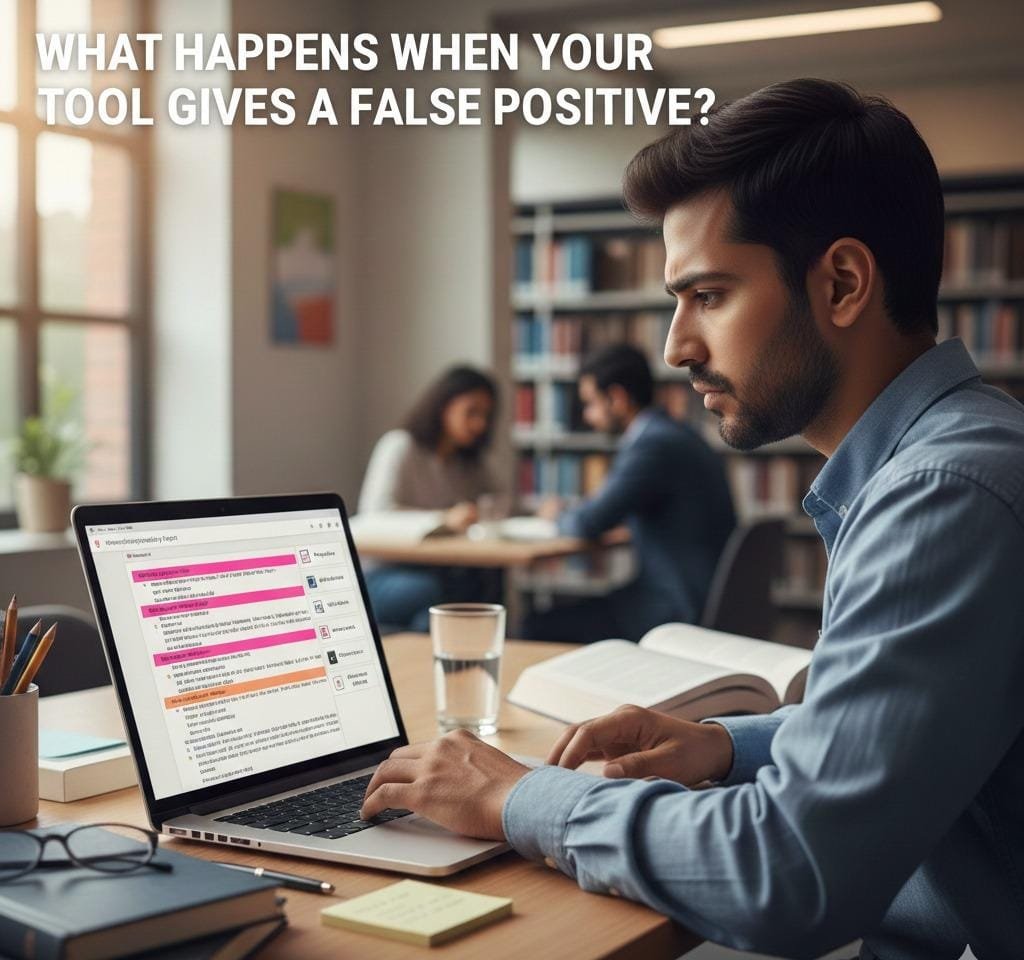
Plagiarism detection tools are essential for maintaining academic integrity in Indian higher education, especially for PhD scholars in private universities. However, these tools are not perfect. Sometimes, they flag content as plagiarised even when it is original — a situation known as a “false positive.” For a research scholar, this can be both frustrating and damaging if misunderstood by supervisors, reviewers, or journal editors. Understanding why false positives occur and how to deal with them is crucial for protecting your academic reputation and ensuring a smooth thesis or paper submission.
Why False Positives Happen
Plagiarism tools compare your text against vast databases of published works, student submissions, and online content. False positives may occur for several reasons:
- Common phrases in your field – Technical terms, definitions, and standard expressions are often repeated across multiple works.
- Properly cited material – Even when citations are correct, the tool may highlight them as matching text.
- Your own previously submitted work – If you uploaded an earlier draft to a tool or institutional repository, it might flag your new draft as “self-plagiarism.”
- Algorithm limitations – Some tools have aggressive matching settings that flag even minor similarities.
Impact on Research Scholars
If not handled carefully, a false positive can lead to unnecessary revisions, delays, or even suspicion of misconduct. In some private universities, supervisors may insist on lowering the similarity index without fully understanding the source of the flagged matches. For journal submissions, editors may reject the manuscript outright if they see a high similarity score without context.
How to Identify a False Positive
A similarity report needs careful interpretation:
- Check the highlighted sections – Are they common phrases, references, or properly quoted material?
- Look for patterns – If the matches are mostly in methodology descriptions or standard definitions, they may not be actual plagiarism.
- Exclude references and small matches – Most tools allow you to exclude bibliography and matches below a certain word count.
Steps to Resolve a False Positive
- Explain to your supervisor or editor – Show them the report and highlight which matches are not plagiarism.
- Adjust the tool’s settings – If possible, remove bibliography and small match filters before rechecking.
- Seek an official review – Many universities have a plagiarism committee to review disputed reports.
- Document your originality – Keep notes and drafts to prove that your work is self-written.
Choosing the Right Tool to Reduce Errors
Some tools, like Turnitin and iThenticate, allow better filtering of non-relevant matches, making them more reliable. Others may not differentiate between cited and uncited content effectively. For PhD scholars in India, especially in private universities, using a UGC-approved tool is the safest way to ensure your report is accepted without dispute.
Conclusion
False positives in plagiarism reports can be stressful, but they are not the end of the road. By understanding why they occur, interpreting the similarity report carefully, and communicating clearly with supervisors or editors, scholars can resolve such issues effectively. For a PhD in a private university, where plagiarism compliance is strict, knowing how to handle false positives is as important as avoiding plagiarism itself. Academic integrity depends not just on avoiding misconduct but also on ensuring that your originality is recognised accurately.