
Introduction
For many Indian PhD candidates, plagiarism removal is not just a technical step but an academic necessity. Between Turnitin checks, UGC’s similarity thresholds, and supervisor feedback, rewriting becomes an unavoidable part of thesis preparation. But there is a subtle risk that rarely gets discussed—rewriting so much that the original meaning or scholarly contribution starts to fade. This balance is particularly challenging for those pursuing a PhD in a private university, where structured progress reviews can push candidates to over-edit in the hope of satisfying every requirement.
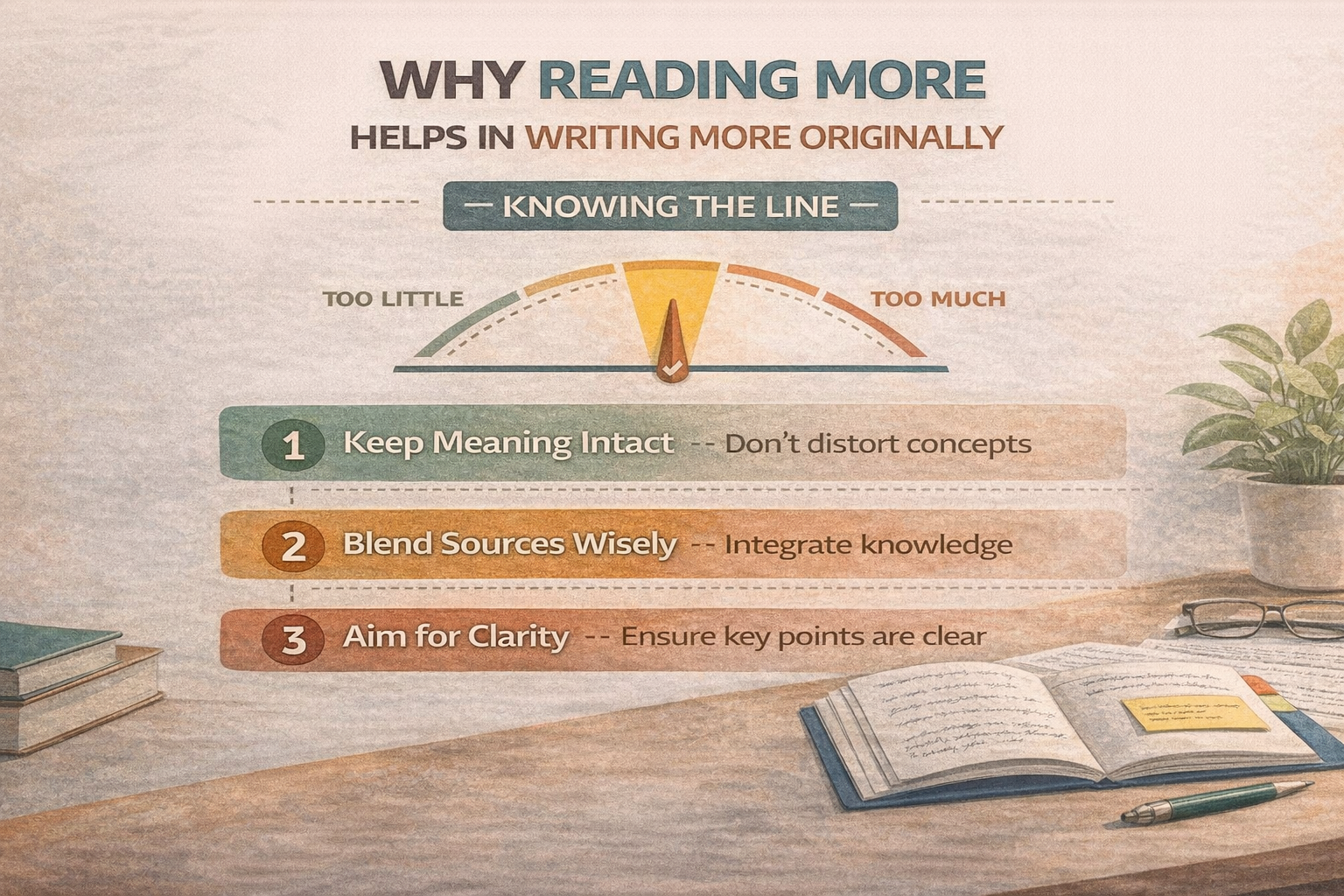
The challenge lies in knowing where to draw the line. Rewriting is meant to make the work more original and academically sound, but excessive changes can weaken arguments, strip away context, or even alter the intended interpretation. For doctoral admission in India, where academic credibility is tied closely to the precision of expression, recognising this limit is crucial.
When Rewriting Starts to Cross the Line
Rewriting is healthy when it improves clarity, refines vocabulary, or restructures sentences to reduce similarity without altering meaning. For instance, replacing repetitive phrases in a literature review or adjusting sentence order in a methodology section can be effective and safe. Problems arise when the urge to lower a similarity score leads to completely reframing core arguments.
Consider a situation where a researcher in economics rewrites an entire theoretical framework just to avoid flagged matches, inadvertently changing the sequence of causal relationships. Even if the new version passes plagiarism checks, it may no longer accurately reflect the theory it is meant to present. In subjects like law or history, excessive rewriting of definitions or legislative excerpts can lead to partial misrepresentation of the source—something supervisors and examiners are quick to notice.
In the Indian context, especially within UGC-approved PhD formats, rewriting is not judged solely on its ability to bypass detection software. Faculty panels and external examiners assess whether the rewritten content still holds the same depth, coherence, and evidence-based reasoning as the original draft. Too much alteration can lead to gaps in argumentation that weaken the overall thesis.
Balancing Originality and Accuracy
The safest rewriting is intentional rather than mechanical. This means evaluating each sentence for its academic purpose before deciding how much to change. If a section is already expressing the idea clearly and in your own words, over-editing it for the sake of lowering similarity may do more harm than good. Conversely, if a section is heavily borrowed from a source, thoughtful rephrasing and structural changes are necessary—not just for compliance but for genuine understanding.
One practical strategy for Indian doctoral researchers is to focus on content integration rather than word-by-word replacement. This involves blending ideas from multiple sources, inserting your analysis, and ensuring the narrative reflects your own voice. By doing this, the similarity score naturally drops without distorting meaning. This approach is particularly valuable for working professionals in mid-career PhD programmes, where the goal is not just to submit a document, but to demonstrate subject mastery.
It is also important to remember that UGC’s plagiarism thresholds are designed to maintain academic integrity, not to encourage excessive rewriting. Achieving a score well below the permissible limit by removing too much substance can be counterproductive. A thesis that looks “safe” to software but fails to convince a human examiner does not serve the researcher’s long-term academic goals.
Conclusion
Rewriting is a vital skill for reducing plagiarism, but like any academic process, it has its limits. Changing too little risks breaching similarity thresholds; changing too much risks losing the integrity of the research. For Indian PhD candidates, knowing where to stop is as important as knowing how to start. The true mark of successful rewriting is not in how different the words look, but in