Introduction
Across India’s academic landscape, PhD candidates are increasingly turning to rewriting tools to help manage plagiarism removal and improve their thesis drafts. This shift is particularly visible in private universities and among working professionals who pursue doctoral degrees alongside full-time jobs. While some view these tools as time-saving aids, others remain cautious, questioning whether they align with UGC’s expectations for originality and academic integrity.
The reality is that rewriting tools are not inherently “good” or “bad.” Their usefulness depends on how they are applied and the degree of manual intervention that follows. For doctoral admission in India, where plagiarism thresholds are strict and evaluators expect nuanced, discipline-specific writing, understanding these tools—and their limitations—is essential.
Popular Choices and How They Are Used
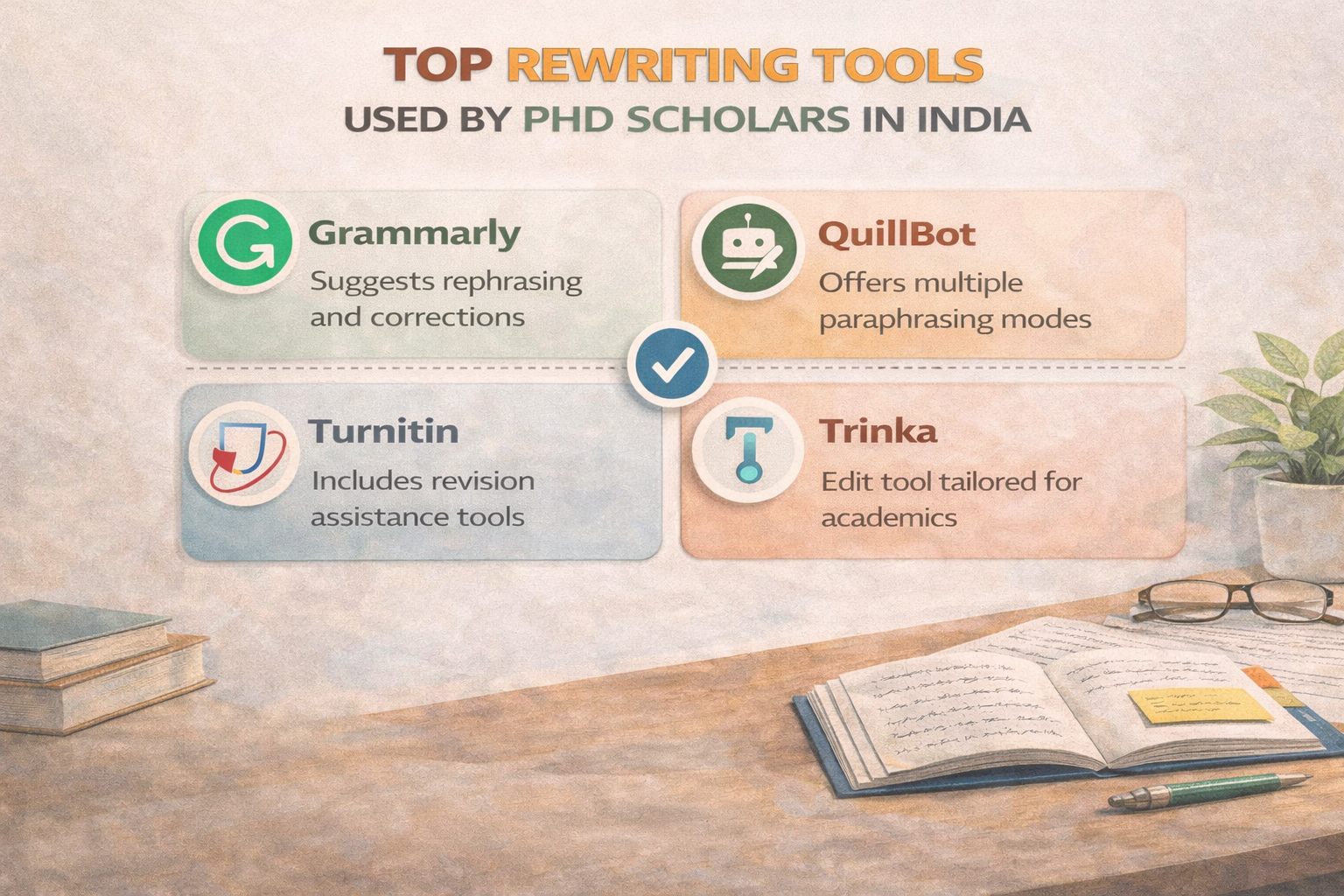
PhD scholars in India often experiment with both free and subscription-based rewriting tools. Commonly mentioned names include Grammarly’s rephrasing suggestions, QuillBot’s paraphrasing modes, and subscription-based academic editors that integrate with plagiarism detection platforms. These tools are frequently used to simplify complex sentences, replace repeated terms, and restructure paragraphs without altering the research meaning.
For example, a scholar writing in the social sciences might use QuillBot’s “Fluency” mode to make interview transcripts more readable, while an engineering student might rely on Grammarly to identify and reframe overly technical sentences for clarity. In literature reviews, rewriting tools can help reword long summaries of past research, provided the writer carefully checks each change against the original source.
However, these tools work best when paired with the researcher’s own academic understanding. Many automated rewrites lack contextual accuracy, which can lead to subtle but significant errors. For instance, in a law thesis, replacing “precedent” with “example” changes the meaning in a way that could undermine the argument. This is why scholars often treat tool-generated drafts as starting points, not final versions.
Risks and Responsible Use
While rewriting tools can speed up the drafting process, over-reliance can erode the development of personal academic voice. Doctoral supervisors in India often encourage students to write directly from their own understanding of the material, integrating citations naturally rather than simply rewording existing texts. This ensures that the final work reflects both originality and subject mastery.
There are also data privacy concerns, especially with free online tools that may store uploaded content. For researchers working on sensitive topics or unpublished data, this risk can be significant. A safer approach is to use offline or subscription-based tools that provide clear privacy guarantees, or to process only non-confidential sections through online platforms.
Moreover, rewriting tools are not a guaranteed way to lower similarity scores. Some plagiarism detection software, including Turnitin, evaluates sentence structure and conceptual similarity in addition to word changes. This means that a poorly supervised rewrite could still result in flagged matches. In the Indian academic context, where plagiarism thresholds are enforced not just mechanically but through faculty review, this can delay thesis approval.
Ultimately, the most effective use of rewriting tools comes from treating them as aids for refining clarity and structure, while ensuring that the intellectual substance, analytical depth, and original interpretation remain firmly the researcher’s own. This balanced approach is more likely to satisfy both software checks and human evaluators.
Conclusion
Rewriting tools have become a common part of the PhD writing process in India, offering convenience for those balancing research with other responsibilities. Yet, their value depends entirely on the researcher’s judgment and willingness to review every automated change. Used wisely, they can enhance clarity and help meet plagiarism standards; used blindly, they risk distorting meaning and weakening academic credibility. For scholars aiming to combine efficiency with integrity, these tools are best seen as partners in the writing process, not as replacements for careful, informed scholarship.