
Introduction
For many Indian PhD scholars, the process of reducing similarity scores in a thesis can feel like a constant balancing act. On one side is the need to present work in a way that passes plagiarism checks; on the other is the responsibility to retain meaning, maintain academic tone, and meet institutional requirements. With online tools like Grammarly and QuillBot becoming common in academic circles, the temptation to rely on them for quick fixes is understandable. The real question, however, is how to use Grammarly and QuillBot safely for plagiarism removal without risking errors or losing the authenticity of one’s writing.
In India’s doctoral landscape, particularly in private universities where students often juggle research with professional and family commitments, these tools can seem like time-savers. But their misuse can lead to unintended problems—ranging from unintentional meaning changes to introducing language patterns that don’t match the researcher’s own style. Understanding where these tools fit in the process can help avoid such pitfalls.
Using Grammarly for Clarity, Not Overwriting
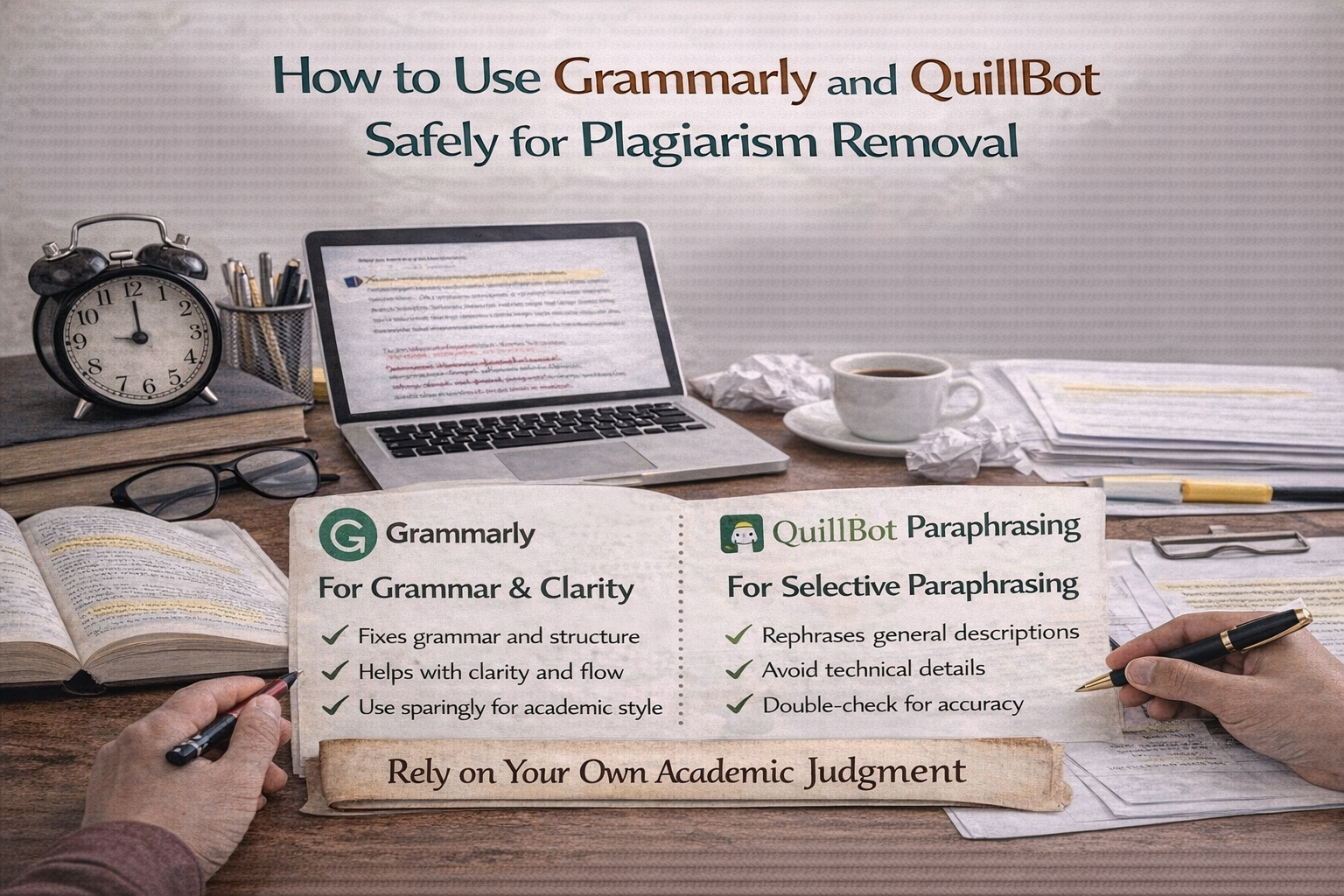
Grammarly is designed to refine grammar, punctuation, and sentence structure, which can indirectly help reduce plagiarism by making your sentences more original. For example, when a literature review contains long, complex sentences that closely match published works, Grammarly’s clarity suggestions can help you break them into simpler, unique structures. This can be especially useful for mid-career researchers returning to academics after years in industry, where formal writing styles differ from academic norms.
However, there is a limit to how much Grammarly should change your text. Accepting every suggestion blindly can strip away the personal academic voice you have developed. For instance, certain “concise” suggestions may remove discipline-specific terms that are important for your field. A PhD in private university settings often requires writing that matches the supervisor’s expectations and the department’s tone, which may not align perfectly with Grammarly’s algorithm. Therefore, the safe approach is to use Grammarly for surface-level improvements—like fixing verb tenses or restructuring overly long sentences—while manually handling paraphrasing for plagiarism removal.
Where QuillBot Works Best and Where It Doesn’t
QuillBot is often used for paraphrasing, but its rewording engine works on a pattern-based approach that can sometimes oversimplify or misrepresent academic ideas. It can be useful when dealing with non-technical background information or introductory descriptions, where exact precision is not critical. For example, explaining a general concept in education policy could be rephrased safely without affecting the overall thesis argument.
On the other hand, QuillBot can be risky when applied to highly technical sections or theoretical frameworks. In disciplines like biotechnology or law, even small shifts in terminology can change the meaning. Moreover, over-reliance on its “fluency” or “creative” modes may introduce phrases that sound unusual in an academic Indian context, making them stand out during supervisor reviews. In doctoral admission in India, originality is as much about the coherence of your academic voice as it is about avoiding direct matches in plagiarism software.
A safer strategy is to use QuillBot selectively—perhaps on drafts of secondary literature summaries—while ensuring that all rewritten content is cross-checked with the original source. Reading the output aloud can help spot awkward phrasings or meaning changes before they make it into the final submission.
Conclusion
Grammarly and QuillBot can both contribute to lowering similarity scores, but their role should be carefully defined. Grammarly works best as a polishing tool for clarity and structure, while QuillBot can serve as a starting point for paraphrasing non-critical content. The key is to combine these tools with your own subject expertise, ensuring that each rewritten section still reflects your academic reasoning. When used thoughtfully, they can help manage plagiarism without diluting the personal voice that makes a PhD thesis truly yours.