
Introduction
In the age of AI-assisted writing tools, Indian PhD scholars are presented with faster and more accessible ways to revise and rephrase academic content. These platforms, from grammar checkers to advanced paraphrasing engines, have become popular for reducing similarity scores in thesis work. Yet, the experience of many doctoral candidates reveals that the process is far from straightforward. The question of why human editing is still better than AI for plagiarism fixes becomes particularly relevant for scholars in private universities, where submission timelines are flexible but evaluation standards remain uncompromising.
While AI tools can restructure sentences and replace words within seconds, the nuances of doctoral writing in India—such as aligning with discipline-specific terminology, maintaining academic tone, and preserving cultural relevance—often require a human touch. The PhD journey is not just about passing software checks; it is about producing work that stands up to the scrutiny of supervisors, external examiners, and peers.
Limitations of AI in Academic Rewriting
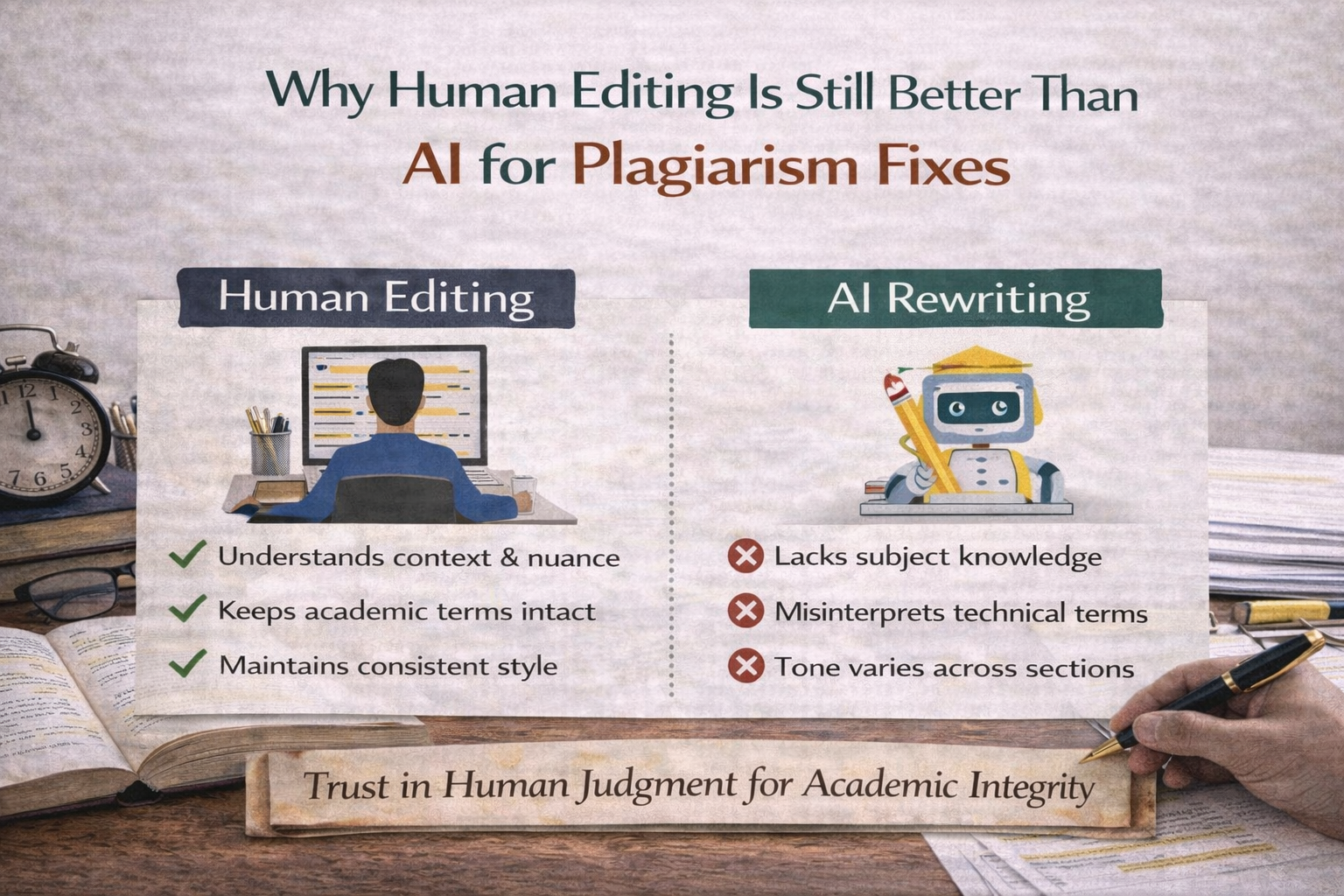
AI-driven tools work by scanning patterns, suggesting synonyms, and altering sentence structures. Although they can reduce textual overlap, they operate without the depth of understanding that human editors bring. For instance, a researcher in education might refer to “constructivist learning theory” in multiple sections. An AI paraphrasing tool could reword this as “theory of building knowledge,” which technically sounds correct but loses the established academic label recognised in the field. This subtle shift can weaken the scholarly accuracy of the thesis.
Moreover, AI tools cannot always differentiate between text that must be preserved verbatim, such as key definitions, and text that can be rephrased without loss of meaning. In the Indian PhD context, particularly for interdisciplinary research where terms have precise definitions across subjects, this can be risky. It can also result in unnecessary alterations to citations or references, creating inconsistencies that supervisors quickly notice.
AI rewriting can also lead to uneven tone, especially if it is used in isolated sections rather than across the entire document. Examiners often pick up on these shifts during evaluation, prompting questions about the authenticity of the work. This is a growing concern in private university doctoral admissions, where students come from varied professional backgrounds and may not have extensive writing practice.
Why Human Editors Add More Value
A skilled human editor—whether a professional academic consultant, a faculty mentor, or even the scholar themselves—engages with the content beyond its surface. Human editing involves understanding the core argument, recognising the importance of specific terms, and ensuring that the rewriting does not dilute meaning. For example, in a management thesis, an editor will know that “Porter’s Five Forces” should not be replaced with “five influences in competition,” even if the latter reduces similarity, because it changes the recognised academic reference.
In India, many doctoral candidates pursue their PhD while working full-time or managing family responsibilities. This often means that their writing time is limited, and the temptation to rely on AI tools is high. Human editing, however, allows for context-aware decision-making—retaining certain phrasings where necessary, reordering sentences for clarity, and ensuring the argument flows logically from chapter to chapter.
Another advantage of human intervention is cultural and linguistic sensitivity. Indian academic writing often requires careful balancing of global scholarly standards with locally relevant examples. A human editor can ensure that the rewritten content resonates with both audiences, something AI tools struggle to achieve.
Conclusion
While AI tools can assist in managing plagiarism scores, they cannot replace the judgement, subject knowledge, and contextual awareness that human editors bring to doctoral writing. PhD research is a deeply intellectual exercise, and its rewriting phase demands as much engagement as its data collection or analysis. For Indian scholars, particularly in private universities where maintaining originality is as important as meeting deadlines, human editing remains the most reliable way to ensure both compliance and quality. In the end, the credibility of a thesis lies not in how quickly it passes a plagiarism check, but in how well it reflects the scholar’s understanding and voice.