
Introduction
When it comes to plagiarism checks in a PhD thesis, many scholars focus on the overall percentage. However, certain sections like the abstract and introduction often raise doubts—how much similarity is acceptable here? In Indian private universities, the UGC guidelines specify an overall similarity limit, but they do not clearly state separate allowances for specific sections. This creates confusion for scholars, especially when common academic phrases or definitions are unavoidable. Understanding how plagiarism detection works for abstracts and introductions can help you prepare a clean, compliant thesis.
Why Abstracts and Introductions Are Tricky
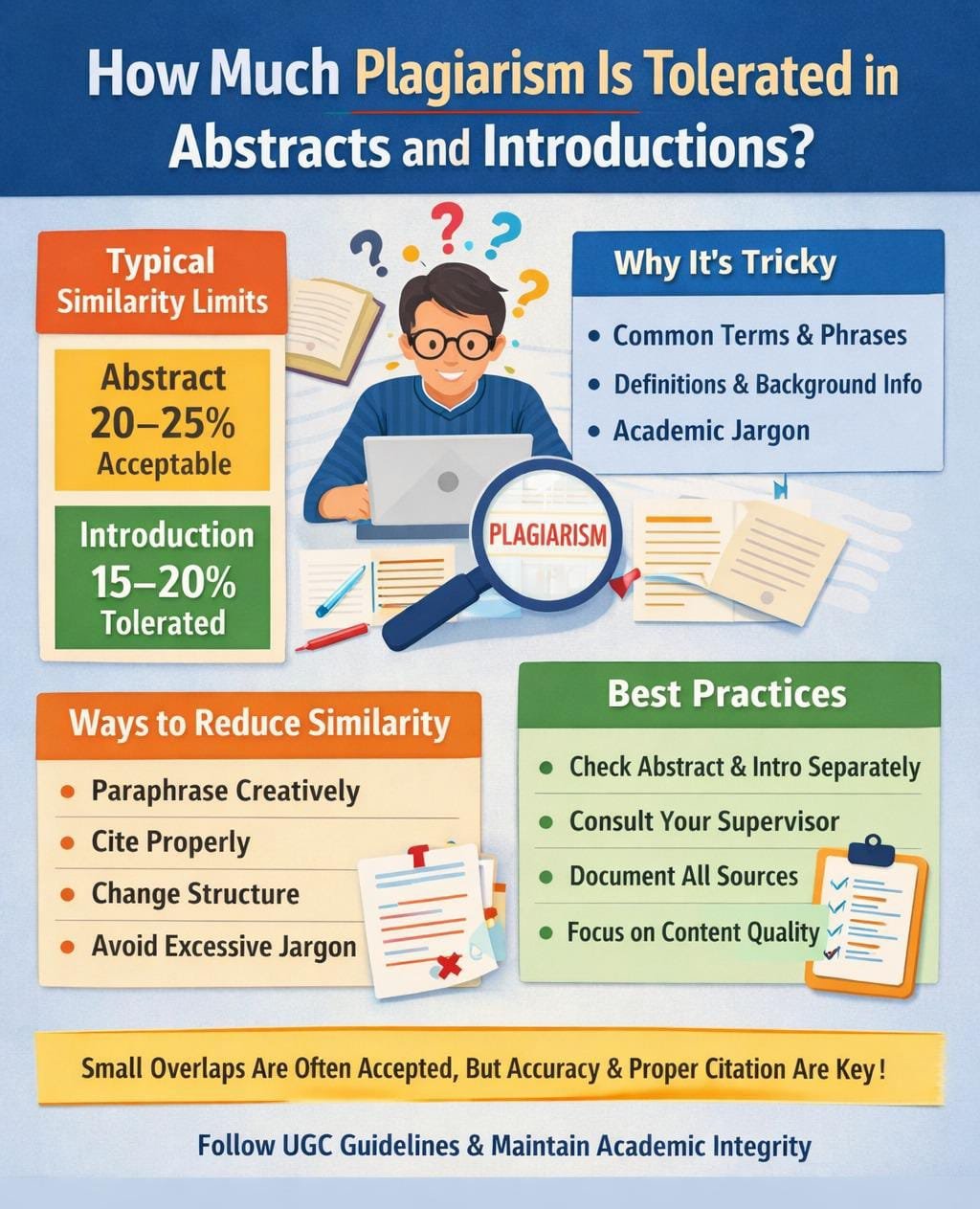
These sections are more prone to similarities because they often contain:
- Standard phrases used in your research field.
- Definitions or theoretical frameworks from existing literature.
- Background information that might be similar to other works.
- Keywords and terminology that cannot be rephrased too much without losing meaning.
Because of these factors, even original writing in abstracts and introductions can trigger similarity matches in plagiarism software.
UGC Guidelines and Institutional Practices
UGC’s official plagiarism policy focuses on the total similarity percentage across the thesis, with tiered penalties for higher overlaps. While there’s no official separate rule for abstracts and introductions, many private universities interpret the guidelines with some flexibility. Often, minor overlaps in these sections—especially from technical terminology—are tolerated, provided the overall thesis stays within the permissible limit (usually 10% for the final submission).
Acceptable Similarity in Practice
In most Indian universities:
- Abstract – Up to 20–25% similarity is sometimes accepted, mainly due to unavoidable standard terms, provided the rest of the thesis is original.
- Introduction – Around 15–20% may be tolerated if overlaps are from general background content or cited material.
These numbers are not official rules, but practical allowances based on academic norms.
How to Reduce Similarity in These Sections
Even though some similarity is unavoidable, you can still bring it down:
- Paraphrase creatively: Avoid direct lifting of sentences from your own published papers or standard textbooks.
- Change structure: Present background information in your own sequence rather than following a source’s flow.
- Cite properly: If a definition or fact is taken verbatim, enclose it in quotation marks and provide a citation.
- Avoid overuse of jargon: While technical terms are fine, excessive repetition of fixed phrases can raise similarity scores.
Common Mistakes to Avoid
- Copy-pasting your own published abstract: This counts as self-plagiarism unless cited.
- Using sample theses as templates: You may unintentionally keep their structure and wording.
- Not running section-wise checks: Sometimes, an overall pass hides a high similarity percentage in specific sections.
Best Practices for Indian PhD Scholars
- Run plagiarism checks on your abstract and introduction separately during drafting.
- Consult your supervisor if similarity is high but unavoidable due to technical terms.
- Document your sources clearly to show that overlaps are from cited, credible works.
- Remember that the similarity percentage is less important than the nature of the matched content.
Conclusion
While UGC rules focus on the thesis as a whole, abstracts and introductions often face unique plagiarism challenges due to standardised academic language. For PhD scholars in Indian private universities, a small degree of similarity here is usually acceptable, as long as it’s due to unavoidable technical or background terms and not careless copy-pasting. By focusing on smart paraphrasing, accurate citations, and proactive plagiarism checks, you can keep these sections within safe limits while maintaining academic integrity.