
Introduction
Journal submissions in India often face rejection not only for research quality but also for language clarity, originality, and adherence to formatting norms. Rewriting plays a crucial role in refining manuscripts so they meet both academic and editorial expectations. For Indian scholars—especially first-time authors—the rewriting process is not just about avoiding plagiarism but also about improving the scholarly presentation of their work.
Understanding the Purpose of Rewriting
Rewriting is not simply changing words. It is about rethinking how your ideas are expressed to ensure clarity, coherence, and compliance with journal standards. A research article may contain excellent data, but if it is presented in a disorganised or repetitive manner, editors are likely to reject it. Rewriting ensures that the research narrative flows logically from the abstract to the conclusion, making it easier for reviewers to assess the significance of the work.
Addressing Plagiarism through Paraphrasing
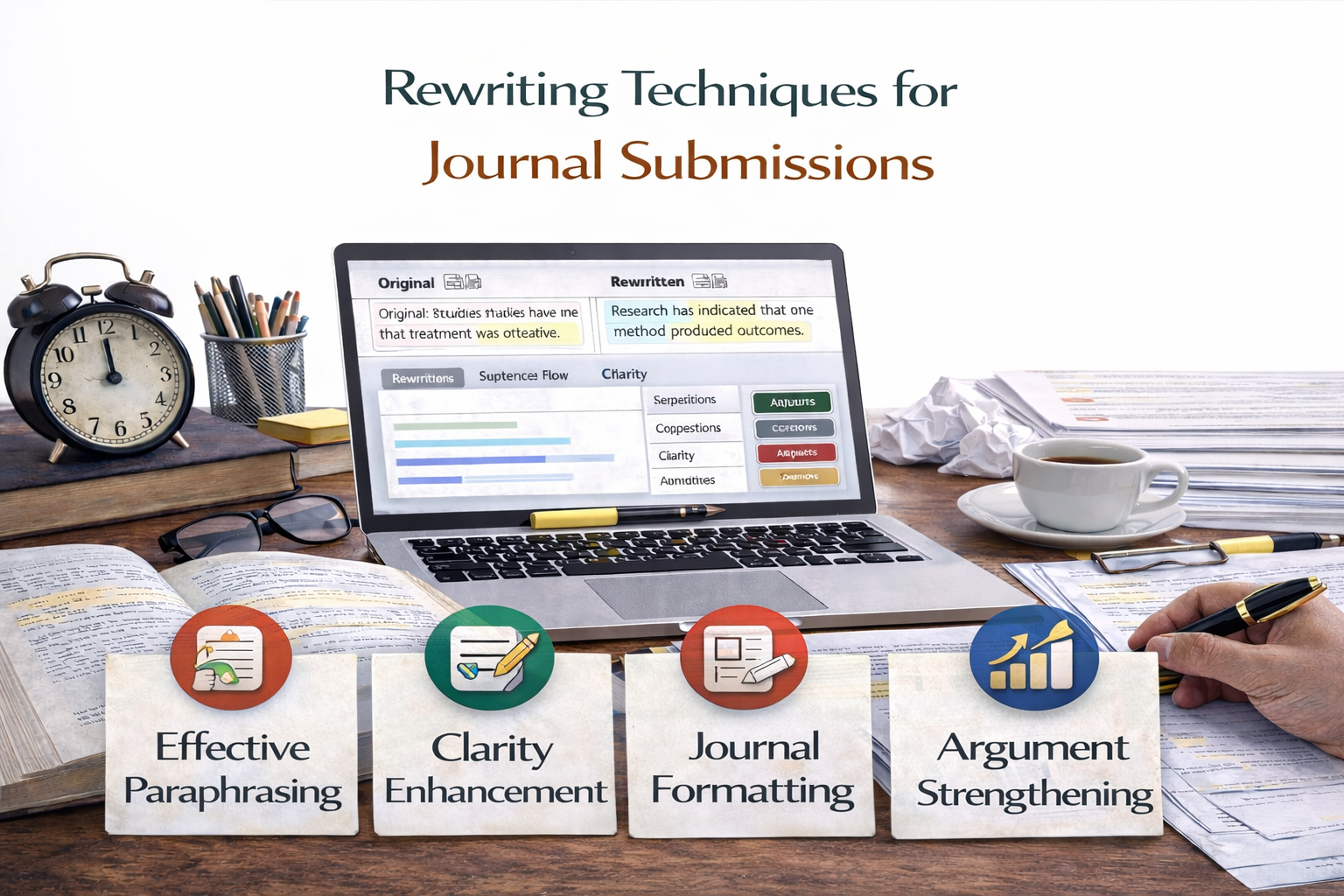
One of the primary reasons for rewriting is to reduce similarity scores. However, paraphrasing must go beyond replacing individual words with synonyms. Effective rewriting involves restructuring sentences, altering the order of information, and integrating original commentary on cited work. This approach helps maintain academic integrity while preserving meaning. Indian PhD scholars, especially in humanities and social sciences, must pay special attention to avoiding close paraphrasing from secondary sources, as this can still be flagged by plagiarism detection tools.
Improving Clarity and Readability
Rewriting for clarity involves simplifying complex sentences, removing unnecessary jargon, and ensuring that technical terms are used precisely. For instance, while engineering and medical journals expect technical accuracy, they also value readability for a global audience. Breaking long sentences into shorter, precise statements can significantly improve readability scores, which some journals now check before peer review.
Aligning with Journal Formatting and Style
Different journals—whether Scopus, UGC-CARE, or international peer-reviewed—have distinct style requirements. Rewriting includes adapting the manuscript to these requirements, such as reference style (APA, MLA, IEEE), headings structure, and figure/table placement. Indian scholars submitting to multiple journals must be prepared to rewrite certain sections each time to ensure compliance with varying guidelines.
Ensuring Logical Flow and Argument Strength
Rewriting should also focus on the logical progression of arguments. Sometimes, initial drafts are written in the order the research was conducted, but journals prefer a thematic organisation. Moving paragraphs, merging related ideas, and adding linking statements help create a stronger argument structure. This is particularly important in interdisciplinary research, where clarity of connections between concepts is essential.
Refining Abstracts and Conclusions
A common oversight is not rewriting the abstract after revising the main text. The abstract must accurately reflect the rewritten manuscript, highlighting the problem statement, methodology, and findings in a concise manner. Similarly, the conclusion should be revisited to ensure it reflects the updated flow of arguments and aligns with the rewritten results.
Collaborative Rewriting and Supervisor Input
In Indian academic culture, supervisors play a key role in shaping a manuscript. Sharing rewritten drafts for feedback can help identify gaps, ensure disciplinary accuracy, and refine academic tone. However, scholars must take ownership of the rewriting process rather than relying entirely on supervisors, as journal editors expect the primary author to demonstrate control over the writing.
Conclusion
Rewriting for journal submissions is more than a last-minute edit—it is a deliberate, skill-based process that improves originality, clarity, and compliance with publication standards. For Indian PhD scholars, mastering rewriting techniques not only increases the chances of acceptance but also strengthens overall research communication skills. By balancing plagiarism reduction with content enhancement, scholars can present work that stands out in competitive academic publishing environments.