
Introduction
In academic writing, especially at the postgraduate and doctoral levels, scholars often struggle with ensuring originality, clarity, and compliance with institutional guidelines. Two common approaches to improving manuscripts are rewriting and professional editing. Although these terms are sometimes used interchangeably, they involve different processes, goals, and levels of intervention. Understanding the distinction is essential for selecting the right service for your needs, particularly in the Indian academic context where plagiarism norms, formatting rules, and language expectations vary widely between universities.
Understanding Rewriting
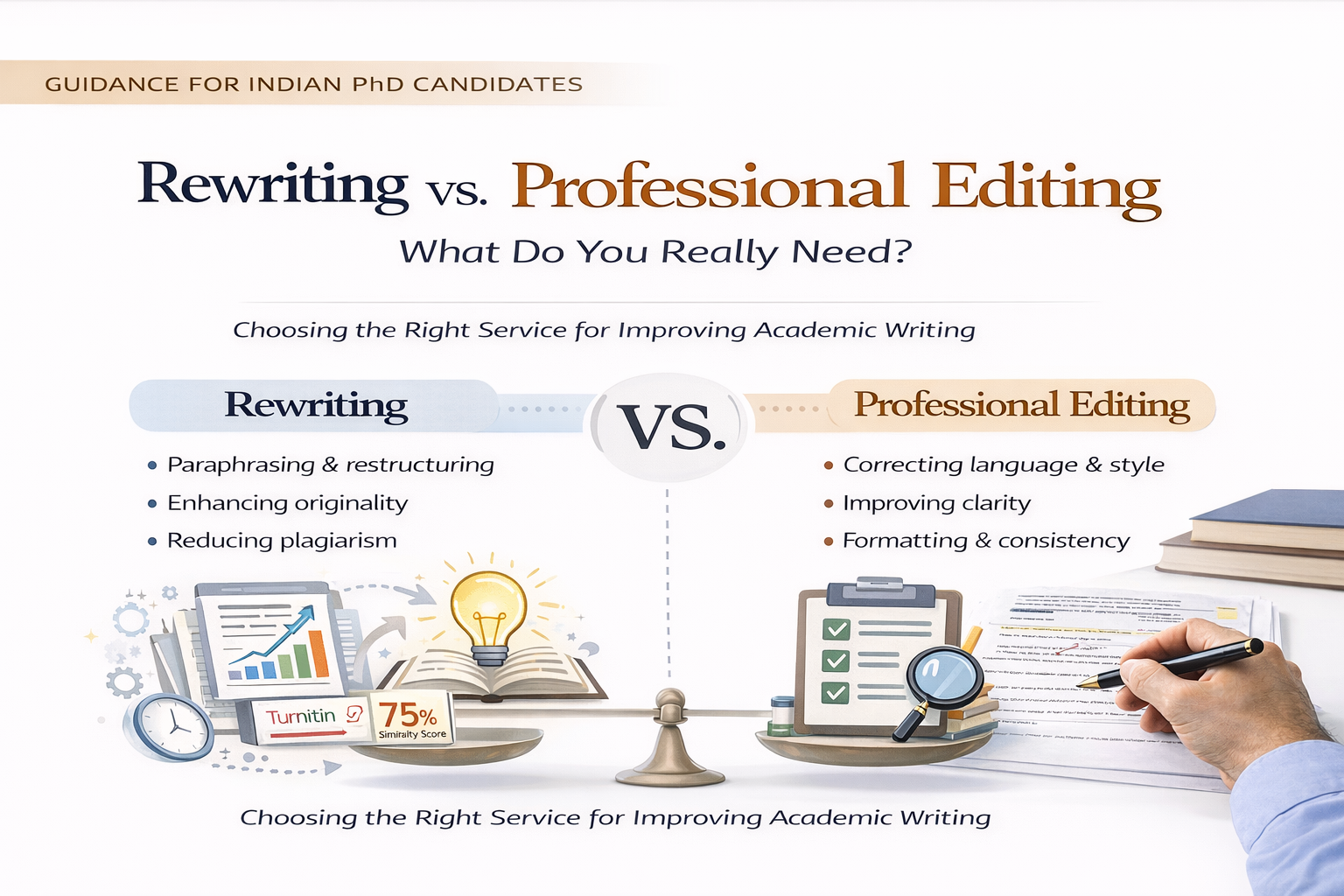
Rewriting involves restructuring and rephrasing your text to improve originality and reduce similarity with existing sources. It focuses on changing sentence structures, replacing vocabulary, and modifying paragraph flow while retaining the original meaning. For example, if a section in your thesis has high similarity in Turnitin due to close paraphrasing or over-reliance on source material, rewriting helps present the same ideas in your own words.
In the Indian academic setting, rewriting is often used for plagiarism removal before submission. This process requires subject knowledge to avoid distorting meaning while altering the language significantly. Unlike simple word replacements, rewriting demands a deeper understanding of the topic and a commitment to maintaining conceptual accuracy.
Understanding Professional Editing
Professional editing is a more holistic process that goes beyond language changes. It includes checking grammar, syntax, punctuation, and spelling, but also evaluates logical flow, clarity, tone, and adherence to formatting guidelines such as APA, MLA, or university-specific styles.
Editing services may be divided into copyediting (surface-level language corrections) and substantive or developmental editing (deep structural and content-focused improvements). For Indian PhD scholars, professional editing is crucial for meeting not only linguistic standards but also formal academic expectations like consistency in citations, coherence in arguments, and compliance with guidelines from UGC, Scopus, or other bodies.
Key Differences Between Rewriting and Editing
The primary difference lies in purpose and scope. Rewriting is primarily aimed at reducing plagiarism and improving originality, whereas editing aims at improving readability, coherence, and presentation quality. Rewriting is meaning-sensitive and content-focused, while editing is more concerned with refinement and polishing.
For example, if your literature review section contains multiple sentences similar to published work, rewriting will paraphrase and reorganise it. Editing, however, will ensure that your rewritten text is grammatically correct, logically ordered, and stylistically consistent.
When to Choose Rewriting
Rewriting is ideal when your work has high similarity scores in plagiarism checks, particularly from tools like Turnitin or Urkund. This is common in research fields where definitions, methods, or concepts are often expressed in similar ways across multiple studies. If your thesis draft is rich in content but overlaps too closely with source material, rewriting will help reframe ideas without losing meaning.
It is also necessary when translating work from another language into English, where direct translation might retain too much of the original phrasing, leading to similarity issues.
When to Choose Professional Editing
Professional editing is most suitable when your work is already original but requires refinement to meet academic writing standards. For instance, you may have written an entirely plagiarism-free draft but struggle with long, unclear sentences, inconsistent terminology, or formatting issues. Editing ensures the final manuscript reads smoothly and meets submission requirements.
This service is also helpful for non-native English speakers in India who may have strong research content but need language polishing to reach publication quality.
Combining Rewriting and Editing
In many cases, Indian scholars benefit from both services. A thesis chapter may first undergo rewriting to reduce overlap, followed by professional editing to improve clarity and presentation. This sequence ensures the manuscript passes plagiarism checks while also meeting academic quality standards.
For example, a methodology chapter heavy with procedural details from existing studies might first be rewritten for originality, then edited for readability, ensuring it is both plagiarism-free and polished.
Risks of Choosing the Wrong Service
Selecting the wrong service can lead to wasted time, higher costs, and potential academic setbacks. If you choose editing when the real problem is high plagiarism, the similarity report may still fail institutional checks. Conversely, if you opt for rewriting when only minor language corrections are needed, you may unnecessarily alter sections that were already well-written.
In Indian universities, where strict plagiarism limits are enforced, misunderstanding the difference can even delay your thesis submission or viva process.
Factors to Consider Before Deciding
When deciding between rewriting and professional editing, consider:
- Plagiarism report results – High similarity calls for rewriting.
- Language quality – Frequent grammar and clarity issues indicate the need for editing.
- Submission requirements – Some journals demand both originality and polished language.
- Budget and time – Combining services may be ideal but requires additional resources.
Conclusion
Rewriting and professional editing serve distinct but complementary roles in preparing academic work. Rewriting focuses on originality and plagiarism removal, while professional editing enhances clarity, coherence, and presentation. For Indian scholars, understanding the difference is essential to meet both institutional plagiarism limits and quality expectations. The most effective approach often involves a combination of the two, ensuring that your thesis or research paper is both plagiarism-free and academically refined for successful submission.