
Introduction
In the Indian academic context, plagiarism removal is more than a technical process—it is about meeting institutional requirements, aligning with UGC guidelines, and ensuring the originality of a scholar’s work without losing its intended meaning. For many researchers, particularly PhD scholars, the process can be overwhelming due to strict similarity thresholds and evolving plagiarism policies. This is why full-service plagiarism correction packages have become a practical solution. Such services go beyond basic rewriting, offering a structured, multi-step process to ensure compliance while preserving academic integrity.
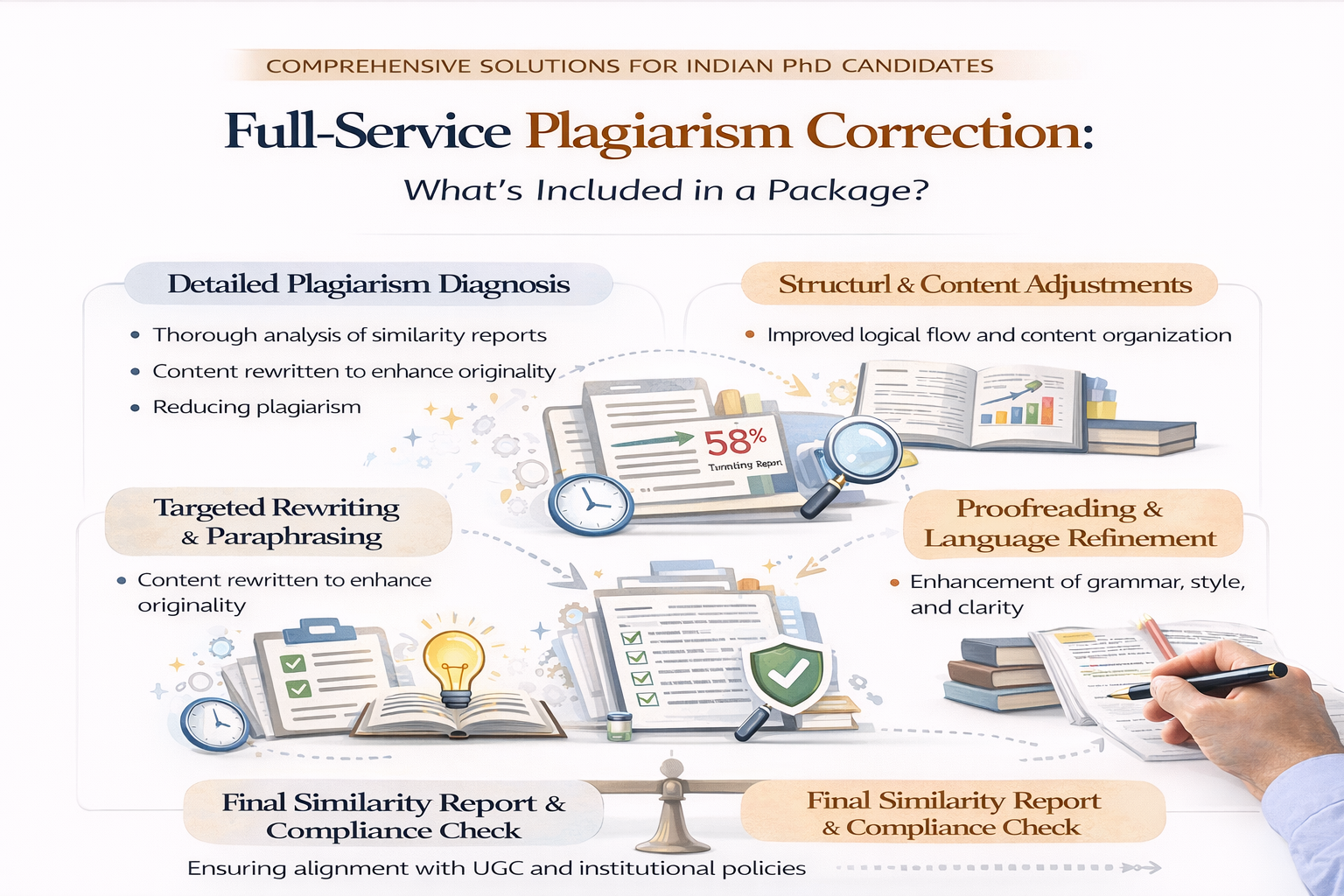
Detailed Plagiarism Diagnosis
The starting point of any comprehensive package is a detailed similarity report analysis. Service providers often work with Turnitin or similar tools to identify not only the overall percentage but also the nature of overlaps—whether they are from literature review sections, methodology descriptions, or direct quotations. Instead of focusing solely on reducing numbers, a quality service will distinguish between permissible overlaps (such as common academic phrases or references) and those requiring rewriting.
Targeted Rewriting and Paraphrasing
Once the problematic sections are identified, professional rewriting becomes the next step. Skilled academic writers reformulate sentences without altering their meaning, ensuring the work still reflects the scholar’s original voice. In India, where research often includes standardised concepts or culturally specific references, maintaining contextual accuracy during paraphrasing is crucial. A full-service approach ensures that these are not lost in the process, avoiding overly mechanical rewording that could harm readability.
Reference and Citation Corrections
Incorrect or incomplete citations often contribute to plagiarism scores. Many scholars unintentionally fail to follow proper citation styles like APA, MLA, or Chicago. A professional package includes citation verification, ensuring that in-text citations match the reference list and follow the required format. This step is critical for UGC compliance, as Indian universities are increasingly strict about referencing accuracy.
Structural and Content Adjustments
Sometimes plagiarism issues are not just about sentences but entire sections mirroring previously published works in structure. A comprehensive service addresses this by reordering content, presenting ideas in a different logical flow, and integrating original analysis. This is especially relevant in literature reviews, where multiple studies are summarised. Full-service correction packages ensure the section feels cohesive and unique, even when discussing widely known research.
Proofreading and Language Refinement
Reducing similarity alone does not guarantee acceptance. Academic tone, grammatical correctness, and clarity are equally important. Many plagiarism removal packages include professional proofreading to refine sentence structure, correct typographical errors, and improve overall coherence. This step ensures the rewritten work meets both originality and readability standards.
Final Similarity Report and Compliance Check
After all corrections, a full-service provider runs the revised document through plagiarism detection software again to confirm the reduction meets institutional requirements. A quality service will not only provide the final percentage but also offer a section-by-section breakdown, demonstrating how overlaps were addressed. For Indian scholars, this is particularly useful during submission to university plagiarism committees, as it shows transparency in the correction process.
UGC and Institutional Policy Alignment
Full-service plagiarism correction packages are designed with academic regulations in mind. In India, the UGC’s Academic Integrity and Research Publication Ethics guidelines mandate specific thresholds for similarity—often 10% to 15% for doctoral submissions. Providers familiar with these rules ensure that corrections align with such limits while maintaining the academic quality expected in research submissions.
Additional Support Services
Some comprehensive packages go beyond plagiarism correction to offer value-added services like formatting as per university guidelines, assistance with cover letters for thesis submission, and basic statistical result interpretation for research chapters. For scholars juggling deadlines, these added elements save time and reduce administrative stress.
Benefits of Choosing a Full-Service Package
The primary advantage is convenience. Instead of engaging multiple freelancers for rewriting, editing, and formatting, a scholar works with one team managing the entire process. This ensures consistency in writing style and formatting. Additionally, such services often offer confidentiality agreements, ensuring that the research content is secure—a key concern among Indian researchers wary of data misuse.
Conclusion
Full-service plagiarism correction packages are not just about lowering Turnitin percentages; they are about delivering a ready-to-submit, UGC-compliant document that reflects a scholar’s original thinking while meeting institutional standards. By covering every stage—from diagnosis to rewriting, citation correction, and final compliance checks—these packages offer a structured, efficient solution for academic integrity. For researchers aiming to meet tight deadlines without compromising on quality, investing in a full-service package can provide both peace of mind and professional credibility.