Introduction
Career growth has become one of the most pressing concerns for professionals in today’s competitive job market. Whether you are working in the corporate sector, teaching in an institution, or preparing for government jobs, one question constantly arises: how can I advance without pausing my career? For many Indians, distance education has emerged as a practical solution. It allows learners to acquire additional qualifications, build new skills, and upgrade their profiles without leaving their current responsibilities. But does distance education genuinely contribute to career advancement, or is it just a convenient second option? The answer lies in understanding both its opportunities and its limitations.
Flexibility Meets Career Goals
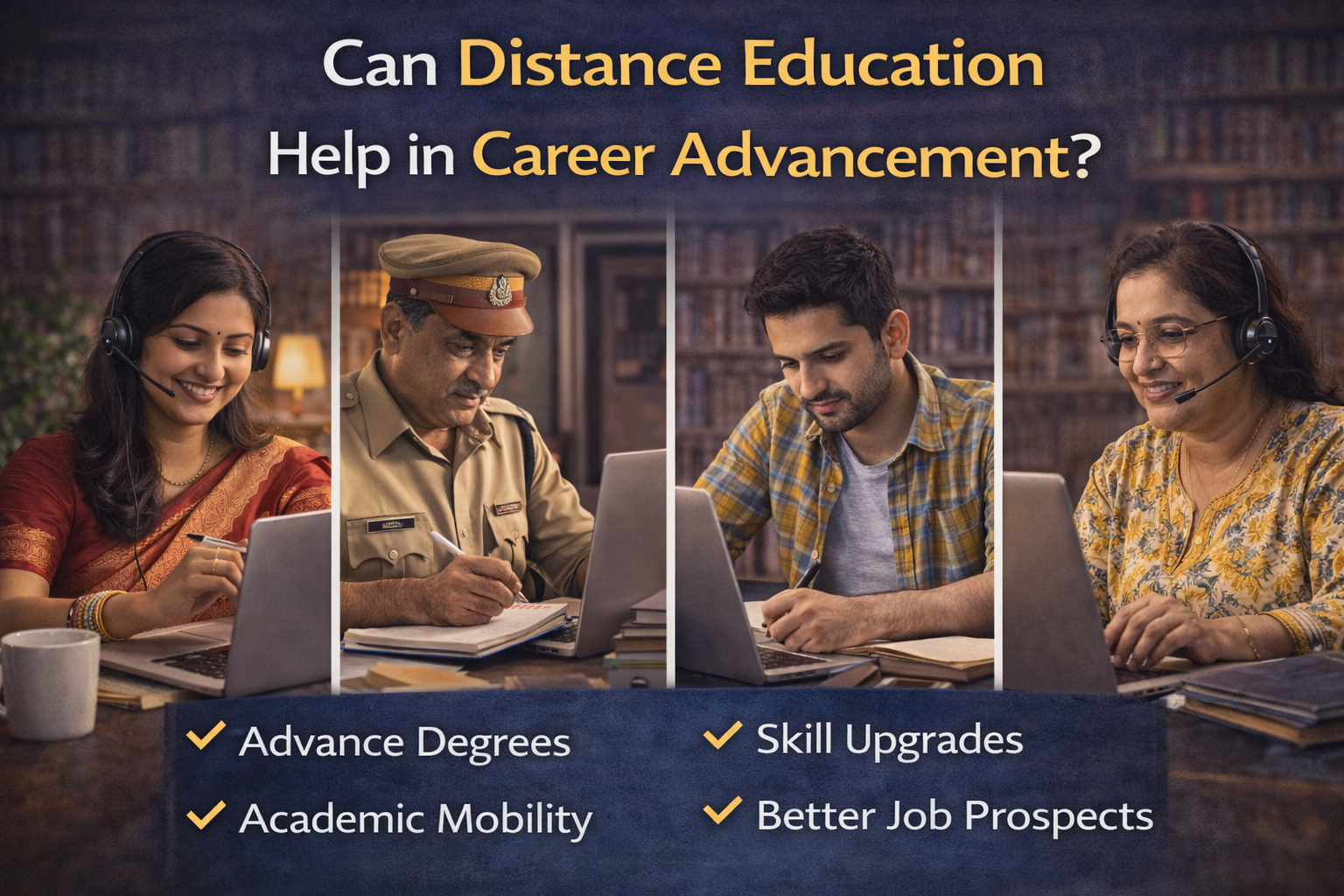
One of the strongest advantages of distance education is flexibility. Unlike regular courses that demand physical attendance and rigid schedules, distance programs allow learners to study alongside work or personal commitments. This flexibility is particularly beneficial for mid-career professionals who cannot afford a career break but need an additional qualification — for example, a master’s degree, diploma, or certification — to secure promotions or shift industries.
Imagine a teacher in a private college pursuing a distance M.Ed. or PhD. Without leaving her current job, she adds an advanced qualification to her profile. This not only enhances her teaching credentials but also opens opportunities for promotions and eligibility in government or UGC-approved institutions. In such cases, distance education directly contributes to professional growth.
Recognition Matters
Career advancement is not just about earning a certificate but about ensuring that the qualification is respected by employers. This is where recognition becomes critical. Distance education degrees from UGC-DEB approved institutions carry the same value as those from regular courses. Such recognition allows candidates to confidently use their degrees for job applications, competitive exams, or higher studies.
For example, in government service, a distance postgraduate degree from an approved university makes you eligible for promotions or departmental exams. In the private sector, many companies now accept UGC-DEB approved qualifications as proof of continuous learning. The key, however, is to carefully check the approval status of the program before enrolling.
Bridging the Skill Gap
Another way distance education aids career advancement is by bridging the skill gap. Industries are changing rapidly, and many professionals find their existing degrees outdated. Distance learning offers a chance to reskill or upskill without uprooting one’s career. Courses in data science, business administration, project management, and even niche areas like library sciences or social work are offered in distance mode.
By gaining these updated skills, professionals position themselves as valuable assets in their workplace. A working professional who earns a distance MBA in finance or HR, for instance, is more likely to be considered for managerial roles compared to someone with only a graduate degree.
Creating Academic Mobility
Career advancement is not limited to jobs; it also includes opportunities for further studies. Distance education can act as a stepping stone. Many learners use it to qualify for higher programs, such as enrolling in a PhD after completing a distance master’s degree. Because UGC-DEB approved qualifications are recognised nationally, they open doors to higher academic pursuits without discrimination between distance and regular learners.
Real-World Examples
Across India, there are countless examples of distance education serving as a ladder for career growth. A government employee who completes a distance master’s degree gains eligibility for higher pay scales and administrative posts. A corporate professional with a distance MBA can switch roles from operations to leadership. Even homemakers who return to professional life after a break find distance programs a way to re-enter the workforce with updated knowledge.
These real-world stories highlight that distance education is not just an alternative — it is a viable strategy for upward mobility.
Limitations to Keep in Mind
However, career advancement through distance education is not automatic. There are certain limitations:
- Perception issues: Some employers still prefer regular degrees, though this gap is closing.
- Self-discipline: Distance learners must be highly motivated, as there is less day-to-day supervision.
- Networking: Regular programs often provide stronger peer networks, which may be limited in distance mode.
Understanding these limitations helps learners set realistic expectations and work on overcoming them. For instance, students can supplement distance programs with internships, workshops, or online networking to strengthen their profiles.
Distance vs. Online vs. Regular Programs
While distance education has its merits, students must also differentiate it from online or regular programs. Regular programs may provide richer campus experiences, but they demand time and physical presence. Online programs often focus on short-term skill certifications. Distance education, however, sits in the middle — offering long-term, recognised degrees with the flexibility to balance personal and professional lives.
Conclusion
The question is no longer whether distance education helps in career advancement — it clearly does. What matters is choosing the right program, ensuring recognition, and aligning it with career goals. In India, where millions juggle work, family, and aspirations, distance education offers a bridge to progress. By upgrading qualifications, filling skill gaps, and opening academic doors, it transforms career paths that might otherwise remain stagnant.
For those willing to commit to disciplined learning, distance education is not a second choice but a smart choice — one that keeps careers moving forward without pause.