Introduction
Higher education in India today comes in many forms — distance, online, and regular. For students and working professionals, this variety can be both empowering and confusing. Each mode of learning carries its own advantages, recognition, and limitations. Yet, many people still struggle to understand the real differences between them. Is a distance degree the same as an online one? Does a regular program always carry more weight? And how do these choices affect one’s career in India? This blog unpacks these questions to help learners make informed decisions.
Understanding Regular Programs
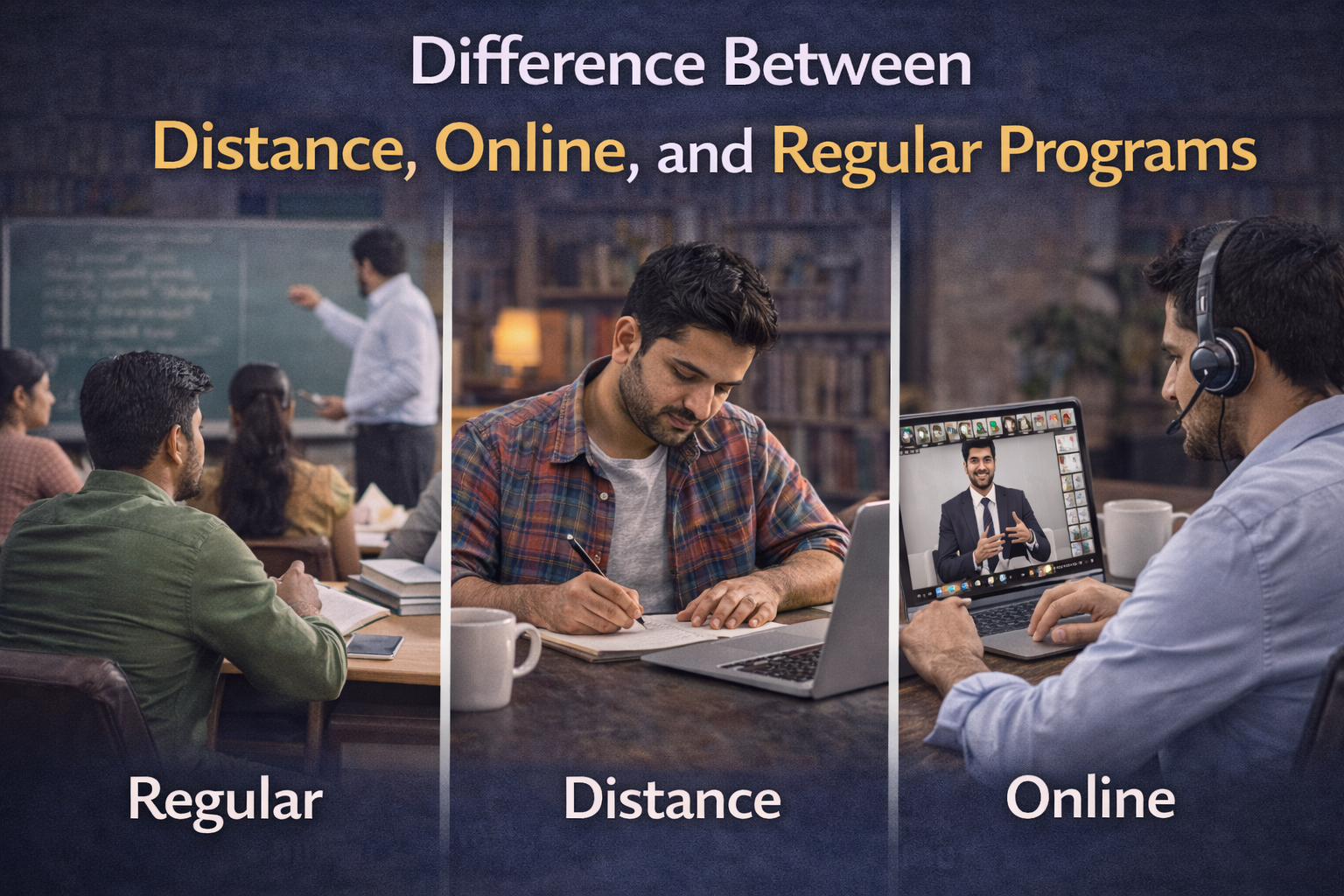
Regular programs are the traditional form of higher education in India. Students attend classes in person, follow a fixed timetable, and participate in campus-based activities such as seminars, workshops, and group projects. Regular courses are still the most common form of education and often preferred by students immediately after school.
The strength of regular programs lies in structured learning and networking opportunities. Students benefit from direct interaction with teachers, peer discussions, and access to university facilities. In India, employers often view regular degrees as the standard, particularly for fields such as engineering, medicine, and law. However, regular programs also demand significant time, financial investment, and physical presence, making them less flexible for working professionals.
Distance Education in Practice
Distance education differs from regular programs in that students are not required to attend classes on a daily basis. Instead, study material is provided through printed modules, digital resources, or periodic contact classes. This model is especially popular among working professionals and those living in areas without easy access to major universities.
The key advantage of distance programs is flexibility without compromising recognition. When offered by UGC-DEB approved institutions, these degrees carry the same value as regular qualifications. They allow individuals to pursue higher education while managing work, family, or other commitments. For example, a teacher in a rural town can complete a distance master’s degree without leaving their job, enabling career advancement.
The Rise of Online Programs
Online programs are the newest entrant in India’s higher education system. Unlike distance education, which often relies on self-study, online programs involve real-time virtual interaction through video lectures, discussion forums, and online assessments. Universities and private ed-tech platforms offer online degrees, diplomas, and certificate courses.
The strength of online programs lies in accessibility and technological integration. Students can attend classes from anywhere, interact with faculty globally, and use digital platforms for learning. They are particularly attractive to younger learners comfortable with technology and those looking for international exposure. However, not all online courses carry the same recognition. Only those approved by UGC or delivered by accredited institutions hold official academic weight in India.
Comparing the Three Modes
The differences between the three modes can be understood in terms of flexibility, recognition, cost, and learning experience:
- Flexibility: Distance and online programs offer flexibility, while regular programs demand fixed schedules.
- Recognition: Regular and UGC-DEB approved distance degrees hold strong recognition. Online programs are gaining credibility but need careful checking of accreditation.
- Cost: Distance programs are often more affordable than regular or online courses, making them attractive for financially constrained students.
- Learning Experience: Regular programs offer face-to-face interaction, online programs rely on virtual classrooms, and distance programs focus on self-study with periodic support.
Career Implications in India
For career advancement, the choice of program should align with personal goals.
- Those aiming for academic or government careers may benefit most from regular or UGC-DEB approved distance degrees, which are widely recognised.
- Professionals looking for skill upgrades, such as in data analytics or digital marketing, may find online certifications more useful.
- Distance education is often the bridge for mid-career professionals, especially teachers and administrators, who need higher qualifications without pausing their work.
Employers in India increasingly value lifelong learning. What matters most is the credibility of the institution and how the qualification complements professional experience.
Challenges and Misconceptions
One of the major misconceptions is that distance or online degrees are “inferior” to regular ones. In reality, the University Grants Commission has made it clear that approved distance degrees hold the same value as regular programs. Another challenge is perception bias in some industries, though this is steadily reducing as more professionals succeed with distance and online qualifications.
At the same time, students must be cautious about unapproved programs. With the growth of online learning, many unrecognised courses are marketed aggressively. Choosing wisely ensures that time and money are invested in degrees that genuinely advance careers.
Choosing What Works for You
The decision should ultimately depend on personal circumstances. A young student with the resources to attend campus may benefit from the immersive environment of a regular program. A working parent may find distance education more practical. A professional aiming to add quick, industry-relevant skills might choose an online course. Each path is valid if chosen with clarity about recognition and long-term goals.
Conclusion
The differences between distance, online, and regular programs reflect the diversity of higher education in India today. Regular programs remain the traditional and widely respected route. Distance education offers a bridge for those balancing work and study. Online programs bring the world to one’s laptop, combining flexibility with global exposure.
Rather than debating which is “better,” students should focus on which is right for their context. Recognition, career alignment, and personal circumstances must guide the choice. In a country where education is both a personal aspiration and a family milestone, having multiple pathways ensures that no learner is left behind.