
Introduction
In India, a degree is more than just a piece of paper—it is often seen as a passport to career opportunities, social recognition, and personal fulfillment. For decades, students and families have preferred traditional classroom education because it was assumed to be superior. With the rise of distance education, however, many learners are asking whether a degree earned through this route holds the same value as a regular one. The question matters because it affects employability, promotions, and even social acceptance. Understanding the equality between distance and regular degrees requires a closer look at policy, perception, and practice in the Indian context.
The Legal and Policy Perspective
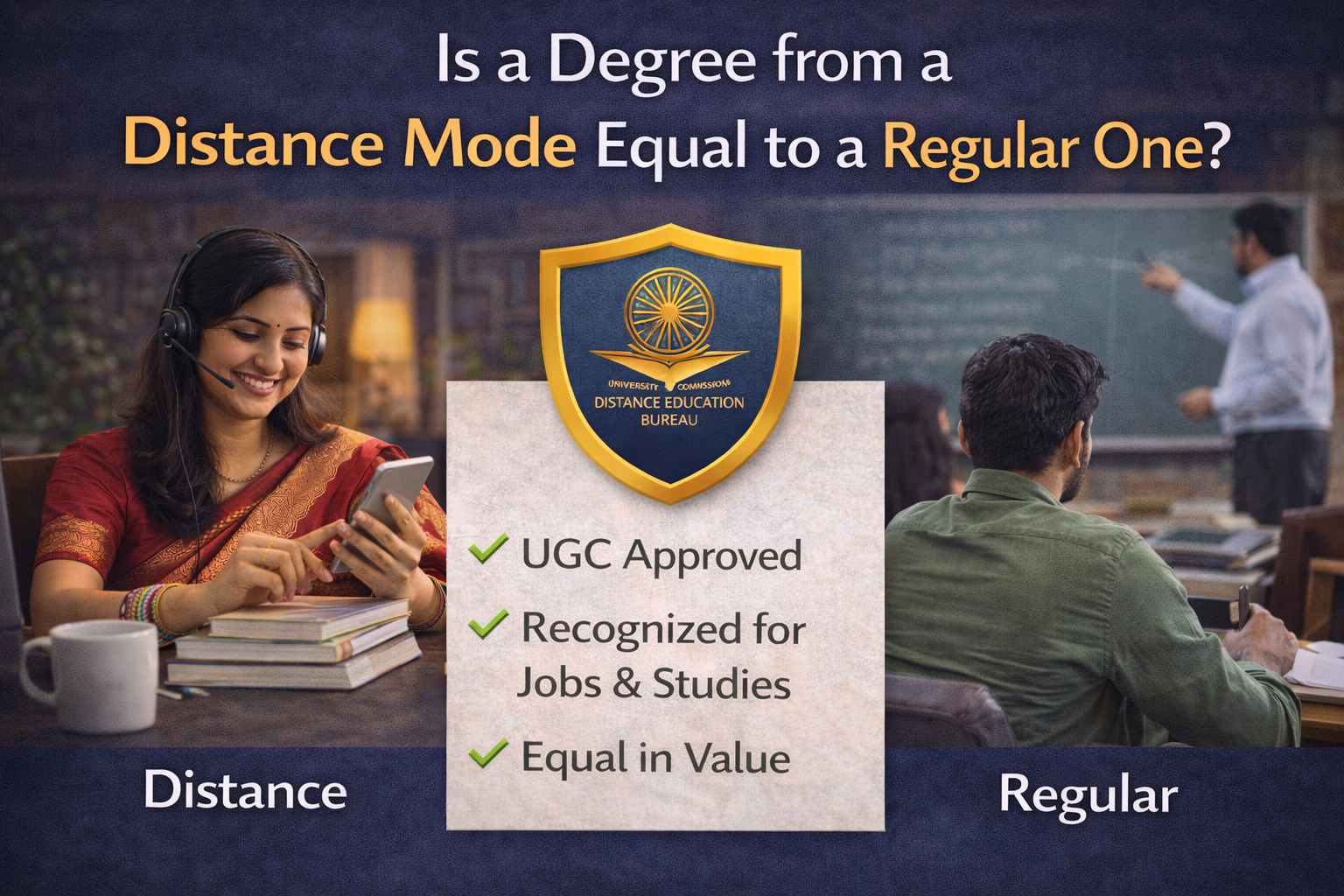
From a regulatory standpoint, the University Grants Commission (UGC) and its Distance Education Bureau (DEB) have clarified that degrees earned through approved distance education programs are considered equivalent to regular ones. This means that as long as the university and the program are officially recognised, the degree holds the same weight in terms of eligibility for jobs, higher studies, and competitive examinations. For example, a student with a distance MBA from a UGC-DEB approved institution is legally as eligible for public sector employment as someone with a regular MBA.
However, confusion often arises because not all programs are allowed to be offered in distance mode. Professional courses like engineering, medicine, and law are restricted to regular programs due to the requirement of practical training. Therefore, while equivalence exists in principle, students must ensure that their chosen program is among those permitted for distance delivery.
The Perception in the Job Market
Legal recognition is only part of the story. In practice, how employers view distance degrees plays a significant role. In government recruitment, there is little bias as long as the degree is from a recognised institution. In fact, many government employees pursue distance education specifically to qualify for promotions or higher pay scales.
In the private sector, perceptions are more mixed. Larger companies with structured HR policies often treat distance and regular degrees on par, especially for postgraduate qualifications like MBAs or MAs. Smaller organisations or traditional employers may still show preference for regular degrees, particularly at entry-level hiring. Yet, as more working professionals successfully upgrade their skills through distance learning, this perception is gradually changing.
The Role of Private Universities
Private universities in India have added a new dimension to the debate. By offering flexible and technology-enabled distance programs, they have blurred the line between distance and regular education. Recorded lectures, online interaction, and digital libraries ensure that distance learners today are not isolated but actively engaged with the institution. When such universities are well-recognised and accredited, their distance degrees often carry the same institutional brand value as their regular programs, helping graduates overcome doubts about equivalence.
This is especially important for working professionals who cannot leave their jobs to attend full-time programs. For them, a distance degree from a reputed private university provides both flexibility and recognition, bridging the gap between professional needs and academic requirements.
Myths That Continue to Exist
Despite regulatory clarity, myths about distance education continue to circulate. One common belief is that distance degrees are easier to earn and therefore less credible. In reality, distance learners often juggle jobs, family, and study commitments, which demands equal, if not greater, discipline. Another misconception is that distance graduates are excluded from government jobs. This is incorrect, as long as the program is UGC-DEB approved. These myths reflect outdated attitudes rather than actual policies.
The Changing Academic Landscape
The evolution of digital tools has further narrowed the distinction. Many distance programs now use blended models, combining printed material with online classes, discussion forums, and e-resources. This creates a learning experience closer to regular education than ever before. Internationally, too, distance learning has become mainstream, with top universities offering online or blended degrees. India’s gradual acceptance of such practices is part of a broader global trend where the mode of study is less important than the quality and recognition of the institution.
Conclusion
The question of whether a distance degree is equal to a regular one has both a straightforward answer and a nuanced reality. Legally, UGC-DEB approved distance programs carry the same value as regular degrees for employment and further study. Socially and professionally, perceptions are improving, though some bias remains in specific sectors.
What truly matters for students is choosing recognised institutions and aligning their degree with their career goals. In a higher education system as diverse as India’s, distance learning has carved out a legitimate space. For many, it is not a second choice but the most practical path to growth.