
Introduction
An MBA has long been considered one of the most influential qualifications in shaping careers in management, entrepreneurship, and corporate leadership. In India, the degree carries prestige as well as practical value, often opening doors to promotions, higher salaries, and industry recognition. With the rapid rise of distance education, many working professionals and fresh graduates now face a critical question: should they pursue a distance MBA or a regular MBA? Both options are legally valid and recognised, but their impact on career growth, learning experience, and personal circumstances can differ. Understanding the pros and cons of each route is essential for making the right choice.
The Appeal of a Regular MBA
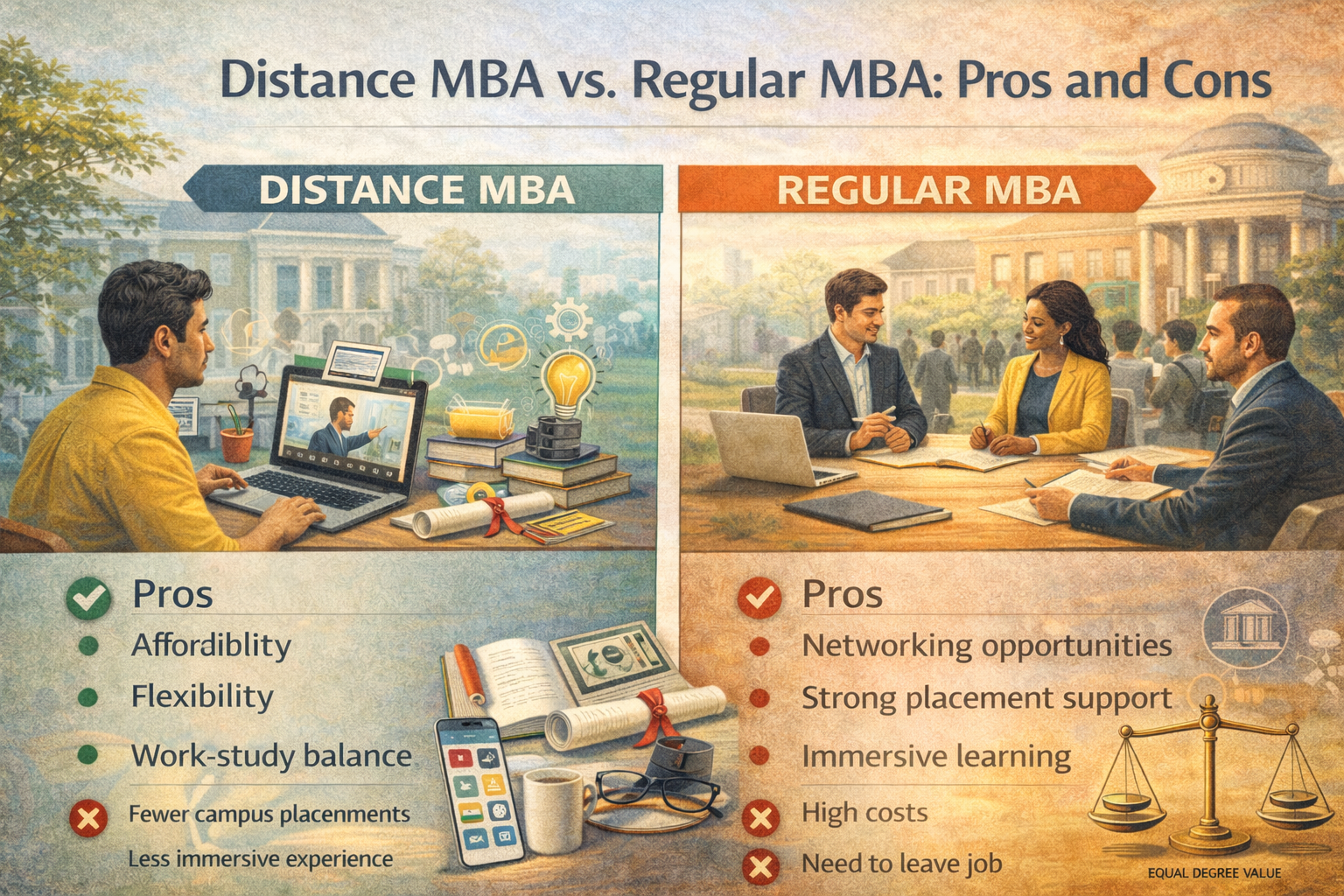
A regular MBA has traditionally been viewed as the gold standard of management education. The classroom experience offers students direct interaction with faculty, peers, and industry experts. This environment fosters teamwork, communication skills, and leadership qualities that are difficult to replicate in distance mode. Regular MBAs also provide access to campus placements, career counselling, and alumni networks, which often translate into lucrative job opportunities.
Another advantage is the immersive nature of the program. Students live and breathe the MBA experience for two years, engaging in group projects, case studies, and internships. For young graduates looking to establish themselves in the corporate world, this exposure is invaluable.
However, the regular MBA also comes with significant costs—both financial and personal. Tuition fees in reputed institutions can run into lakhs, and students must often relocate or leave jobs to attend full-time. For many working professionals or those with family commitments, these demands are difficult to manage.
The Strengths of a Distance MBA
A distance MBA, recognised by the University Grants Commission (UGC) and Distance Education Bureau (DEB), offers a more flexible alternative. Students can pursue the program without leaving their jobs, making it especially suitable for working professionals seeking career advancement. The affordability is another major advantage. Distance MBAs usually cost a fraction of regular programs, allowing wider accessibility without heavy financial strain.
In terms of learning resources, distance MBAs have improved dramatically in recent years. Universities now offer digital libraries, recorded lectures, online discussion forums, and even live virtual classes. For students already employed in management roles, the ability to directly apply classroom concepts to real-world situations makes the program highly practical.
Yet, distance MBAs may lack the strong campus placement opportunities of regular programs. Networking is more limited, and the absence of daily peer interaction can make the learning experience less dynamic. For students looking to switch careers rather than grow in an existing role, this can be a drawback.
Comparing Career Outcomes
From a career standpoint, both distance and regular MBAs are legally equivalent if pursued from UGC-DEB approved institutions. Government jobs and public sector promotions treat them on par. In private companies, the perception can vary. Large corporates often prefer regular MBAs from reputed institutes for entry-level management positions, while distance MBAs are valued for upskilling existing employees.
For example, a mid-level executive in banking may use a distance MBA to qualify for promotion to managerial roles. On the other hand, a fresh graduate aspiring to enter consulting or investment banking may find a regular MBA from a premier institute more advantageous.
Thus, suitability often depends on the individual’s career stage and goals. Distance MBAs tend to support vertical growth within a current career path, while regular MBAs open doors to wider industry shifts.
The Role of Private Universities
Private universities in India have played a significant role in bridging the gap between distance and regular MBAs. Many now offer blended programs combining online learning with periodic contact classes, workshops, and industry seminars. This hybrid approach ensures flexibility while maintaining opportunities for networking and exposure. Some universities also invite industry professionals to conduct virtual sessions, thereby enhancing credibility and engagement.
These innovations are slowly changing employer perceptions. As more successful professionals graduate from blended and distance MBAs, companies are recognising that quality does not solely depend on physical attendance but also on the rigour of the program and the learner’s initiative.
Myths and Misconceptions
Despite progress, several myths continue to cloud the reputation of distance MBAs. One misconception is that they are “easier” than regular MBAs. In reality, balancing work, family, and study in distance mode often requires greater discipline. Another myth is that distance MBAs are not accepted abroad. While recognition varies, degrees from reputed Indian universities approved by UGC-DEB are increasingly acknowledged, particularly when backed by professional experience.
There is also a belief that distance MBAs are unsuitable for freshers. While it is true that younger graduates may benefit more from the immersive environment of a regular MBA, motivated individuals can still leverage distance MBAs effectively, especially if they supplement it with internships and industry exposure.
Conclusion
The choice between a distance MBA and a regular MBA is not about which is universally “better” but about which aligns with one’s personal and professional needs. Regular MBAs offer immersive learning, strong networks, and placement opportunities, making them ideal for career shifts and entry into competitive sectors. Distance MBAs, on the other hand, provide affordability, flexibility, and practical application, making them highly suitable for working professionals seeking growth without leaving their jobs.
For Indian students and professionals, the key is to ensure that the program is UGC-DEB approved and that the degree complements long-term goals. As the education system evolves and digital tools narrow the gap between distance and regular learning, both pathways can serve as powerful tools for career advancement—provided the learner chooses with clarity and commitment.