Introduction
In recent years, higher education in India has undergone rapid transformation. Traditional classroom learning, once considered the only legitimate form of education, now exists alongside distance, online, and blended formats. Among these, the term ODL—Open and Distance Learning—is frequently used in policy documents, advertisements, and university announcements. At the same time, students also hear about “online” programs, which often sound similar but are, in fact, distinct in structure and regulation. For learners trying to make informed choices, especially in 2025, it is essential to understand what an ODL program really means and how it differs from purely online education.
Understanding ODL in the Indian Context
ODL stands for Open and Distance Learning, a system designed to expand educational opportunities to those who cannot attend regular classroom-based programs. Its roots in India go back several decades, with institutions like the Indira Gandhi National Open University (IGNOU) and state open universities pioneering the model. The essence of ODL is inclusivity—it allows anyone, regardless of age, location, or background, to pursue recognized degrees and diplomas without the restrictions of formal entry barriers in many cases.
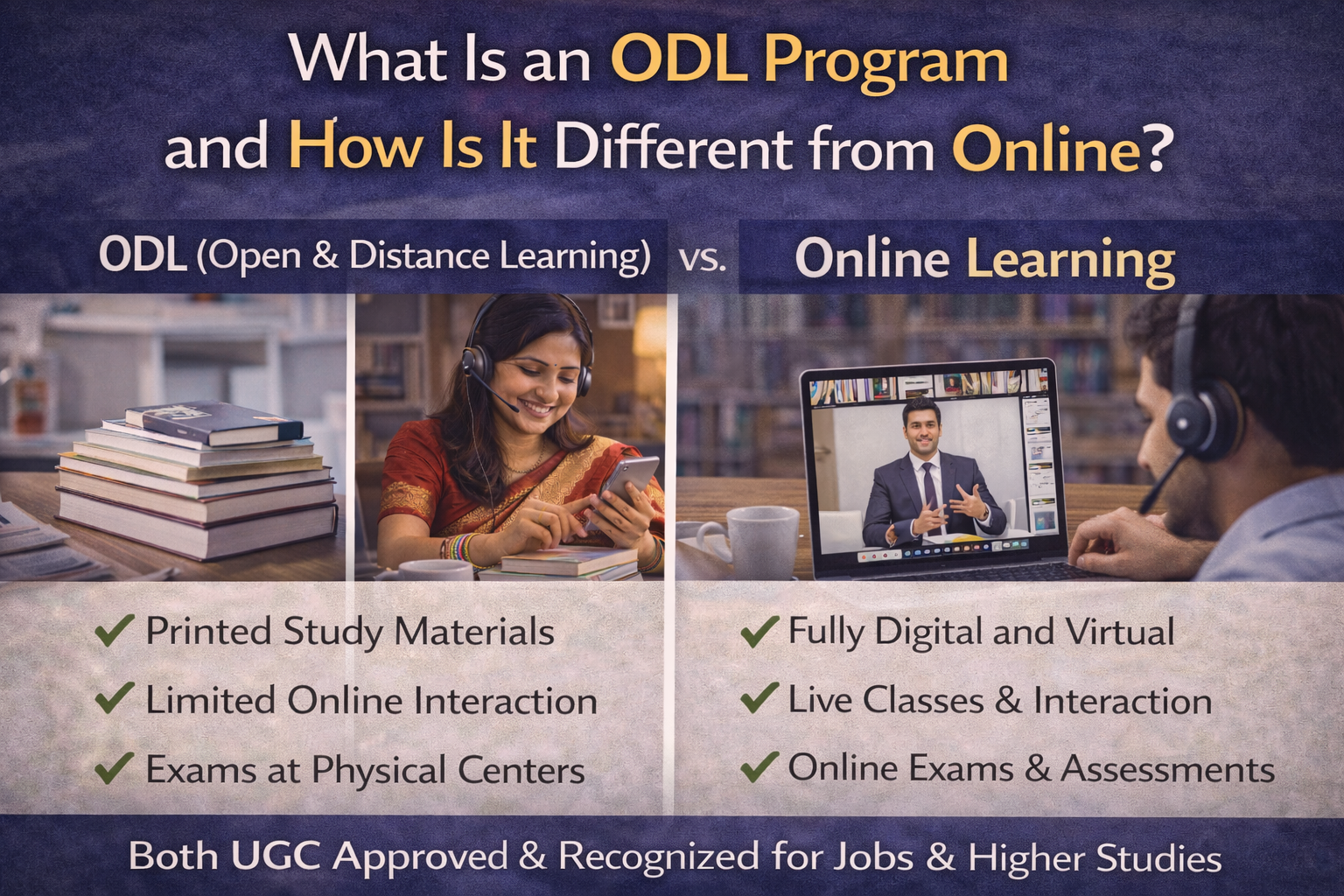
In ODL, students typically receive printed self-learning materials, supplemented by audio-visual content, recorded lectures, and sometimes in-person contact classes at regional centers. Examinations are conducted in designated centers across the country. This model ensures that even learners in rural or remote areas without reliable internet can continue their studies. In this sense, ODL balances flexibility with structure, making it a trusted pathway for millions of Indian students.
The Rise of Online Education
Online education, on the other hand, is a more recent development. Enabled by advancements in digital infrastructure, online programs deliver the entire teaching-learning process through the internet. From lectures to assignments, discussions to exams, every stage happens online. This format gained momentum during the COVID-19 pandemic, when universities worldwide moved classes to virtual platforms.
In India, the University Grants Commission (UGC) now regulates online degrees separately, ensuring they meet academic standards. Online programs often include live classes, interactive webinars, digital libraries, and discussion forums. Unlike ODL, where printed material is central, online education assumes that students have continuous internet access and the digital literacy to navigate platforms.
Key Differences Between ODL and Online Programs
Although both ODL and online modes aim to provide flexibility, their differences are important for students to recognize.
- Mode of Delivery: ODL uses printed materials and offline support as its backbone, with limited online integration. Online programs rely almost entirely on digital delivery.
- Accessibility: ODL is more inclusive for students in areas with poor connectivity, while online programs cater better to those with stable internet and devices.
- Interaction: Online courses often provide real-time interaction through webinars and chats. ODL relies on recorded content, regional study centers, or occasional contact classes.
- Assessment: In ODL, exams are usually conducted at physical centers. In online programs, assessments may include proctored online tests or project-based evaluations.
- Flexibility: Both are flexible, but ODL offers broader accommodation for those balancing work, family, and study without demanding continuous online presence.
Regulatory Clarity from UGC
The University Grants Commission has drawn clear lines between ODL and online education to avoid confusion. Degrees from both modes are valid and recognized, provided they are offered by institutions with UGC-DEB (Distance Education Bureau) approval. However, certain professional courses—such as medicine, law, and engineering—are not permitted in either ODL or online format due to the requirement of practical training.
For students, this means that as long as they enroll in an approved program, their degree will be treated on par with regular degrees for employment, further studies, and government job eligibility. The distinction lies not in recognition but in delivery and learning experience.
The Indian Learner’s Perspective
Choosing between ODL and online depends largely on a student’s context. A learner in a rural area with limited internet may prefer ODL, relying on printed modules and occasional support sessions. A working professional in a metro city, however, may opt for online education, attending live classes after office hours and engaging in digital peer networks.
Both systems serve different needs but share a common goal—making higher education more inclusive. Importantly, the stigma once attached to non-regular modes has diminished, as even top universities now offer degrees through ODL and online platforms.
Global Comparisons and Local Relevance
Globally, the distinction between ODL and online is less pronounced because digital access is more widespread. In India, however, ODL continues to play a vital role in bridging the digital divide. Universities like IGNOU and state open universities reach millions of learners who may not yet be ready for a fully online model. Meanwhile, online programs offered by private universities and ed-tech partnerships appeal to digitally savvy learners seeking interactive experiences.
This dual structure ensures that no group is excluded—those with minimal resources still benefit from ODL, while those with better access embrace online learning. Together, they form a complementary ecosystem within India’s education sector.
Future Directions
Looking ahead, the line between ODL and online may blur as technology penetrates deeper into rural areas. Hybrid models that combine printed resources with online lectures are already emerging. For example, a student might receive printed study material while also logging into an app for video sessions. Such blended approaches could represent the future, ensuring that both inclusivity and interactivity are maximized.
For students, the key is to focus less on the label—ODL or online—and more on the credibility of the institution, the approval status of the program, and its alignment with career goals.
Conclusion
ODL and online education are not rivals but complementary systems designed to expand access to higher learning. ODL provides a lifeline for those without reliable internet, while online programs deliver flexibility and interactivity for digitally equipped learners. Both are legitimate, UGC-approved, and recognized for jobs and higher studies.
In a diverse country like India, where educational needs vary drastically across regions, having both ODL and online modes ensures that opportunities reach everyone. The difference lies in delivery, but the outcome—a recognized degree—remains the same. For learners, understanding this distinction is the first step toward choosing the path that best fits their life circumstances and ambitions.