Introduction
One of the biggest questions that students ask before enrolling in a distance education program is about access to study material and resources. In traditional universities, learners benefit from physical libraries, labs, and in-person support. Distance learners, however, often worry that they might miss out on these academic tools. In India, where digital literacy and infrastructure are uneven, the concern is valid. Yet, over the last decade, universities and regulatory bodies have significantly strengthened the support offered to distance learners, especially through digital platforms and online libraries. This blog explores how access to learning resources is being redefined for students who choose the distance mode.
The Changing Nature of Study Material
Earlier, distance education was synonymous with printed self-learning material delivered by post. While these printed booklets are still widely used, the landscape has changed dramatically. Today, universities provide digital copies of study materials through Learning Management Systems (LMS), mobile apps, or institutional portals. These materials are often interactive, featuring diagrams, case studies, and even embedded videos.
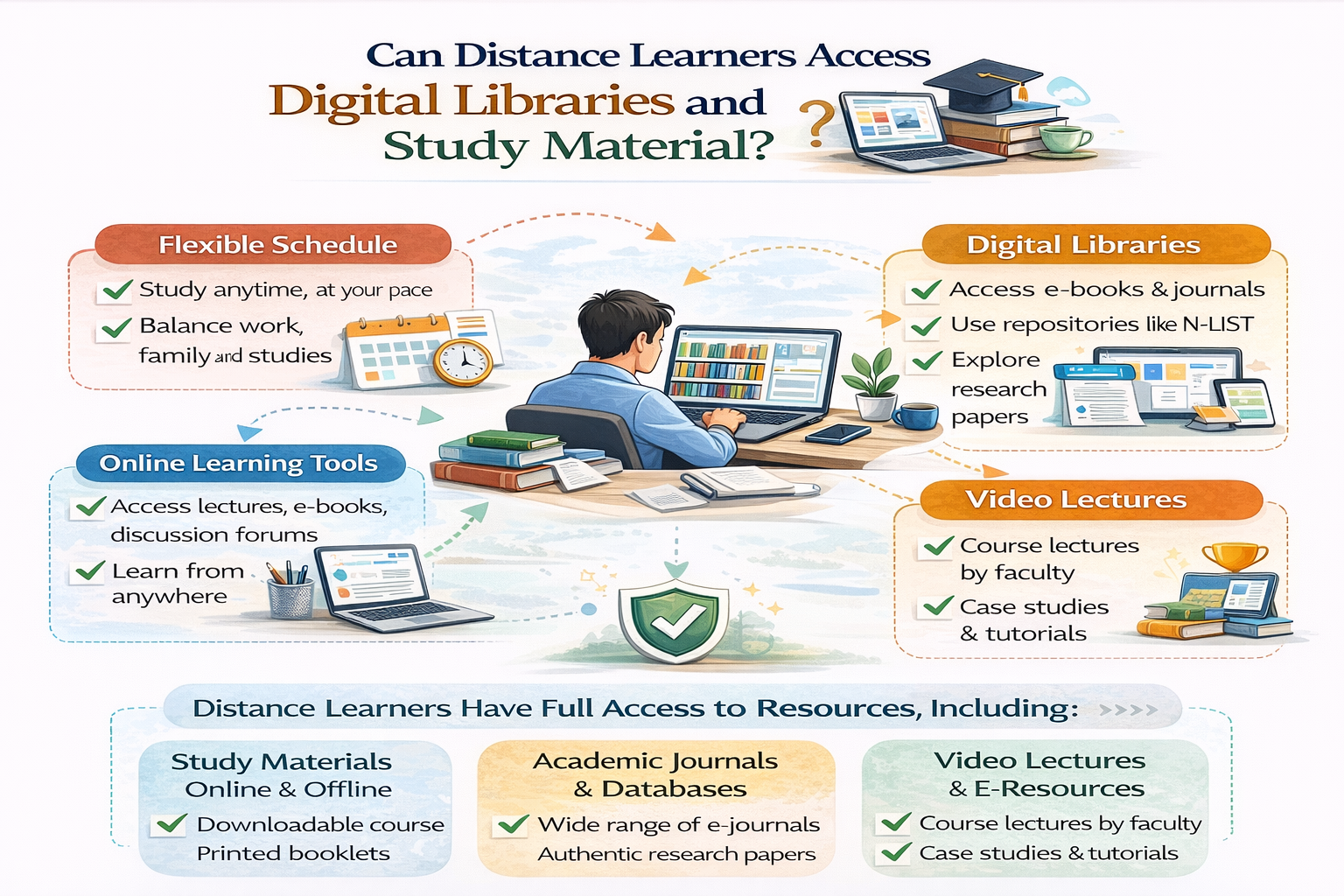
Moreover, the University Grants Commission (UGC) and Distance Education Bureau (DEB) now require institutions to provide comprehensive study resources in both digital and print formats. This dual availability ensures that students from rural or remote areas, who may face connectivity issues, are not disadvantaged. At the same time, those with internet access can benefit from the speed and convenience of digital downloads.
Access to Digital Libraries
One of the most significant advantages for distance learners today is access to e-libraries. Many universities have partnerships with national and international digital repositories, giving students free access to journals, e-books, and research papers. Platforms like INFLIBNET’s N-LIST program, Shodhganga, and e-ShodhSindhu provide millions of academic resources at no cost to students.
For postgraduate and doctoral learners, this access is invaluable. It allows them to stay updated with the latest research trends, cite authentic sources, and prepare strong dissertations or project reports. Digital libraries also bridge the gap between regular and distance students, ensuring that both groups are exposed to the same academic literature.
Role of LMS Platforms
Most reputed universities now conduct their distance education programs through LMS platforms. These platforms act as a one-stop hub for all academic needs. Apart from study material, students can watch recorded lectures, participate in discussion forums, take mock quizzes, and even interact with faculty. Study resources are often categorised module-wise, helping learners progress step by step.
For example, a student enrolled in a distance MBA can download e-books, watch topic-specific lecture videos, and attempt practice questions — all from the LMS. This format not only provides study material but also makes the learning process structured and interactive.
Support for Rural and Remote Learners
India’s diversity poses a challenge: not all students have regular internet access or the devices needed to use e-libraries. Recognising this, many universities still distribute printed self-learning material. Additionally, some universities set up regional centres or study centres where students can access computers, internet, and printed academic resources. This hybrid model ensures inclusivity, making distance education more equitable across social and geographical boundaries.
Government initiatives like the National Digital Library of India (NDLI) have further expanded opportunities. NDLI provides access to over seven crore digital resources in multiple Indian languages, ensuring that even distance learners in remote districts can benefit from high-quality academic material if they have occasional internet access.
Challenges That Still Remain
Despite these advances, challenges persist. Not all private universities provide seamless digital access, and some rely too heavily on generic study material without updates. Technical glitches in LMS platforms, limited awareness about e-libraries, and language barriers can also restrict effective use. Distance learners often need orientation sessions to make full use of these digital tools, something many institutions are still working to implement.
Why Access Matters for Profile Building
For distance learners, access to authentic study material is not just about completing exams — it also plays a key role in academic profile building. Having access to research papers, case studies, and updated references allows students to produce higher-quality assignments and dissertations. This, in turn, enhances their credibility during job applications or further studies.
Employers and universities are increasingly less concerned about whether a degree was earned in regular or distance mode. Instead, they look at the knowledge, skills, and confidence a candidate demonstrates. A student who has actively engaged with digital libraries and resources is far better prepared than someone who relied only on outdated booklets.
Conclusion
The perception that distance learners are cut off from academic resources is outdated. With the rise of digital libraries, LMS platforms, and government-supported repositories, distance education students now enjoy wide access to study material. While connectivity and institutional quality remain challenges, the overall trend is positive.
For today’s learners, the real task lies in making full use of these opportunities. Whether through e-journals, recorded lectures, or printed booklets, the resources are available — what matters is how effectively students engage with them. Distance education in India is no longer about isolation; it is about learning with flexibility, supported by a strong and growing academic ecosystem.