
Introduction
When Indian students think about distance education, they often imagine a system limited to books, notes, and online lectures. A common doubt is whether such programs can include practical training. After all, practical exposure is critical for many fields, especially technical, vocational, and professional courses. Without it, learners may worry about gaps in their knowledge or employability. This blog explores whether distance education can realistically provide practical training, how institutions manage it, and what options exist for students who want both flexibility and hands-on learning.
The Policy Framework
According to the University Grants Commission (UGC) and the Distance Education Bureau (DEB), not all courses are permitted in distance mode. Fields like medicine, law, pharmacy, and engineering, which rely heavily on practical or laboratory-based learning, are restricted to regular classroom study. This rule ensures quality and prevents students from receiving incomplete or inadequate training.
However, for other programs where practical elements can be simulated or delivered through short workshops, distance education has been evolving. For example, courses in management, commerce, social sciences, and education often include case studies, project work, and internships that serve as practical components. The flexibility lies in how universities design these aspects within a distance framework.
Blended Learning Models
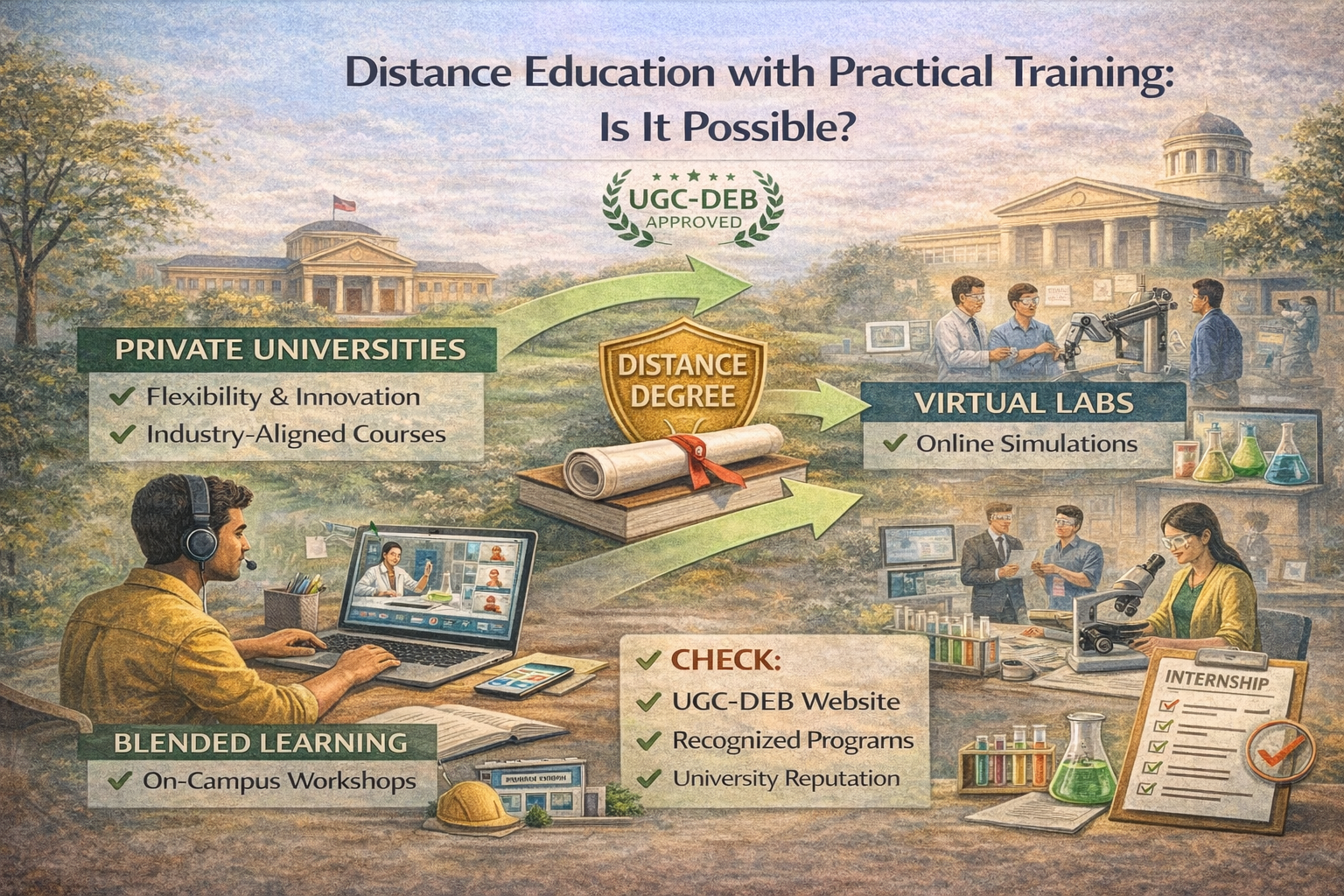
Many private and public universities have adopted blended models to integrate practical exposure. For instance, distance learners may be asked to attend weekend workshops, summer training sessions, or short residential programs at the university or regional centres. This allows students to experience hands-on learning without committing to a full-time campus presence.
In vocational and skill-based courses, partnerships with local training centres are also common. Students can enrol in a distance program for theoretical learning while completing practical modules at approved centres in their city or district. This approach balances flexibility with skill-building.
Virtual Labs and Simulations
One of the most promising developments for distance education in India is the use of virtual labs and simulations. Initiatives like SWAYAM and NPTEL have already shown how technology can deliver complex concepts online. In fields like computer science, biotechnology, or electronics, universities are now using virtual labs where students can simulate experiments, run coding tasks, or practice technical exercises remotely.
While virtual labs cannot entirely replace real-world exposure, they significantly reduce the gap. For many students, especially those in remote areas, this makes previously inaccessible courses more feasible.
Internships and Fieldwork
For courses like management, education, and social work, practical training often takes the form of internships, teaching practice, or field assignments. Distance learners are usually required to complete these components locally, under the supervision of qualified mentors or through industry partnerships. Universities provide guidelines and evaluation frameworks to ensure these activities meet academic standards.
This method has proven effective, as it allows students to gain real-world exposure in their own contexts — whether through local schools, NGOs, or companies — while still benefiting from the flexibility of distance education.
Challenges in Practical Training for Distance Learners
Despite innovations, challenges remain. Virtual labs require stable internet and devices, which are not equally accessible across India. Regional workshops may be difficult for students living far from university centres. Moreover, some employers still assume that distance courses lack serious practical components, leading to doubts about graduate skills.
Another issue is variation in quality: while reputed universities integrate strong practical modules, less regulated institutions sometimes offer only theoretical content, leaving learners underprepared. Students must therefore carefully check how a university manages the practical side before enrolling.
Why Practical Training Matters
Practical exposure is not just about passing exams — it strengthens employability and confidence. Employers often test candidates on real-world problem-solving and application of concepts, not just theoretical knowledge. A distance degree with well-designed practical components ensures that students are job-ready, even if they have studied remotely.
For example, a distance MBA student who has completed a structured internship and project work will stand out compared to someone who has only read course material. Similarly, a distance B.Ed. graduate with supervised teaching practice will be better prepared for classroom challenges.
Conclusion
Distance education in India is not limited to theory. With regulatory support, technological innovation, and creative delivery models, practical training has become an important part of many distance programs. While certain professional fields remain restricted to regular study, numerous other courses successfully integrate practical elements through workshops, internships, simulations, and blended learning.
For students, the key is to choose universities that prioritise practical exposure alongside academic content. In today’s education system, flexibility and hands-on training can go hand in hand — making distance learning a viable and credible option for those who want both convenience and competence.