
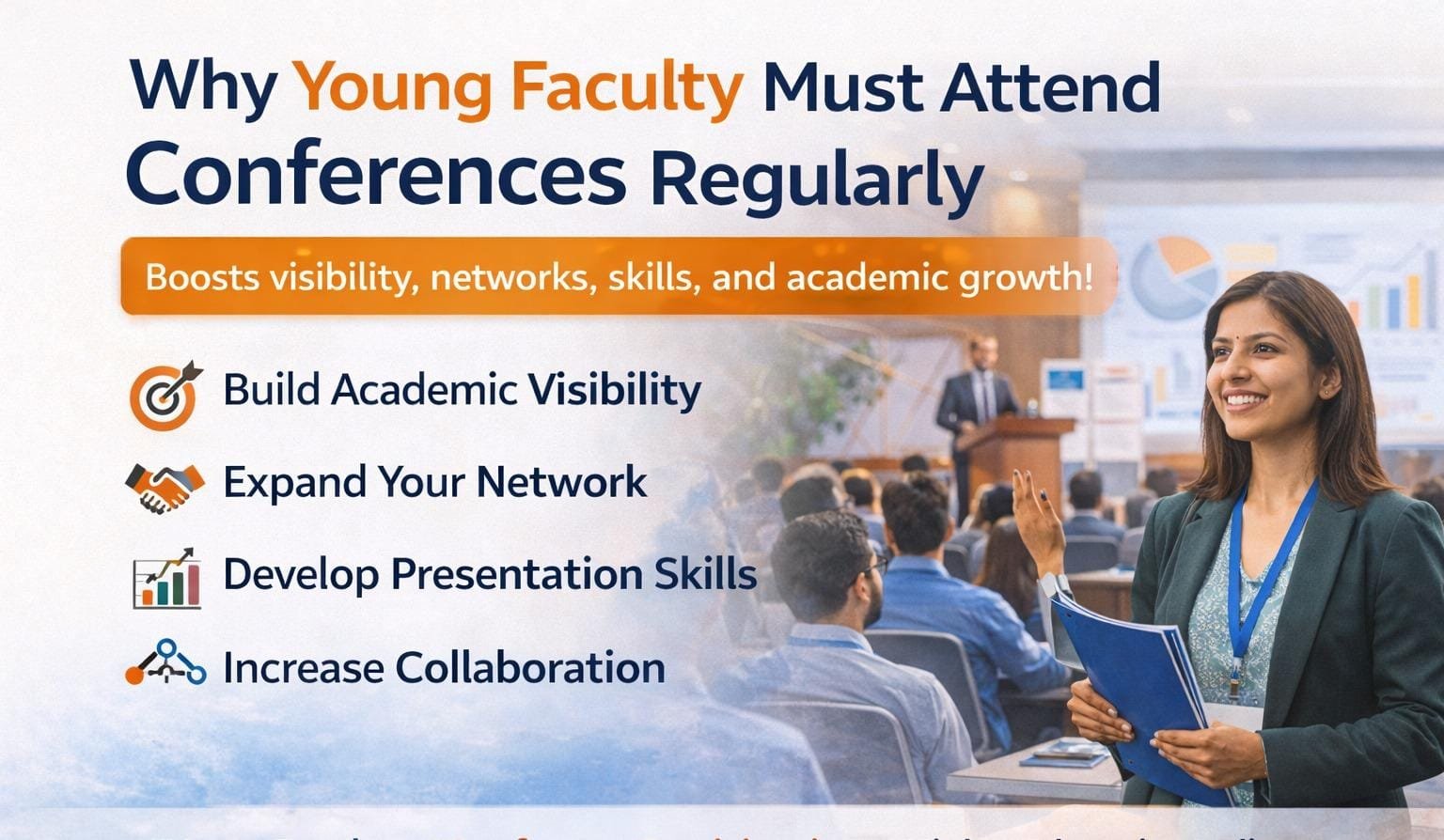
Introduction
For young faculty in India, the early years of an academic career are critical for establishing credibility, building networks, and developing a strong research profile. Conferences provide an ideal platform to achieve these goals, offering exposure to the broader scholarly community, opportunities for collaboration, and insights into emerging trends. Regular participation ensures that young faculty do not remain confined to their own institution’s environment, but actively contribute to and learn from the wider academic discourse.
Building Academic Visibility
Regular conference participation helps young faculty gain recognition beyond their home university. In India, private universities are increasingly emphasizing research and scholarly engagement, but younger faculty often face challenges in establishing their professional identity. Presenting papers, chairing sessions, or participating in panel discussions signals active contribution to the field. Repeated presence at conferences over time builds a visible track record, enhancing credibility with peers, potential collaborators, and evaluators.
Visibility is not limited to presenting research. Observing other scholars, engaging in discussions, and asking informed questions positions young faculty as active and thoughtful participants in academic debates. Such engagement demonstrates initiative and professionalism, qualities that are valued during promotions, faculty appraisals, and grant evaluations.
Networking and Collaboration Opportunities
Conferences offer young faculty access to mentors, collaborators, and senior researchers who can guide their academic trajectory. In India, where institutional hierarchies and professional connections influence research opportunities, networking at conferences is particularly valuable. Interactions during sessions, workshops, or informal gatherings can lead to co-authored papers, joint research projects, or invitations to participate in collaborative initiatives. These connections often provide guidance on best practices in research, publication strategies, and career development.
Networking also allows exposure to interdisciplinary perspectives. By attending conferences outside one’s immediate specialization, young faculty gain fresh insights, discover new methodologies, and identify potential areas for collaborative research that enhance both the scope and quality of their work.
Skill Development and Confidence
Presenting at conferences hones communication, critical thinking, and presentation skills. Young faculty learn to summarize complex ideas concisely, defend methodologies under scrutiny, and engage with diverse audiences. In India, where viva examinations, peer evaluations, and faculty appraisals are rigorous, these experiences build confidence and professional competence. The process of repeated participation strengthens the ability to handle challenging questions, interact with senior academics, and navigate professional discourse effectively.
Listening actively at conferences further contributes to skill development. Observing how senior scholars respond to questions, structure arguments, and engage with feedback provides practical lessons that can be applied to teaching, research, and academic presentations.
Strategic Participation for Long-Term Growth
Young faculty should plan conference participation strategically, balancing research, teaching responsibilities, and available resources. Selecting events aligned with research interests, prioritizing high-quality academic gatherings, and incorporating both national and regional conferences ensures meaningful engagement. Online conferences can supplement offline participation, offering additional exposure without excessive travel or financial burden. Regular participation, rather than sporadic attendance, ensures consistent growth and sustained academic visibility.
Conclusion
For young faculty in India, conferences are more than occasional professional events—they are essential for visibility, networking, skill development, and career growth. Regular attendance builds credibility, fosters collaborations, and equips scholars with practical skills for research and academic communication. By integrating conferences into their professional routine, young faculty establish a strong foundation for long-term success, ensuring that they remain connected, informed, and active participants in the wider academic community.