
Introduction
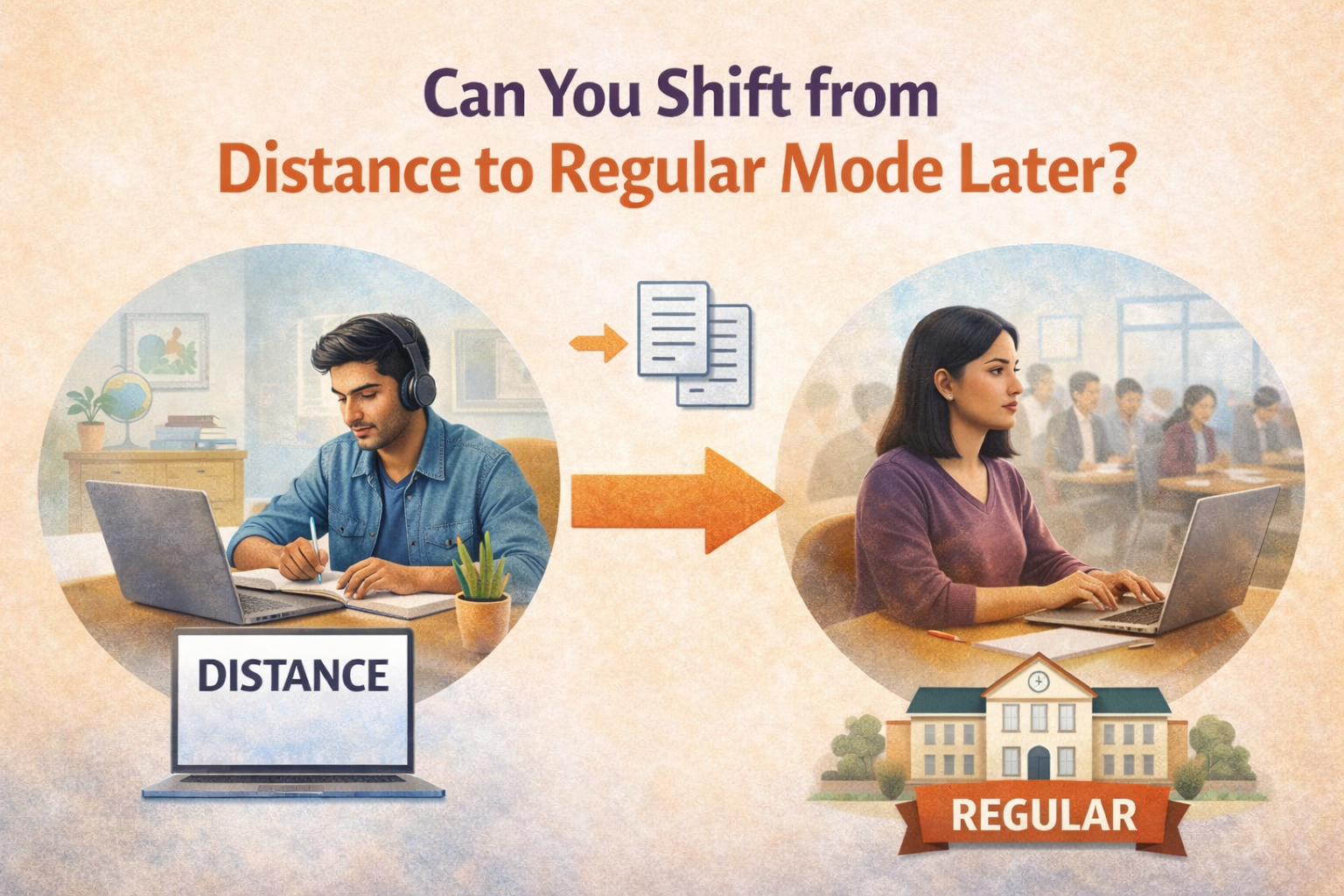
Many students in India choose distance education because it offers flexibility, affordability, and accessibility. For those managing jobs, family, or living in regions far from major universities, distance programs become the practical choice. Yet, as circumstances change, some learners begin to wonder: can they switch from distance mode to regular, on-campus study later? The answer depends on university policies, regulatory guidelines, and the student’s own academic journey. Exploring this possibility is essential, as it directly impacts long-term career planning and academic recognition.
Why Students Consider Switching
The decision to move from distance to regular mode often comes from changing life situations. A learner who initially chose distance education due to financial constraints might later be able to afford regular study. Others may complete a portion of their program while working, and then want to shift to full-time study for deeper exposure.
Regular mode provides benefits such as face-to-face learning, direct faculty interaction, access to campus facilities, and opportunities for peer networking. For students preparing for careers in research or professional fields that demand practical exposure, these advantages are significant. Thus, the idea of shifting modes becomes a natural consideration.
UGC and University Guidelines
In India, the University Grants Commission (UGC) regulates higher education, including distance programs. UGC guidelines generally allow universities to frame their own rules regarding migration between distance and regular modes, provided academic standards are maintained. However, the availability of this option varies widely between institutions.
Some universities permit students to transfer from distance to regular mode at specific stages, such as after completing the first year of a degree. Others may not allow it at all, requiring students to either complete the program in the mode they began or reapply fresh to the regular program. The rules also depend on the equivalence of curricula—if the syllabi differ significantly, migration may be denied.
Credit Transfer Systems
A key factor in switching modes is credit transfer. Universities following the Choice Based Credit System (CBCS) often allow students to carry forward completed credits from distance courses into regular programs. This means a learner does not have to repeat modules already studied. For example, if a student finishes the first year of a B.Com through distance mode, they may transfer those credits to a regular B.Com program, provided both institutions follow CBCS and recognise each other’s courses.
However, not all universities accept external credits, and students may lose some academic progress in the transition. Therefore, it is vital to verify policies before enrolling in a distance program if one plans to eventually shift to regular study.
Practical Challenges in Switching
Even when policies allow migration, practical challenges exist. Admission to regular programs often depends on seat availability, entrance examinations, and merit lists. A distance learner hoping to shift may find that seats in the regular program are limited or reserved for fresh applicants.
Additionally, universities sometimes restrict transfers to within the same institution. For example, a student enrolled in the distance wing of a central university may be allowed to move to its regular campus, but not to another university altogether.
These challenges highlight the importance of foresight. Students who anticipate a switch later should ideally choose institutions that operate both regular and distance programs under the same umbrella, increasing the likelihood of migration.
Career and Recognition Aspects
From a career perspective, both distance and regular degrees recognized by the UGC carry equal academic weight. Yet, in certain fields—especially where practical experience or lab work is central—regular degrees may offer stronger preparation. This is why students often seek the shift.
Employers in sectors such as IT, business, or public services generally treat both modes equally if the university is recognised. However, for academic careers, professional licensure, or highly specialised roles, the regular pathway can sometimes offer an edge. Thus, shifting may make sense depending on individual goals.
Advice for Students Considering a Switch
For those planning to shift from distance to regular mode, careful planning is necessary. Research the university’s policies before enrolment, maintain strong academic performance in the distance program, and prepare for possible entrance exams if required.
It is also wise to have realistic expectations. Shifting may not always be possible mid-course, and in some cases, starting afresh in the regular mode may be the only option. While this can feel discouraging, the long-term benefits—such as access to labs, internships, and campus networks—may justify the effort.
Conclusion
Switching from distance to regular mode is possible in India, but it depends on institutional rules, curriculum compatibility, and seat availability. While UGC recognition ensures that both modes hold equal academic value, the experiential benefits of regular study often motivate students to make the change. For learners, the best approach is to research thoroughly, choose universities that allow flexibility, and remain open to both pathways. Ultimately, whether in distance or regular mode, what matters most is dedication, consistent effort, and clarity of career goals.