
Introduction
Distance education in India has grown tremendously in the last two decades. From undergraduate degrees to specialised postgraduate programs, learners now have access to a wide variety of courses offered by central universities, state universities, private institutions, and open universities. This growth has opened up opportunities for millions of students who cannot pursue traditional education due to work, geography, or family responsibilities.
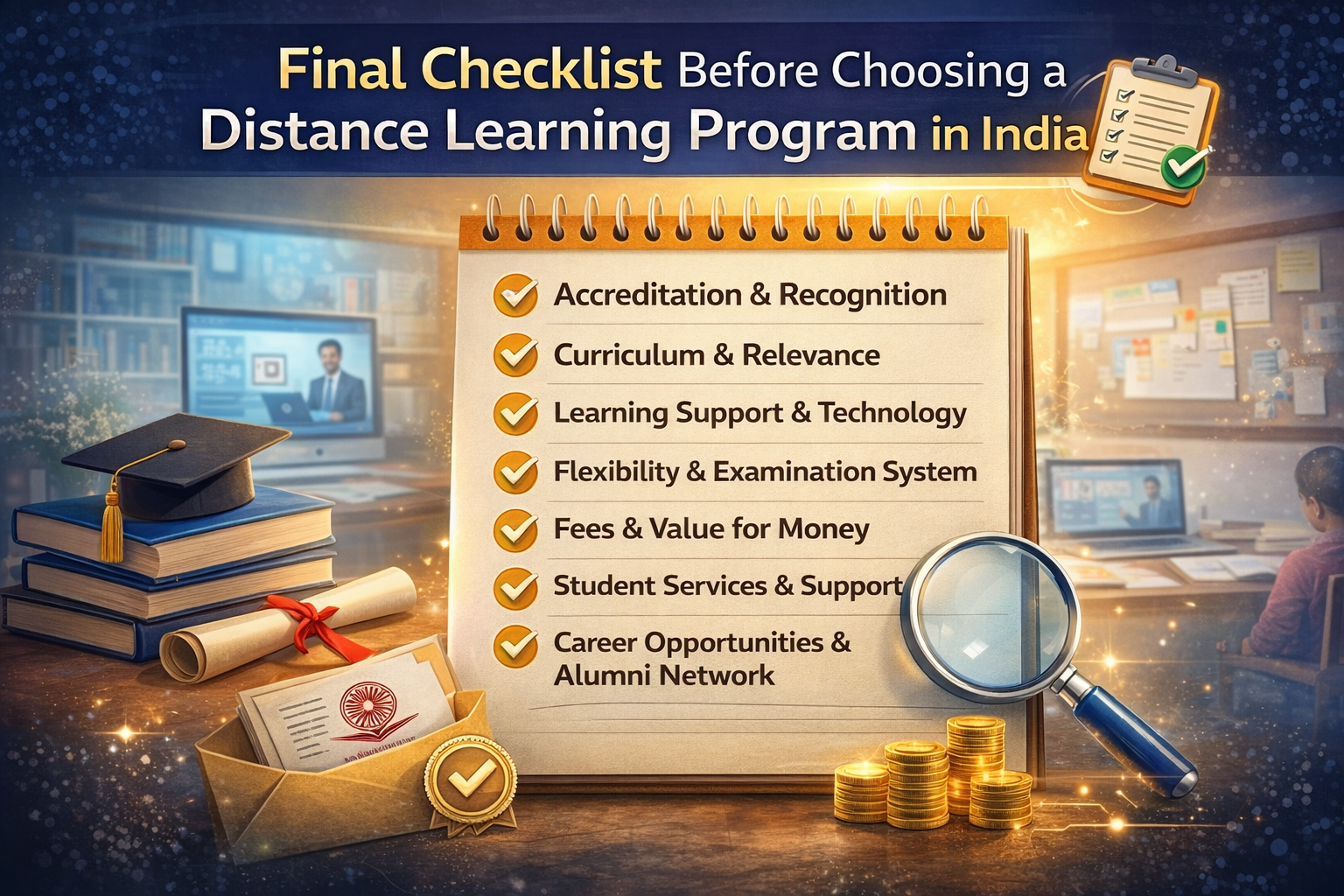
However, the abundance of choice also creates confusion. Not every program delivers on its promises, and not every university is equally recognised. Before enrolling, students must carefully evaluate their options to ensure that the course they choose aligns with their academic goals, professional aspirations, and personal circumstances. A final checklist can serve as a reliable guide to making the right decision.
Accreditation and Recognition
The first and most important step is to confirm whether the program is recognised by the University Grants Commission (UGC) and, where relevant, approved by bodies like the AICTE (for technical programs) or NCTE (for education courses). Without proper recognition, degrees may not be valid for jobs, competitive exams, or higher education. Unfortunately, some institutions run unaccredited programs, and unsuspecting students suffer later when their degrees are rejected.
Learners should always check the official UGC-DEB (Distance Education Bureau) list of approved universities and courses. This ensures that the investment of time and money leads to a degree with genuine value.
Curriculum and Relevance
A program’s curriculum should align with a student’s goals. For example, a working professional in business might prefer a distance MBA with case studies, project work, and industry-relevant modules, rather than one that focuses purely on theoretical concepts. Similarly, teachers pursuing a B.Ed. in distance mode should ensure that the program includes practical components such as teaching practice.
Reviewing the syllabus, evaluating learning materials, and checking whether the course structure follows the Choice Based Credit System (CBCS) can provide clarity on its academic depth.
Learning Support and Technology
Modern distance education relies heavily on technology. A good program offers access to a Learning Management System (LMS) where students can view lectures, download study materials, and submit assignments. Interactive elements such as webinars, discussion forums, and virtual classes also enhance learning.
Before enrolling, students should check the availability of these facilities. In India, where internet access is uneven, the presence of offline resources like printed materials and contact classes adds significant value. A balanced program blends traditional study materials with digital tools to suit diverse learners.
Flexibility and Examination System
Flexibility is one of the main attractions of distance education, but this flexibility varies. Students must ask:
- Are there options for rescheduling exams if necessary?
- Does the university allow online examinations or only in-person tests?
- How often are assignments due, and is there scope for extensions?
A program that accommodates working professionals or students with family responsibilities is often more sustainable in the long run. Understanding the examination system in advance prevents last-minute surprises.
Fees and Value for Money
Distance programs are usually more affordable than regular ones, but costs still vary widely. Some private universities charge premium fees without offering proportionate support. Students should compare tuition fees, study material costs, and examination fees before deciding. At the same time, value matters more than cost alone. An affordable program that lacks recognition or quality resources is ultimately more expensive in terms of wasted time and opportunities.
Student Services and Support
Strong student support systems make a huge difference in distance learning. Reliable communication channels, responsive helplines, and regional centres for administrative assistance can reduce stress for students. Checking alumni reviews or speaking with current students can reveal whether the university genuinely supports its learners.
Career Opportunities and Alumni Network
A final but crucial factor is employability. Programs that provide placement assistance, industry partnerships, or access to an active alumni network often give students an edge in their careers. Even if formal placements are not offered, programs with practical components like internships or projects tend to improve job readiness.
Conclusion
Choosing a distance learning program in India requires careful consideration. Recognition, curriculum quality, technological support, flexibility, affordability, student services, and career prospects all matter. A degree is not just a piece of paper; it represents years of effort and serves as a stepping stone for future opportunities. By using a structured checklist before enrolling, students can avoid pitfalls and ensure that their chosen program genuinely supports their academic and professional goals. In a landscape as diverse as India’s, thoughtful decision-making transforms distance education from a convenient option into a life-changing investment.