
Introduction
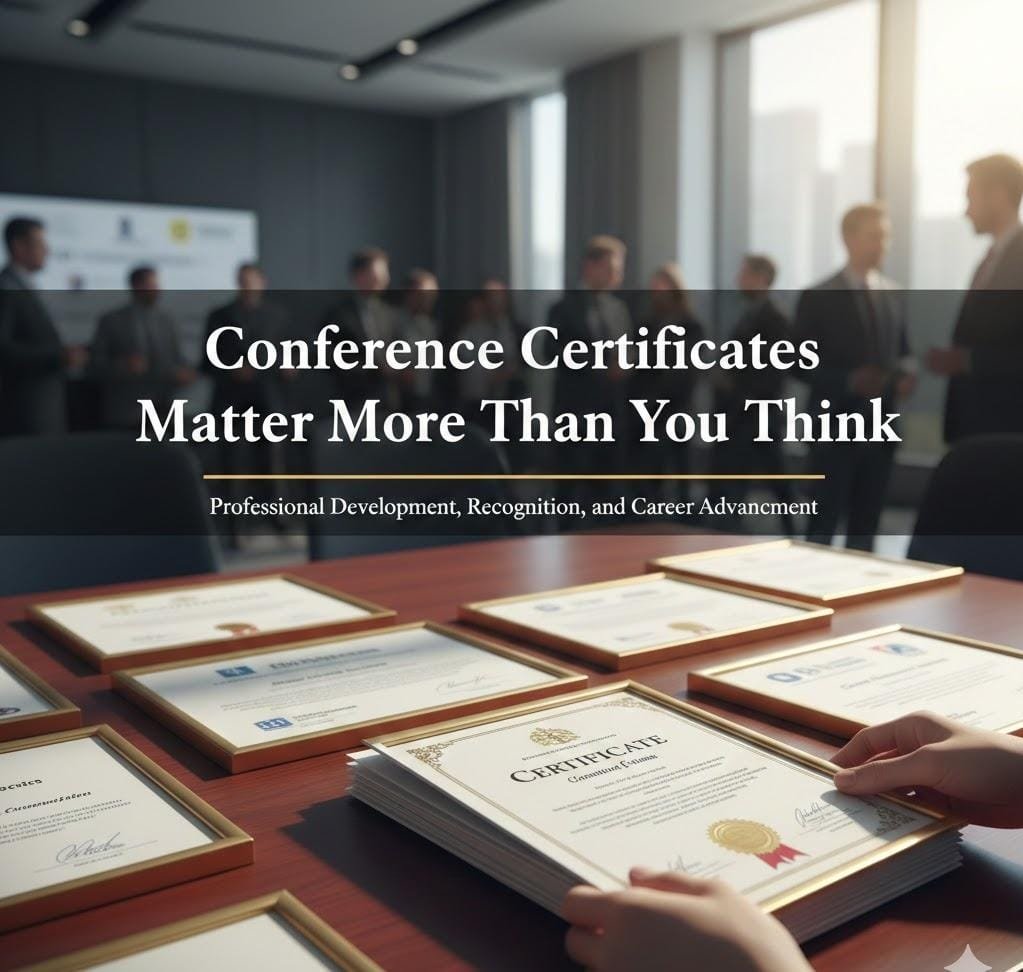
For many Indian PhD scholars and faculty, conference certificates are often seen as minor formalities—mere proof of attendance or participation. However, these certificates carry value beyond documentation. They reflect active engagement, professional development, and recognition within academic communities. Understanding why conference certificates matter helps researchers appreciate their strategic significance, especially in the context of career growth, faculty promotions, and research credibility in India.
Evidence of Active Academic Engagement
Conference certificates serve as tangible proof of participation in scholarly activities. For Indian academics, especially in private universities or research institutions, maintaining a record of such engagement is important for demonstrating commitment to professional growth. Each certificate represents hours spent learning, presenting, or contributing to discussions, signaling dedication to the field.
These certificates also validate involvement in national or international events, highlighting exposure to diverse ideas and methodologies. Promotion committees, funding bodies, and potential collaborators often look for evidence of consistent participation, and certificates provide a credible record of this engagement. In this sense, they are not merely decorative—they substantiate a researcher’s active role in academic discourse.
Supporting Faculty Promotions and Academic Performance
In India, conferences contribute to Academic Performance Indicators (API) and career advancement for faculty. Conference certificates document participation, paper presentations, or session chairing, all of which can be quantified for evaluation purposes. For promotion applications, having a well-maintained collection of certificates demonstrates a track record of scholarly activity, showing that the faculty member is not only productive in research but also engaged with the broader academic community.
Certificates also provide verification when reporting achievements to institutional committees or accreditation bodies. They help establish credibility, especially when faculty are applying for promotions, grants, or research collaborations. In competitive academic environments, these small pieces of documentation collectively strengthen a professional profile.
Building Professional Credibility
Beyond promotions, certificates enhance professional credibility. They indicate that a researcher has been recognized as a participant or presenter at legitimate academic events. For Indian scholars, especially those building a career in private universities or interdisciplinary research, certificates demonstrate seriousness and dedication. They show that the researcher invests time and effort in continuous learning and knowledge sharing, qualities valued in both academic and professional contexts.
Certificates from reputed conferences also signal adherence to academic standards. Attending peer-reviewed sessions or presenting research at recognized events reflects the quality and relevance of one’s work, reinforcing credibility among peers, supervisors, and collaborators.
Networking and Visibility
While certificates themselves are documents, the process of earning them often leads to meaningful engagement. Conferences involve interactions, discussions, and presentations, all of which contribute to professional networks. Certificates serve as a record of these interactions, indicating that the scholar has actively participated in events where collaboration, mentorship, or research visibility may have occurred.
Maintaining a portfolio of certificates allows Indian researchers to showcase a pattern of engagement over time. This can be valuable when applying for research projects, fellowships, or positions requiring evidence of consistent academic activity. Certificates provide a concrete way to demonstrate participation that might otherwise be overlooked if only publications or presentations are considered.
Personal and Strategic Significance
Certificates also hold personal significance. For early-career researchers or PhD students, they are milestones that mark progress and growth in the academic journey. Collecting and reflecting on certificates can provide motivation, track skill development, and highlight areas for improvement.
Strategically, certificates can be used to demonstrate a researcher’s commitment to continuous professional development. They complement publications, teaching experience, and other academic contributions, providing a holistic view of a scholar’s engagement. For Indian faculty navigating promotions, grant applications, or professional recognition, certificates serve as concrete evidence of participation, learning, and contribution.
Conclusion
Conference certificates are more than pieces of paper—they are proof of engagement, credibility, and professional growth. For Indian PhD scholars and faculty, they document participation, support promotions, validate research contributions, and reflect dedication to continuous learning. While often overlooked, these certificates play a strategic role in shaping academic profiles and career trajectories. Collecting and organizing certificates thoughtfully allows researchers to present a comprehensive record of their involvement in scholarly communities. In the competitive academic landscape, certificates matter, not just for recognition, but as tangible evidence of consistent effort, professional commitment, and ongoing contribution to knowledge.