
Introduction
For many Indian students, enrolling in a doctoral programme is not just an academic decision but also a step shaped by career aspirations, family expectations, and the desire to contribute meaningfully to their field. Yet, one question often creates confusion at the very beginning of this journey: who exactly is eligible to guide a PhD scholar? This uncertainty matters because a recognised PhD guide is central to the entire research process, influencing not just the quality of the thesis but also the overall academic experience. The topic of “Who Can Be a Recognised PhD Guide in India?” becomes especially important in the current scenario where private universities are increasingly offering doctoral programmes and expanding opportunities for scholars across disciplines.
Understanding Eligibility in the Indian Context
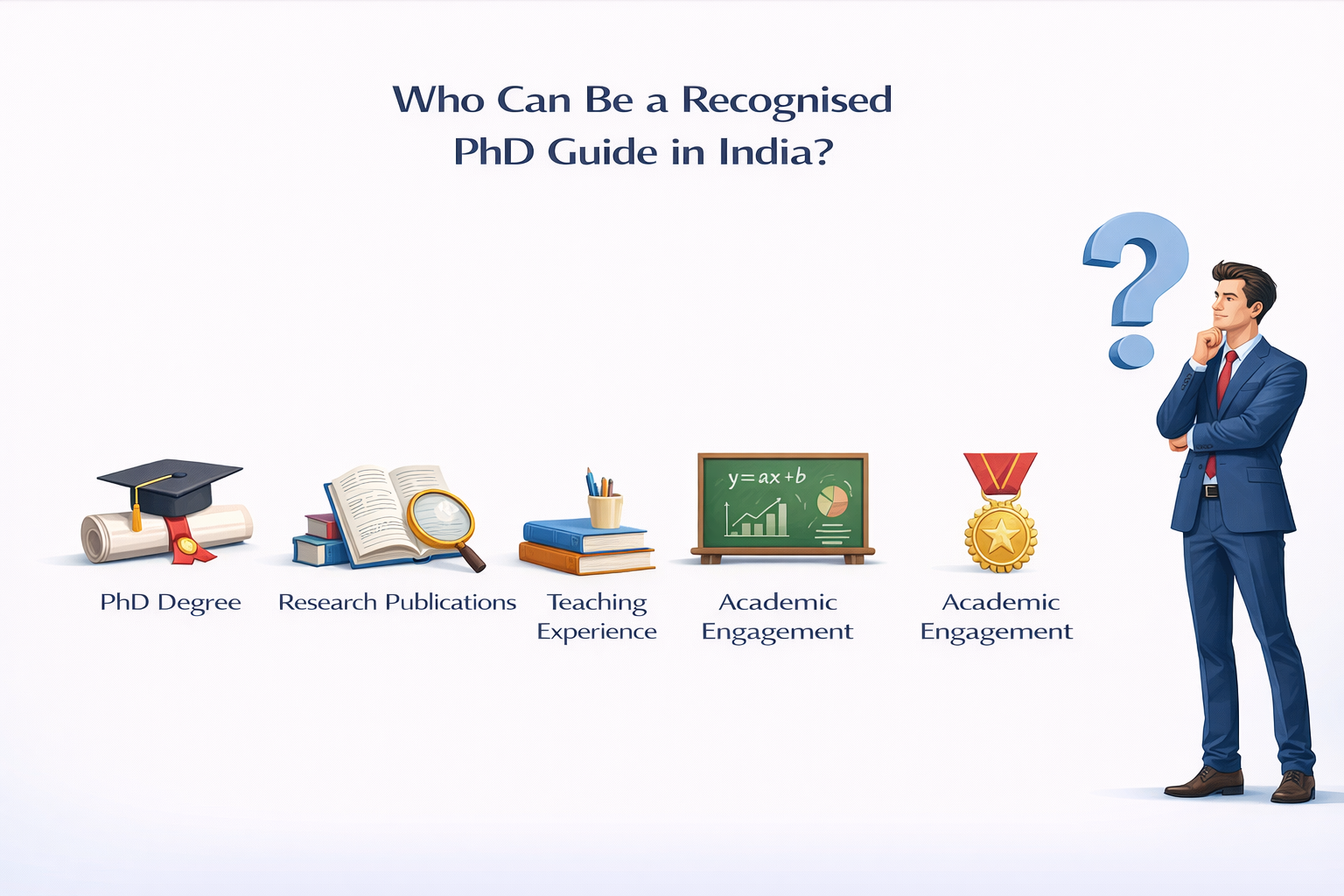
Unlike undergraduate or postgraduate teaching, doctoral guidance is more closely regulated. A PhD guide in India is generally required to hold a doctoral degree themselves and must demonstrate consistent academic engagement, often through research publications and years of teaching experience. In many universities, especially public ones, criteria are explicitly laid down in university ordinances or based on regulatory frameworks. However, the practical application varies between institutions. For example, while one central university may insist on a minimum number of peer-reviewed publications, a private university might place greater emphasis on recent research activity or interdisciplinary expertise. This variation can cause confusion for scholars who are unsure about whether a particular faculty member is eligible to supervise their doctoral work.
The Role of Private Universities
With the rise of private universities in India, doctoral admission has become more accessible to working professionals and mid-career academics who seek flexibility. These institutions often attract faculty members who may not have long tenures in traditional government universities but bring valuable industry experience, international exposure, or cross-disciplinary perspectives. Such faculty can still be recognised PhD guides if they meet the university’s internal criteria. For example, a professor in a private university with a PhD in computer science and several patents or industry collaborations might qualify as a guide, even if their publication record differs from conventional expectations. This reflects how doctoral guidance in private universities is slowly adapting to the changing demands of research in India.
Beyond the Minimum Requirements
While regulations outline the minimum qualifications, being a recognised PhD guide is also about intellectual capacity and mentorship ability. Students often look for guides who can balance academic rigour with realistic timelines, especially in India where delays in thesis completion are common. A faculty member may formally qualify to supervise but may not have the temperament to mentor, whereas another who meets the criteria can help students navigate institutional procedures, balance work with research, and develop interdisciplinary insights. This human aspect is often underestimated in official regulations but becomes crucial in practice. In many cases, doctoral scholars informally consult multiple faculty members, even if only one is officially recognised as their guide.
Myths and Misunderstandings
A common misconception is that only senior professors can be PhD guides. While seniority certainly brings experience, many younger faculty members with strong research backgrounds are also recognised. Another misunderstanding arises from the belief that only government university faculty can serve as guides, whereas in reality, private universities across India are authorised to recognise their own faculty as doctoral supervisors. For scholars, clarity often comes from carefully reviewing a university’s doctoral ordinance and speaking directly with the doctoral admission office rather than relying on assumptions or hearsay.
Balancing Institutional Rules with Academic Growth
In India’s diverse academic landscape, the recognition of PhD guides is ultimately a balance between regulatory norms and the evolving nature of scholarship. Some universities follow rigid structures, requiring a specific number of Scopus-indexed publications, while others allow for broader definitions of research output, including books, policy reports, or applied projects. This balance allows space for different types of scholars to emerge as guides. It also reflects the reality that doctoral research today often cuts across traditional disciplinary boundaries and requires guidance that goes beyond narrow criteria.
Conclusion
Understanding who can be a recognised PhD guide in India is not just about meeting official requirements but also about appreciating how guidance shapes the doctoral journey. For students, the guide is more than an administrative approval; they are mentors, collaborators, and sometimes even bridges between academic life and professional aspirations. As Indian higher education expands, especially with the growing role of private universities, the definition of a recognised guide continues to evolve. What remains constant is the importance of thoughtful, qualified, and engaged faculty who can support doctoral scholars in navigating both research and the realities of academic life.