Introduction
For many young faculty members in India, the question of whether assistant professors can serve as PhD guides is both personal and professional. With doctoral admissions expanding across public and private universities, the demand for recognised supervisors is growing. At the same time, students often wonder whether an assistant professor, who may be relatively new to academia, has the eligibility to supervise doctoral work. The topic “Can Assistant Professors Become PhD Guides?” is particularly relevant today, as Indian higher education increasingly values fresh research talent alongside senior academic experience.
Eligibility in the Indian Academic System
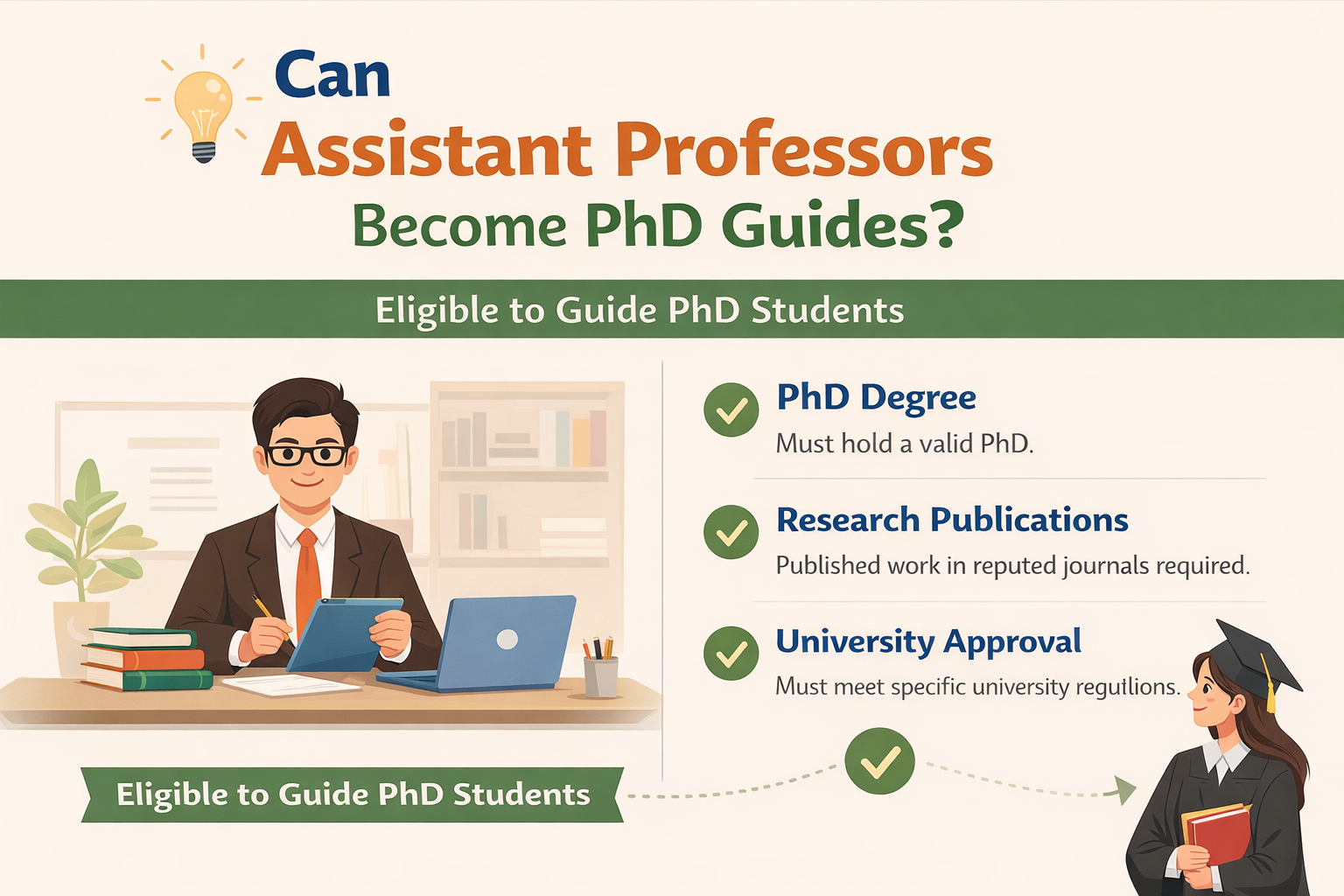
In principle, UGC regulations allow assistant professors with a PhD and a record of research publications to be recognised as doctoral supervisors. The expectation is not only a doctoral degree but also evidence of ongoing academic engagement—such as publications in reputed journals, participation in research projects, or experience in guiding postgraduate dissertations. However, implementation varies. In many central and state universities, eligibility is reviewed through internal committees that assess a faculty member’s research profile before granting supervisory approval. Private universities may interpret the rules more flexibly, recognising assistant professors who bring industry exposure or strong interdisciplinary expertise, even if their academic careers are relatively short.
The Student Perspective
For doctoral scholars, the idea of being supervised by an assistant professor can raise mixed feelings. On the one hand, younger faculty may be more approachable, technologically adept, and attuned to emerging research fields. They may also be more open to innovative methodologies and cross-disciplinary exploration. On the other hand, students sometimes worry about administrative challenges, since senior professors are often more experienced at navigating regulations, managing university committees, and ensuring smooth thesis progression. In practice, some universities balance these concerns by requiring assistant professors to co-supervise initially, pairing them with senior faculty before granting full independent supervisory status.
Private Universities and Flexibility
Private universities in India have played an important role in opening space for assistant professors to act as guides. Many such institutions are relatively young, with dynamic research agendas that welcome mid-career and early-career faculty into supervisory roles. For example, an assistant professor in biotechnology with a strong publication record and funded research projects might be recognised as a guide more quickly in a private university than in a traditional government institution. This flexibility reflects a broader shift in Indian academia, where fresh perspectives and new research areas are gaining institutional recognition.
Balancing Experience with Opportunity
The debate around whether assistant professors should supervise PhD students often comes down to balancing experience with opportunity. Senior professors bring decades of academic practice, established networks, and institutional influence. Assistant professors, meanwhile, bring energy, contemporary knowledge, and a willingness to experiment with research frontiers. Recognising both roles is essential. For scholars, the key is to assess not only a supervisor’s designation but also their active research involvement and capacity to provide consistent mentorship over the duration of the PhD.
Conclusion
The possibility of assistant professors becoming PhD guides highlights how Indian academia is negotiating tradition and change. While UGC regulations set minimum requirements, the actual decision often rests with the university and the faculty member’s research profile. For students, the question is less about designation and more about whether the supervisor can provide steady, informed, and engaged guidance. As private universities continue to expand doctoral opportunities, assistant professors are likely to play a larger role in shaping India’s next generation of researchers.